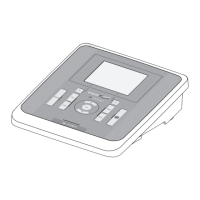
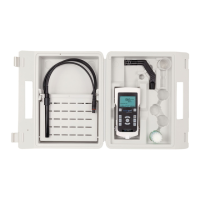
The VWR P4 Spectrophotometer is an instrument designed for research use, not for animal, human therapeutic, or diagnostic purposes. It is compliant with European Directives on Low Voltage (2014/35/EU), Electromagnetic Compatibility (2014/30/EU), and Restriction on Hazardous Substances (RoHS 2011/65/EU).
Function Description
The P4 Spectrophotometer is used in various fields such as Chemistry, Pharmaceuticals, Biochemical, Metallurgy, Light Industry, Textile, Material, Environments, Medical, and Education for Quality Control laboratories. It offers several measurement modes:
- Photometry: Measures the absorbance or transmittance of a sample at a fixed wavelength.
- Quantitation: Establishes a standard curve and measures the concentration of samples.
- Spectrum Scan: Scans a sample across a wavelength range to display its absorbance or transmissivity spectrum.
- Multi-wavelength Analysis: Measures a sample at up to 20 different wavelengths.
- DNA/Protein Analysis: Provides two methods for analyzing DNA/Protein, allowing users to input coefficients.
- Kinetics Analysis: Measures changes in absorbance or transmittance over time to study reaction kinetics.
- Energy Scan: Scans the light source point (Tungsten Lamp or Deuterium Lamp) and allows setting gain (1 to 8 times).
The accompanying VWR Software Multi Wave Pro enhances the instrument's capabilities with additional functions:
- Quantitative Analysis: Offers two methods for standard curve establishment (up to 20 standard samples or input coefficients) and three fitting methods (Linear zero, Linear, and Square).
- Kinetics Analysis: Allows selection of time intervals (0.5, 1.0, 2.0, 5.0, 10.0, 30.0, or 60.0 seconds) and photometric modes (Transmittance-Time & Absorbance-Time).
- Spectrum Scan: Provides scan intervals (0.1, 0.2, 0.5, 1.0, 2.0, and 5.0nm), photometric modes (Wavelength-Transmittance, Wavelength-Absorbance), automatic spectrum peak listing, and mathematics/smoothing functions.
- Multi-wavelength Analysis: Supports measurement of a sample at up to 20 wavelengths.
- DNA/Protein Analysis: Offers two methods, including manual coefficient input.
- Energy Scan: Allows switching between light sources (W Lamp, D2 Lamp, or automatic switch), setting scanning intervals (0.1, 0.2, 0.5, 1.0, 2.0, and 5.0), setting gain (1 to 8 times), and automatic spectrum peak listing.
- Spectrum Smooth: A software function to reduce noise interference during scanning, resulting in smoother spectra.
- Mathematics Function: Allows addition, subtraction, multiplication, or division of two spectra.
- Search Peaks: Automatically identifies and lists peaks on a spectrum, with adjustable peak height precision.
- Scale Setup: Enables adjustment of coordinate values for X and Y axes.
- Auto Fitting: Automatically adjusts the scale to an appropriate value.
- Switch Display Mode: Toggles between Absorbance (Abs) and Transmittance (T) display modes.
- Zoom Selected Area: Magnifies a selected area of the spectrum.
Important Technical Specifications
- Optical System: Single Beam
- Wavelength Range: 190-1100nm
- Band Width: 2nm
- Stray Light: ≤0.05%T @ 220nm & 360nm
- Photometric Range: 0 to 200%T, -0.3 to 3.0A, 0 to 9999C
- Wavelength Accuracy: ±0.5nm
- Photometric Accuracy: ±0.4%T or ±0.004A @ 1A
- Stability: 0.002A/h @ 500nm
- Memory: 236KB
- Language Options: English, French, German, Spanish, Portuguese, Chinese
- Display: TFT Colour LCD (5", Touch Screen)
- Interface: USB-A, USB-B, RS-232
- Power Supply: AC 100~240 V, 50~60 Hz
- Dimension: 456×360×185 mm
- Weight: 10.7kg
- Work Environment: 15 to 35°C, 15 to 70% relative humidity
- Store Environment: -10 to 50°C, 15 to 70% relative humidity
Usage Features
The instrument features a touch screen for easy operation. Users can select applications from the main interface, set measurement parameters, and view results.
Getting Started:
- Turn On and Self-check: The instrument performs a self-check sequence upon power-on, including lamp, filter disc, sample holder, dark current, wavelength, energy, and system baseline checks.
- Touch Screen Usage: The screen can be operated with nails, fingertips, pencil, or stylus; sharp objects should be avoided.
General Operating Instructions:
- Basic Operation: Includes icons for Home (main interface), Return (previous interface), and Page Up/Down (navigation).
- Measurement Results Operation: Allows opening, saving, printing, and deleting results from internal/USB memory. Results can be renamed.
- Files Operation: Provides options for managing files stored in internal or USB memory, including copying, exporting to CSV or TXT formats, and deleting.
Calibration and System Settings:
- Calibration: Users can calibrate dark current, wavelength, and system baseline.
- Light Source Settings: Allows resetting Tungsten and Deuterium lamp usage and changing the lamp switching point. Important note: if the lamp switching point is changed, the system baseline must be recalibrated.
- Clock Settings: Enables setting the year, month, date, hour, minute, and second.
- Memory Management: Allows formatting internal memory and USB mass storage.
- Language Selection: Supports multiple languages.
- General Options: Includes settings for beep sound, LCD display brightness, display auto-close (after 30 minutes of inactivity), and sample holder type (AC-5 for 5 cells, AC-8 for 8 cells).
- Restore Defaults: Restores parameters to factory settings.
Performance Verification:
The instrument allows verification of several performance parameters:
- Wavelength Accuracy and Repeatability: Uses Holmium oxide solution or equivalent filter.
- Photometric Accuracy and Repeatability: Uses NIST 930D or equivalent filter.
- Stray Light: Uses 10g/L Nal solution (220nm) or 50g/L NaNo2 solution (340 or 360nm).
- Noise (0A and 0%T): Measures noise with no sample (0A) or with a block (0%T).
- Stability: Measures noise at 500nm with no sample.
- Bandwidth: Measures bandwidth at 656.1nm with no sample.
- Preheating: The instrument requires 30 minutes of preheating before performance verification.
Maintenance Features
Daily Maintain:
- Check the compartment: Ensure no liquid enters the device. Clean any spills immediately.
- Surface clean: Wipe the instrument's surface with a wet towel.
- Clean the cuvettes: Ensure cuvettes are clean and free of sample remains.
Spare Parts Replacement:
- Fuse Replacement: The fuse (3.15A/250V) can be replaced by picking out the spare fuse and resetting the fuse seat.
- Lamp Replacement (D2 and W lamps):
- Safety Precaution: Wait 20 minutes after power off before opening the lamp chamber to avoid scalds.
- Tools: Requires a 6x150mm Flat Blade screwdriver and gloves.
- Procedure: Power off, unplug, loosen screws, remove lamp cover. For D2 lamp, unplug connector, unscrew, remove, and replace. For W lamp, pull out the old lamp, insert the new one, and adjust its position to focus on the center of the entrance hole.
- User replaceable accessories and spare parts: A comprehensive list of available parts is provided, including various cell holders, cuvettes (glass and quartz), flow cells, Peltier units, sipper units, printers, thermal paper, and lamps.
Important Safety Guidelines:
- Electrical Shock: Do not open the device. Disconnect from mains before maintenance. High-voltage area inside. Do not use if damaged. Repairs only by authorized technicians. Connect to a grounded power outlet.
- Damage to Instrument: Do not allow liquid to enter. Do not operate in hazardous or explosive environments.
- Chemical and Biological Safety: Reagents, dilution buffers, and samples (nucleic acids, proteins, bacteria cultures) can be hazardous. Observe local laboratory safety precautions (protective clothing, gloves, disinfectants) and dispose of materials according to regulations.
- Cuvette Usage: Cuvettes must be clear and free of sample remains. Only Silicon (Quartz) cuvettes are permitted for UV area measurements.

 Need help?
 General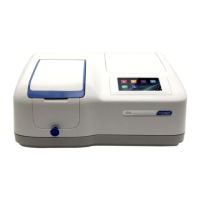

 To Next Page