Operating Instructions
39
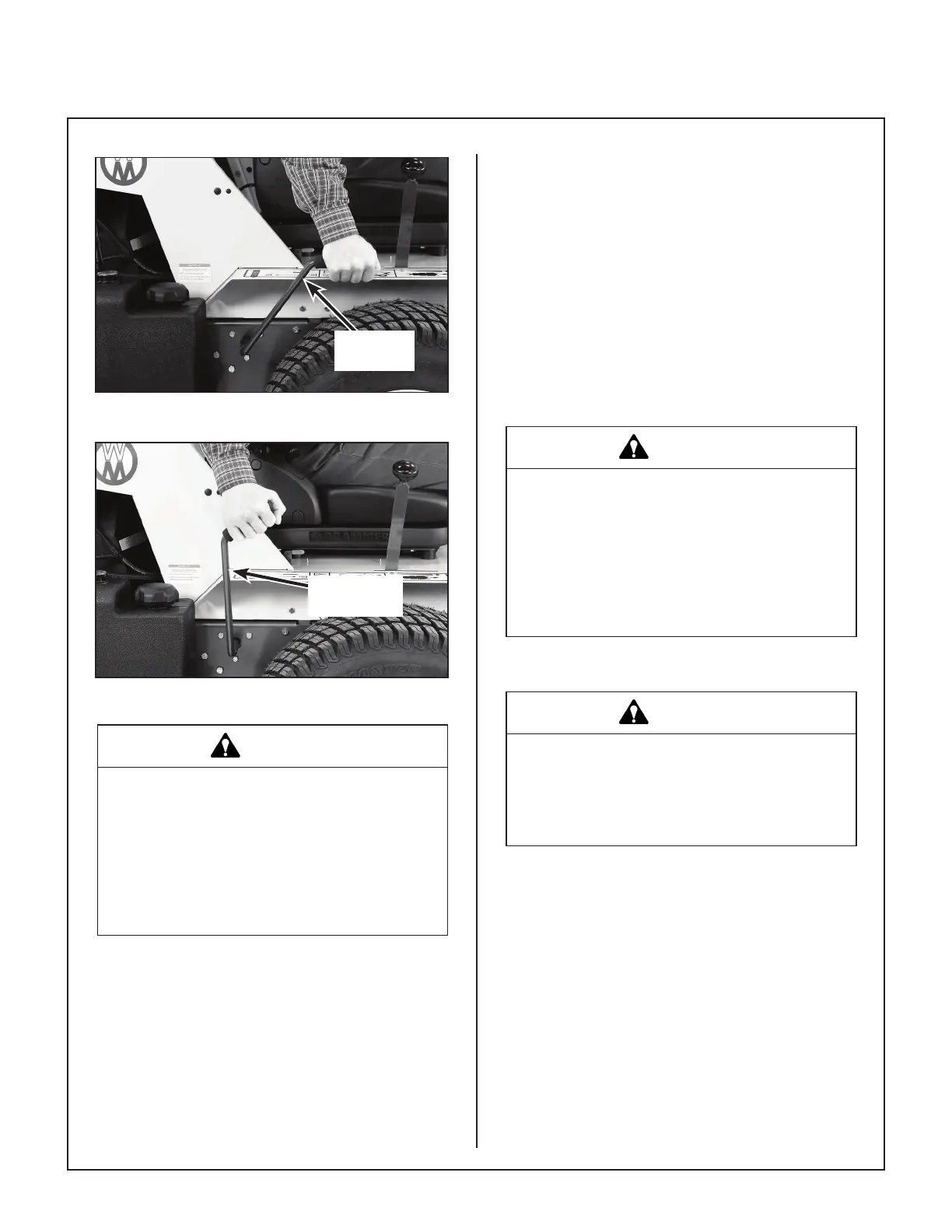
Engaged
Position
Blade Clutch Engaged
Disengaged
Position
Blade Clutch Disengaged
CAUTION
If the cutting blades strike a stationary ob-
ject while mowing, stop the mower im-
mediately, disconnect the spark plug
wires, lift the deck, and inspect the deck
and blades thoroughly for damage. Also,
make sure the blade retaining bolts are
torqued to 70 lb·ft (95 N·m).
STOPPING THE MACHINE
1. Pull the steering levers to the NEUTRAL posi
tion and then move the FSC lever backward to
the NEUTRAL-PARK position.
2. Slow the engine to a fast idle; put the throttle in
the 1/2 throttle position.
3. Disengage the blade clutch.
IMPORTANT: DO NOT disengage the blade
clutch with high engine speed (above 1/2 throt
tle) since the brake action on the blade drive will
cause increased wear of the brake band.
WARNING
A brake stops the cutter blades from free-
wheeling within ve (5) seconds after dis
engaging the clutch. If the brake system
malfunctions and the blades do not stop
within ve (5) seconds, the brake should
be repaired or replaced before operating
the mower. Contact your Walker dealer.
4. Turn the ignition switch OFF.
WARNING
Remove the key from the ignition switch
when leaving the mower unattended. This
will prevent children and inexperienced
operators from starting the engine.
5. Engage the parking brake by moving the lever
forward. Also, engaging the parking brake is
recommended when stopping or parking the
machine in a conned space with little tolerance
for movement.
IMPORTANT: The hydrostatic transaxles lock
to prevent the mower from rolling freely with the
engine stopped. However, if the mower is
parked on a slope, it is necessary to ENGAGE
the parking BRAKE to prevent the mower from
creeping. This is due to a small amount of slip
page in the transaxles, especially when trans
mission uid is warm.


 To Next Page