This document provides installation and safety guidelines for the Weber Genesis Built-In Gas Barbecue, specifically models E-360, S-360, E-460, and S-460, designed for ULPG (Universal Liquid Petroleum Gas) use.
Function Description:
The Weber Genesis Built-In Gas Barbecue is an outdoor cooking appliance designed for permanent installation into a custom-built island structure. It functions as a gas-fired grill, allowing users to barbecue food outdoors. The "built-in" nature implies integration into a larger outdoor kitchen or entertainment area, providing a more permanent and aesthetically integrated cooking solution compared to freestanding barbecues. The appliance is intended for outdoor use only, in well-ventilated areas, and is not suitable for installation in recreational vehicles, boats, or enclosed spaces.
Important Technical Specifications:
- Models: E-360, S-360, E-460, S-460. The "E" and "S" likely denote different finishes or feature sets, while the numbers indicate the size or burner configuration (e.g., 3-burner vs. 4-burner).
- Fuel Type: ULPG (Universal Liquid Petroleum Gas). The manual explicitly states that LPG is not natural gas and warns against conversion or attempted use of natural gas in an LPG unit, as it is unsafe and voids the warranty.
- Gas Category: 13B/P (30 mbar or 2.8 kPa). This specifies the gas pressure and category for which the appliance is designed.
- Burner Valve Orifice Sizes:
- 360 Models: Main Burners 1.04 mm, Sear Burner 1.02 mm.
- 460 Models: Main Burners 0.98 mm, Sear Burner 0.98 mm.
- Total Consumption Data:
- 360 Models: 57.5 Mj/h.
- 460 Models: 63.5 Mj/h.
- LPG Cylinder Requirements: Minimum capacity of 8.5 kg. Cylinders must be stored outdoors, out of reach of children, and not in enclosed spaces. They should never be filled beyond 80% full.
- Gas Line: A 58 inch (147 cm) main corrugated gas line connects to the manifold.
- Hose and Regulator: A nationally approved low-pressure hose and regulator assembly is required and is a part of the built-in gas barbecue. Only the included hose and regulator assembly should be used.
- Built-In Cutout Dimensions (General):
- 360 Models:
- Width (1): 32" (813 mm)
- Depth (2): 36" (914 mm)
- Height (3): 26 1/4" (667 mm)
- 460 Models:
- Width (1): 39" (991 mm)
- Depth (2): 36" (914 mm)
- Height (3): 26 1/4" (667 mm)
- Tolerances: Width ±1/4" (6 mm), Height ±1/8" (3 mm).
- Barbecue Dimensions (Overall):
- 360 Models:
- Width (1): 31 3/4" (806 mm)
- Depth (2): 36 1/4" (921 mm)
- Height (3): 31" (787 mm)
- Control Panel Depth (4): 12 3/4" (324 mm)
- Lid Height (5): 26 1/2" (673 mm)
- 460 Models:
- Width (1): 38 3/4" (984 mm)
- Depth (2): 36 1/4" (921 mm)
- Height (3): 31" (787 mm)
- Control Panel Depth (4): 12 3/4" (324 mm)
- Lid Height (5): 26 1/2" (673 mm)
- Clearances from Combustible Materials:
- Minimum 24" (610 mm) from the edge of the barbecue to any combustible surface (top, bottom, back, and sides).
- Minimum 24" (610 mm) from the back and sides of the grill to any combustible surface or structure.
- Clearances from Noncombustible Materials (Adjacent Wall):
- Minimum 0" (0 mm) from the edge of the built-in to a noncombustible wall.
- Minimum 3" (76 mm) above for lid clearance.
- Minimum 30" (762 mm) countertop to lid clearance height.
- LPG Cylinder Compartment Opening Clearances:
- Height (1): Minimum 686 mm (27") from floor to ceiling.
- Width (2): Minimum 385 mm (15") side to side.
- Height (3): Minimum 559 mm (22") top to bottom.
- LPG Cylinder Enclosure Clearances from Surfaces or Structures:
- Minimum 24" (610 mm) from any combustible surface.
- Minimum 3 1/2" (89 mm) from any surface.
- For a countertop treatment, a recommended 3/4" (19 mm) overhang is suggested.
Usage Features:
- Outdoor Use Only: The barbecue is strictly for outdoor use in well-ventilated areas, away from garages, buildings, breezeways, tents, or overhead combustible structures.
- Integrated Design: Designed to be built into a custom island structure, offering a seamless look in an outdoor kitchen.
- Rotisserie Outlet: The supporting structure can include an electrical outlet for a rotisserie (sold separately), which should be on the right side of the structure.
- Gas Supply: Connects to an LPG cylinder via a dedicated hose and regulator assembly.
- Control Knobs: Features control knobs for burner operation, as depicted on the front panel.
- Lid: The barbecue includes a lid, which should be kept closed in case of a grease fire.
Maintenance Features:
- Leak Testing: All gas connections and joints must be thoroughly tested for leaks in accordance with local and national codes. The Owner's Manual provides detailed leak test procedures.
- Ventilation Cleaning: Ventilation openings in the island structure should be cleaned periodically to ensure proper airflow and prevent debris accumulation.
- Storage: If stored indoors, the LPG cylinder must be disconnected and removed from the barbecue. After a period of storage or nonuse, the barbecue should be checked for gas leaks and burner obstructions.
- Owner's Manual: The manual emphasizes keeping it for future reference and contacting Weber for any questions.
- Registration: Users are encouraged to register their barbecue to access tips, tricks, and information on getting the most out of their barbecuing experience.
Safety Information (Crucial for Maintenance and Operation):
- Gas Leaks: If gas is smelled, immediately shut off the gas, extinguish any open flames, open the lid, and if the odor persists, keep away from the appliance and call emergency services. Do not use a flame to check for leaks.
- Flammable Materials: Do not store or use gasoline or other flammable liquids/vapors near the barbecue. Keep the cooking area clear of flammable materials. Do not use or store flammable materials in or near the appliance during use.
- Unattended Operation: Never leave the barbecue unattended during pre-heating or use.
- Hot Surfaces: Accessible parts of the barbecue become very hot; keep young children away.
- Grease Fires: In case of a grease fire, turn off all burners and leave the lid closed until the fire is out.
- Cylinder Storage: LPG cylinders must be stored outdoors, out of reach of children, and not in enclosed spaces.
- Modifications: Do not modify the appliance.
- Construction Materials: The built-in structure, countertops, and adjacent work areas must be constructed from noncombustible materials only. Wood or other combustible materials are not acceptable.
- Ventilation: The island structure must have adequate cross-ventilation, with openings at both high and low levels, to prevent gas accumulation. These openings must be kept free and clear of debris.
- Assembly: Ensure all parts are in place and properly assembled before use.
- Alcohol/Drugs: The use of alcohol, prescription drugs, or illegal drugs may impair the user's ability to safely operate the barbecue.
- Movement: Do not move the appliance during use.
- Electrical Cords/Hoses: Keep electrical supply cords and fuel supply hoses away from heated surfaces.
- Charcoal/Briquettes/Lava Rock: Do not use charcoal, briquettes, or lava rock in the barbecue.
- Cylinder Valve: Always close the cylinder valve before disconnecting the regulator. Do not attempt to disconnect the gas regulator and hose assembly or any gas fitting while the barbecue is in operation.
- Locking Valve: If young children are in the area, a locking valve for the LPG cylinder should be considered.

 Need help?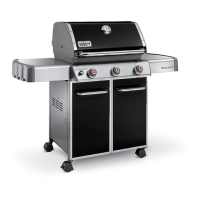



 To Next Page
 General