www.weg.net
34 l Installation, Operation and Maintenance Manual – Synchronous Motors – S Line – Brushless – Horizontal 11866576
5.3.3 Excitation circuit with frequency control
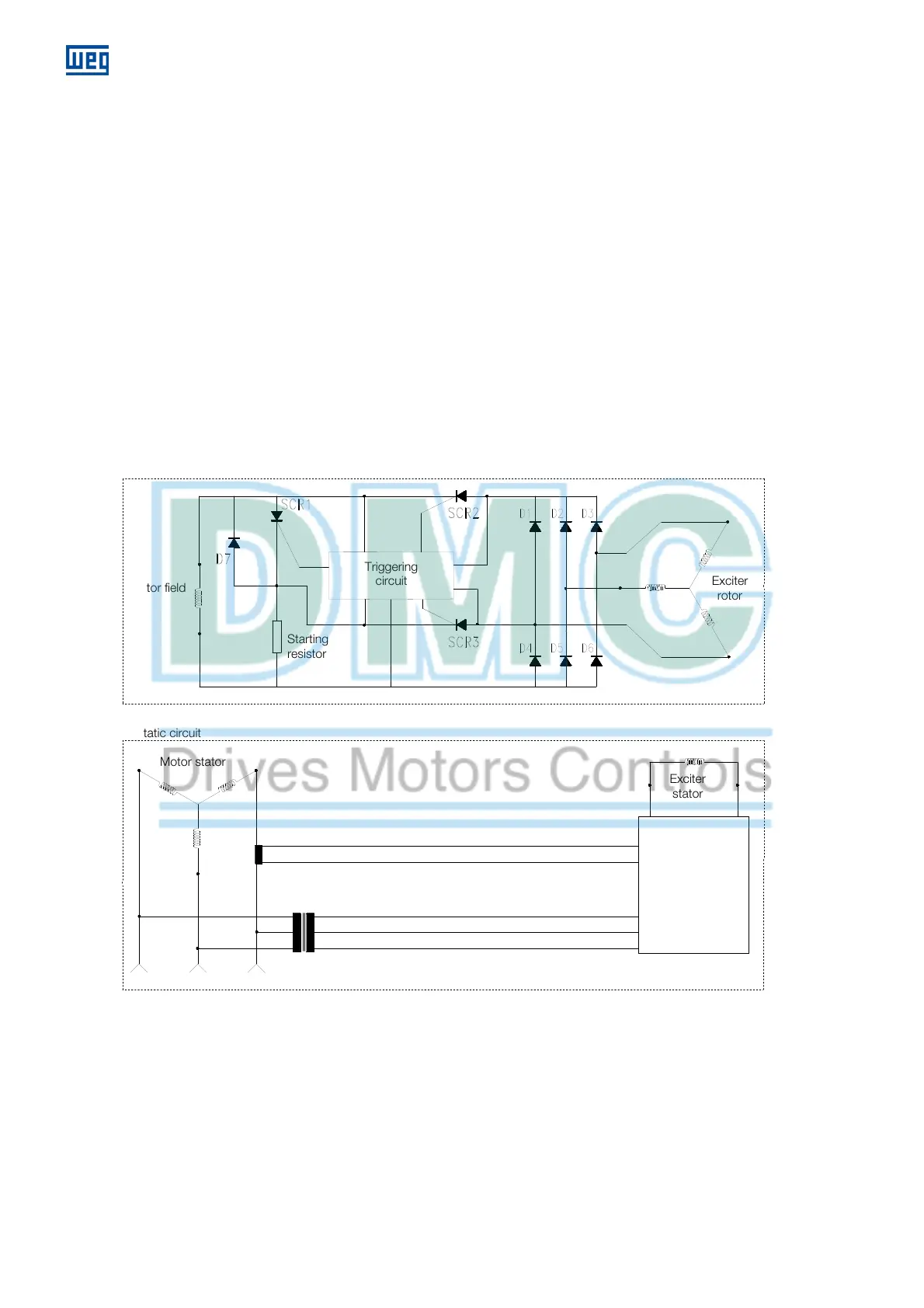
The circuit shown in Figure 5.2 works as follows:
During normal operation, the exciter rotor and the D1-D6
diodes generate rectified DC voltage to supply field
current to the motor according to the exciter field current
supplied by an external controlled source;
During the motor starting, the rotating field generated by
the motor stator induces a very high alternate voltage on
the motor field winding which is proportional to the
relation between the number of turns of the stator and
the slip;
The exciter field must be energized during the motor
start as soon as the motor circuit breaker is closed. That
allows the exciter output voltage to increase with the
increase of the motor speed. The SCR2 thyristor is not
conducting;
When the induced field current is in the positive
direction, the current circulates through the starting
resistor and the D7 diode;
When the induced field current is in the negative
direction, the SCR1 thyristor is initially off. The voltage
increases quickly until the controller activates the SCR1,
and, at this moment, the current of negative direction
circulates through the SCR1 and the starting resistor;
Close to the synchronous speed, the SCR2 thyristor is
continuously activated, so that the field voltage is
applied even if the motor is with a light load and the
acceleration up to the rated speed occurs before the
control can react during a positive semi-cycle.
The SCR3 thyristor provides a switching off circuit for
the SCR1 thyristor in case a transient interference
activates the starting resistor during normal operation.
The motor control notices a continuous voltage in the
starting resistor and activates the SCR3 thyristor.
SCR3 provides an alternate temporary path for the
current, deviating it from the SCR1 thyristor, allowing
SCR1 to be turned off. When the phase of the exciter
connected to SCR3 thyristor is no longer supplying
current to the starting resistor, the SCR3 thyristor
returns to its normal blockade state.
Figure 5.2: Triggering circuit with frequency control
Motor field
Exciter
rotor
Triggering
circuit
Starting
resistor
Exciter
stator
Power supply
and control of
the exciter
field
Motor stator
AC three-phase power supply
C
P
Static circuit
Rotating circuit



 To Next Page