4
1. Important initial information for the Technician
1. Important initial information for the Technician
1.1 Safety precautions
The boiler and related accessories are state of the art and meet all applicable safety regulations. Your boiler and
all accessories operate using 230 V AC electric current. Improper installation or repair can pose the danger of
life-threatening electric shock. Installation may be performed only by appropriately qualified technicians.
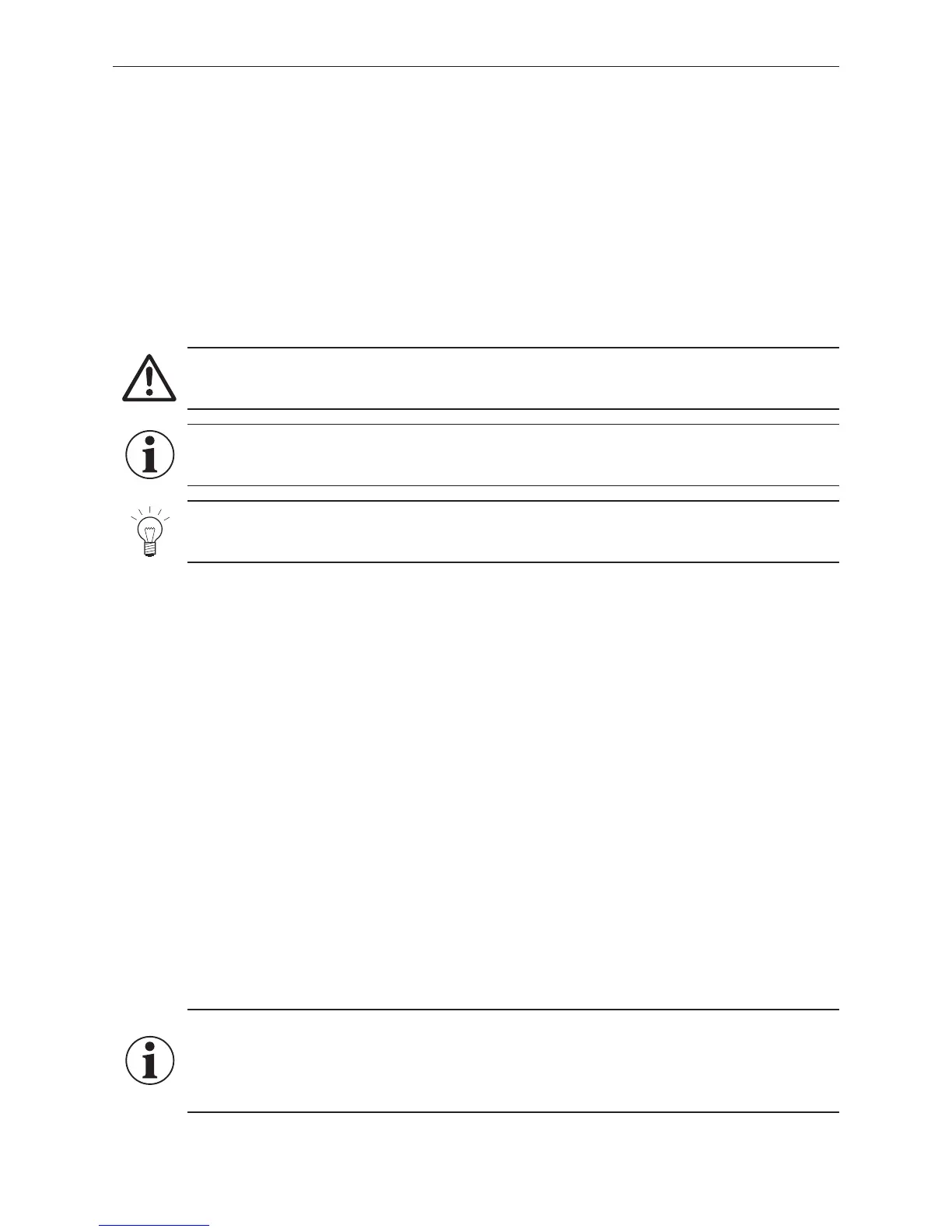
Caution symbols
Please take careful note of the following symbols in these Installation instructions.
Attention!
Ignoring the warnings identified can lead to personal injury.
Information!
Ignoring the warnings identified can lead to malfunction of, or damage to the boiler or heating system.
Note!
The blocks of text highlighted provide information and tips for operation.
1.2 Flue
A properly dimensioned flue is required for optimal functioning of the combustion system. Measurement of the
dimensions must follow EN 13384-1. See the Technical data section for values required for this calculation.
Please note that in the lower performance range, flue gases may be below 90°C. Therefore, thermally-insulated
flues meeting thermal transmittance coefficient Group I requirements according to DIN 18160 T1 or other appro-
priate, officially approved may be connected to the hearths.
The flue gas system must display at least the following classification:
Temperature class: T400 = nominal operating temperature 400 °C
Soot fire resistance class: G = flue gas system with soot fire resistance
Corrosion resistance class: 2 = suitable for unprocessed wood fuels
We would recommend fitting an energy-saving intake regulator for problem-free operation. This will largely
prevent moisture in the flue, and losses resulting from down-time will be reduced (draught interruptions). If you
have a feed pressure (flue draught) of more than 0.20 mbar, the energy-saving intake regulator must be fitted.
According to TRVB H118 a deflagration flap (combi energy-saving intake regulator with explosion flap EEX) must
be fitted in the connecting piece (exhaust pipe) or in the flue inside the boiler room.
Our recommendation: Fit the exhaust pipe upward to the flue with U-bolts and provide an opening for cleaning.
Insulate the exhaust pipe to avoid low flue intake temperatures.
Information!
Frequently, overhaul of existing systems involves oversized flue cross-sections or flues not desig-
ned for lowtemperature operation. We suggest an evaluation by the local building inspector before
installing the boiler system. In this way appropriate modifications can be made to the flue before
system installation (see technical data for flue calculation values).


 To Next Page