21| P a g e
Operational Tips on Boat Handling
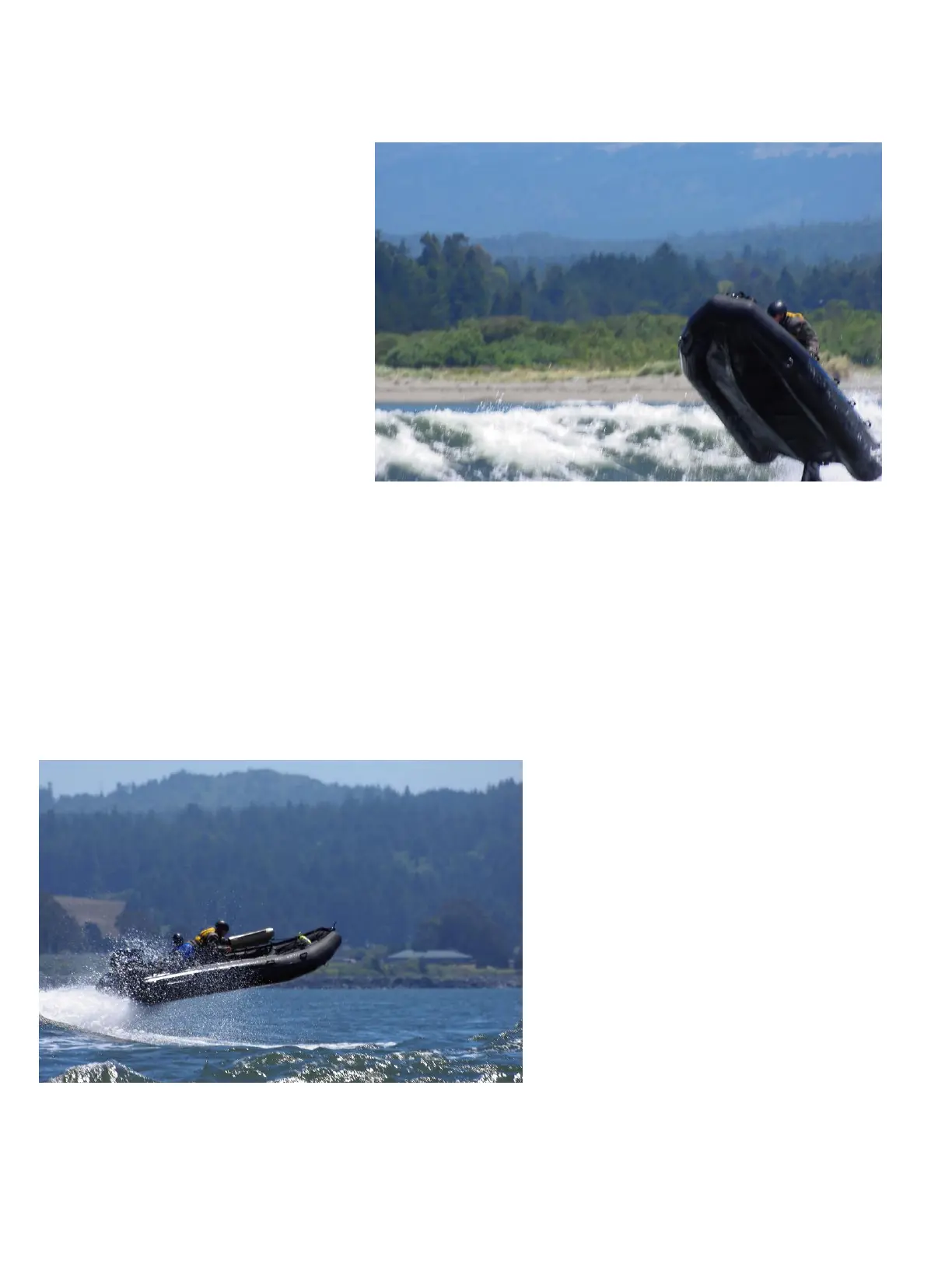
Wave & Wake Jumping
Operating the Wing CRRC over waves
and/or wakes is a natural part of boat
operations. However, when this activity is
done with sufficient speed to force the hull
partially or completely out of the water,
certain hazards arise, particularly when the
CRRC re-enters the water. In this instance,
because of the rigidity of the urethane-coated
polyester fabric, the Wing P4.2, P4.7, P5.3
and P5.8 CRRCs may behave more like a
rigid hull boat than a fully inflatable boat. In
other words, there is less flex and less play in
the interfaces of the Wing CRRCs— hence,
less “give” in the MBT and keel. The
response of the CRRC can be sudden and
swift.
Of primary concern is the craft changing direction while in the midst of the jump. In such a case the landing may cause
the CRRC to veer violently in a new direction. A sharp sudden change in direction can cause occupants to be thrown out
of position, or out of the CRRC.
Avoid serious injury from being thrown within or out of a CRRC when it lands by instructing all occupants to get low
and hang on to any CRRC hand-hold.
There is another less common hazardous result from launching a CRRC off a wave or wake. If the bow of the CRRC
pitches down far enough while airborne, upon water contact it may penetrate under the water surface and submarine for
an instant. This will bring the CRRC to a nearly instantaneous stop and can send the occupants flying forward.
The CRRC may also steer sharply to one side. If
wave launches are anticipated, pay particular
attention to the trim of the craft. Landing on the
stern or flat of the inflatable hull is much preferred
to landing bow down. The inflatable keel acts as a
CRRC-long shock absorber making flat-hull
landings safer, and far less jarring than with a rigid
hull.
Ensure all operators are experienced and capable of
operating in these conditions. This is by no means a
complete list of operational hazards as there is an
assumed risk inherent to boating.



 To Next Page