4.2 General
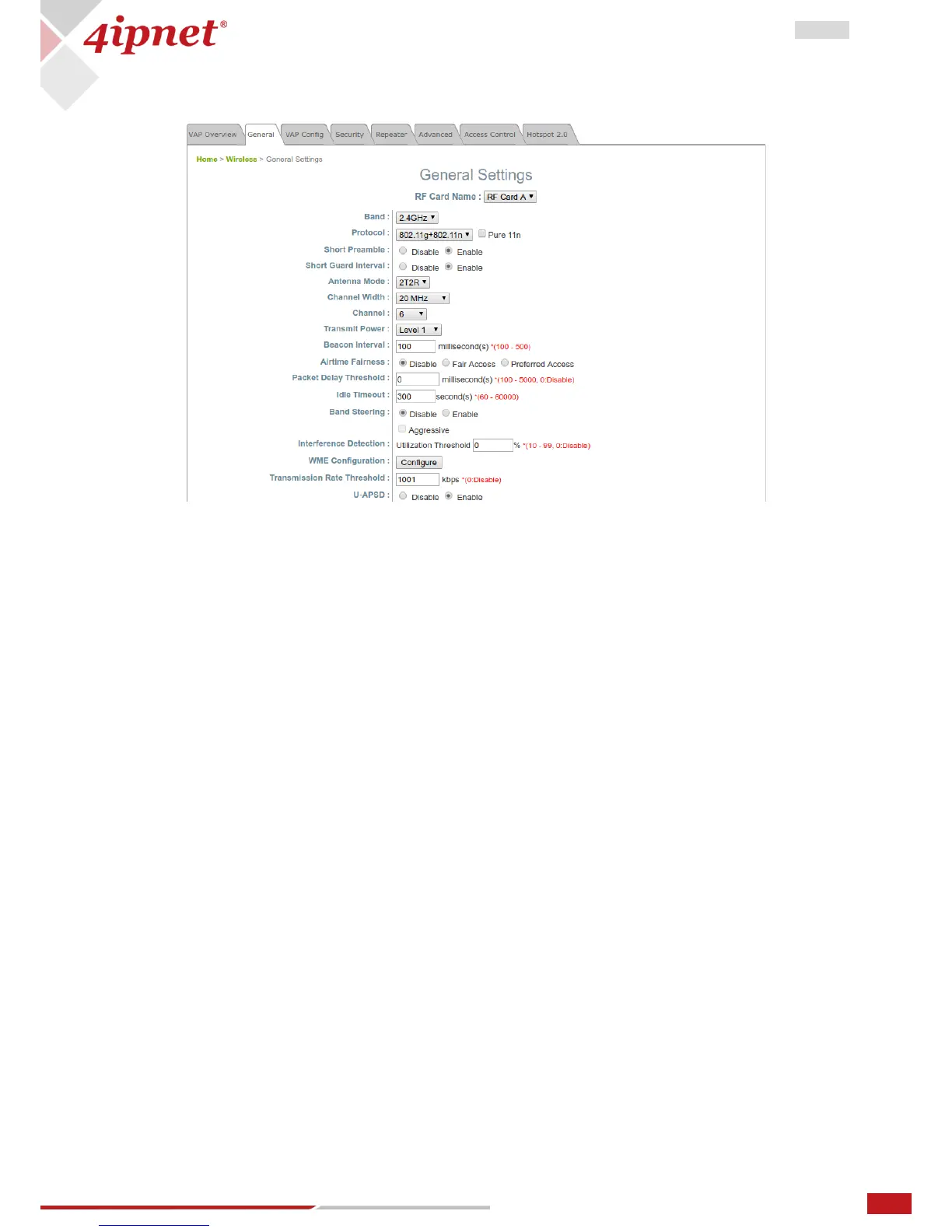
AP’s system general wireless settings can be configured
RF Card Name: Select one RF card for further configuration.
Band: Select Disable if the wireless function is not required.
Protocol: Select an appropriate wireless protocol: 802.11a, 802.11a+802.11n, 802.11ac or 802.11b,
802.11g, 802.11b+802.11g, 802.11g+802.11n. The protocol is dependent or the Band of the RF Card.
- Pure 11n: Enable 802.11n network only.
Short Preamble: The short preamble with a 56-bit synchronization field can improve WLAN transmission
efficiency. Select Enable to use Short Preamble or Disable to use Long Preamble with a 128-bit
synchronization field.
Short Guard Interval (available when Band is 802.11g+802.11n or 802.11a+802.11n): The guard interval is
the space between symbols (characters) being transmitted to eliminate inter-symbol interference. In
order to further boost throughput with 802.11n, short guard interval is half of what it used to be; please
select Enable to use Short Guard Interval or Disable to use normal Guard Interval.
Antenna Mode: Select 1T1R for one spatial stream or 2T2R for two spatial streams.
Channel Width: Double channel bandwidth to 40 MHz or 80 MHz to enhance throughput.
Channel: Select the appropriate channel from the drop-down menu to meet the regularity.
- When configured as “Auto” in Radio Card B, there is channel selector table for channel switching
when the chosen channel is interfered or DFS channel signal is detected
- For outdoor AP models, the “Outdoor mode” will affect the channel selection
Transmit Power: The signal strength transmitted from the system can be selected by Levels.
- Each Level signifies a decrement of 1dBm from the highest power.
- Level 1 is the actual highest power, while Level 2 is the highest power minus 1dBm, so on and so
forth.
ACK Timeout: It indicates a period of time when the system waits for an Acknowledgement frame sent
back from a station without retransmission. In other words, upon timeout, if the Acknowledgement frame
is still not received, the frames will be retransmitted. This option can be used to tune network
performance for extended coverage. For regular indoor deployments, please keep the default setting.


 To Next Page