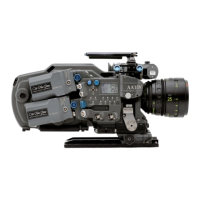
6.1 SUPER VS STANDARD 35MM
6.1.1 The Super35 Format
Super35 is a comeback to the cinema origins: silent cameras were
exposing all the available area between perforations of the 35mm
film. When came the “talkies” the picture had to be reduced to give
room to the 2.54mm-wide optical sound track. Equipment manu-
facturers had to shift the optical axis of all their cameras and projec-
tors by 2.54/2 = 1.27mm. Sixty years later Super35 is coming back
because it records 16/9 pictures with much less of a waste than the
so called “Wide-Screen” formats. For a camera to handle both for-
mats, it must be able to align the lens mount and the viewfinder
optical axis either in the middle of the film width (Super35) or
1.27mm away (Standard35).
Standard 35mm Super35
6.1.2 Why Shooting Super35 ?
If contact prints with analog sound track is not a requirement,
Super35 is the unquestionable choice for maximum resolution.
This format should always be selected when it comes to shoot high
quality 16/9 films for video distribution only ; all telecines are able
to “scan” the wider Super35 pictures with no modification at all.
Super35 will be the format of choice for films treated through
Kodak Cineon and Quantel Domino, or distributed with digital
sound tracks only. For the time being and for normal film distribu-
tion (with analog optical sound track), this format requires an opti-
68


 To Next Page