OMNIVERSA
®
ULTRASOUND / ELECTROTHERAPY SYSTEM - 55 -
COPYRIGHT © 2017-2020, ACCELERATED CARE PLUS CORP., ALL RIGHTS RESERVED
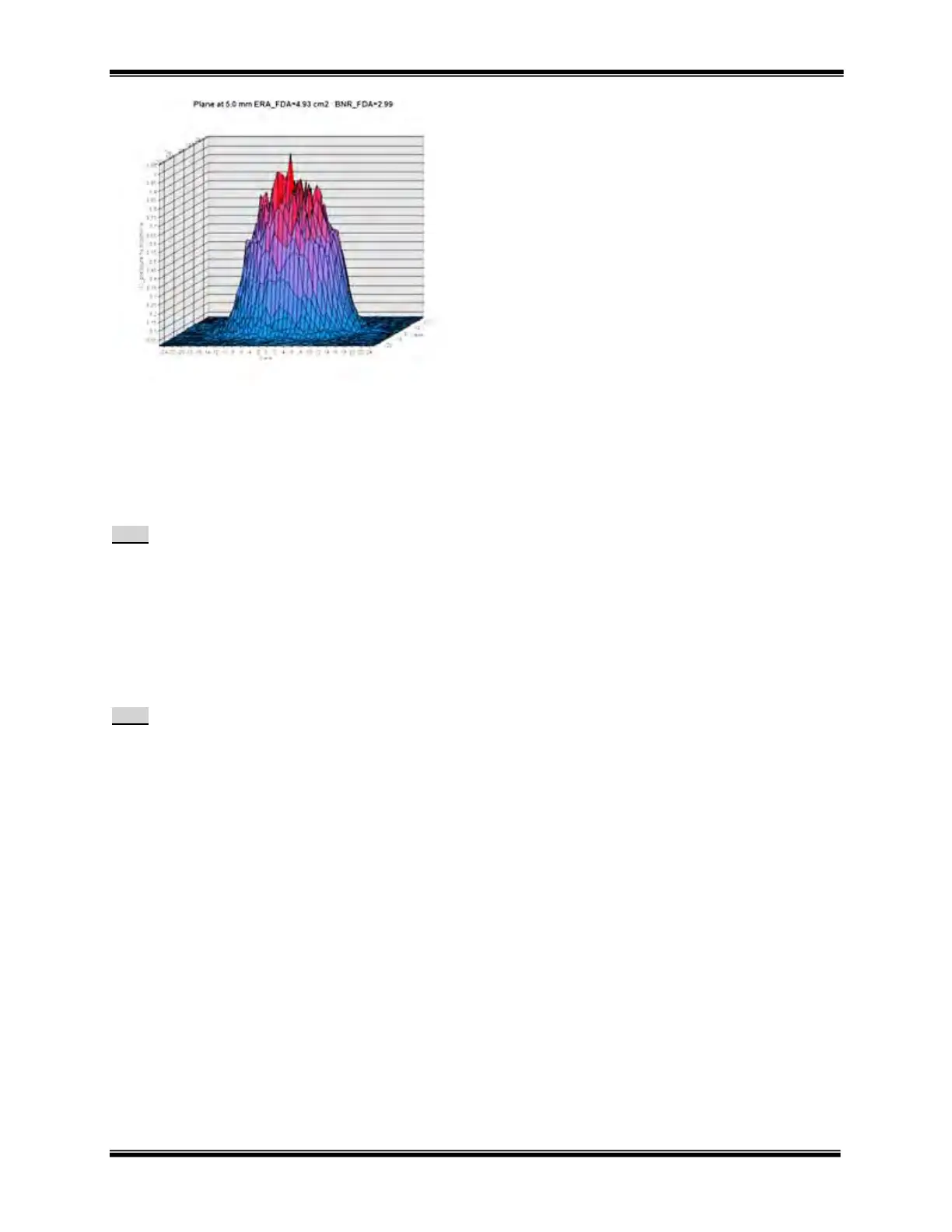
Beam non-uniformity ratio is defined as the ratio of temporal - average spatial - maximum intensity to the temporal
average effective intensity as measured at 5mm from the transducer surface. The typical range for most commercially
obtainable transducers is between 3 to 1 and 10 to 1. BNR can be useful in comparing one unit to another for field
uniformity. One should keep in mind that the spatial maximum intensity in watts/cm
2
is equal to the calibrated intensity
on the output display multiplied by the BNR, i.e.: if 1 W/cm
2
was registering on the output display and the BNR was
7:1 the maximum intensity in the tissue would equal 7 W/cm
2
at certain portions of the field. This should be kept in
mind when determining output dosage.
Note:
It is also important to maintain continuous movement of the head for these reasons.
Output Power and Exposure Time
The total power for a given amount of treatment time determines the total energy transferred to the tissue. One should
note that if one uses different ultrasonic generators with differing effective radiating areas, one should use the total
power measurement not the intensity measurement in order to correlate the settings on the units. Times must also be
accurate in order to assure proper treatment dosage.
Note:
Care should be taken when applying therapy to move the head continuously over the treatment area.
Monitoring of Delivered Power or Intensity
The power meter displays the ultrasonic power level to be delivered to the patient under proper coupling conditions. First
apply an ultrasound coupling to the treatment area. The output control (up power arrow) should then be increased to the
desired power or intensity level. Power should be reduced prior to decoupling to avoid overheating of the transducer when
used. If little coupling is occurring in the treatment area due to the size of the area, underwater application technique may be
indicated. It is poor practice to allow continuous overheating of the transducer
.
Ultrasound Transmission and Absorption
When ultrasonic energy is applied to the tissue, it is absorbed in varying degrees. This absorption of energy can
increase tissue kinetic energy leading to increased temperature or the formation of cavitation or acoustic micro
streaming
.
It is known that different tissue types absorb ultrasound differently and for this reason, the modality has the ability to
selectively treat certain tissues due to their greater energy absorption. The absorption coefficient describes the degree
of absorption by the tissue and is approximately equal to the frequency in the 1-4MHz range. For this reason, ACP
uses both 1.0 and 3.0MHz ultrasonic outputs through its treatment transducer. The use of these two frequencies allows


 To Next Page