- 56 - OMNIVERSA
®
ULTRASOUND / ELECTROTHERAPY SYSTEM USER MANUAL
COPYRIGHT © 2017-2020, ACCELERATED CARE PLUS CORP., ALL RIGHTS RESERVED
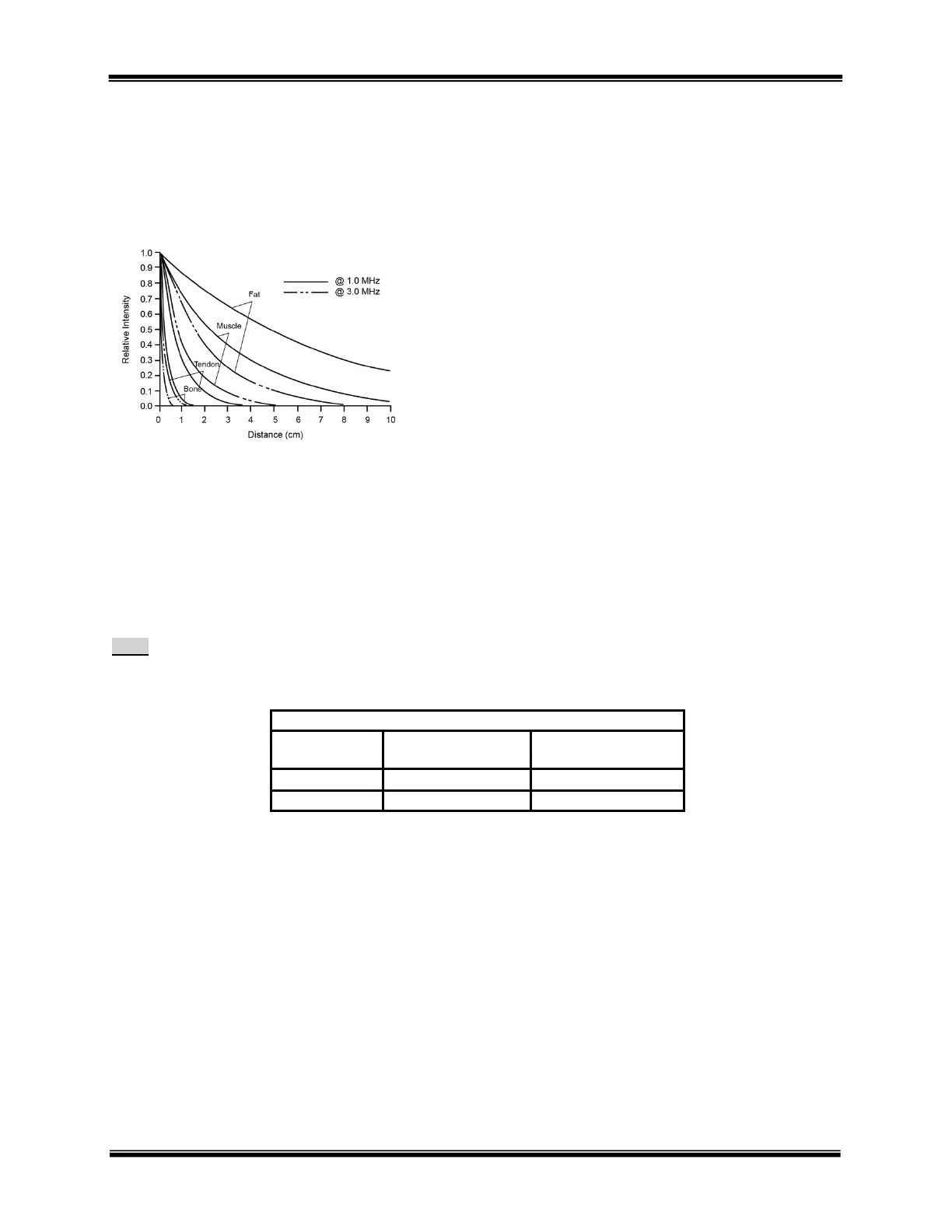
greater or less attenuation of the beam, for example, 1.0MHz penetrates approximately 3 times more than 3.0MHz.
This may be helpful in selecting intensity and time for ultrasonic therapy applications. Due to this reason, the patient
will generally experience much faster heating with 3MHz ultrasound and dosage or treatment time may have to be
reduced to avoid overheating of the tissue
.
Temperature Mode of Operation / T Mode
In order to achieve repeatable thermal effects of ultrasound in tissue the dosage of the ultrasound beam must be
carefully controlled. This involves accurate determination of the treatment area, coupling to be used, frequency of
operation, BNR and the desired temperature increase required to achieve appropriate therapeutic effects in the tissue.
Lehman and other investigators have categorized the effects of ultrasound on tissue as being of a mild or 1°C increase,
moderate or 2°C increase or vigorous or 2-4°C heating effect above the baseline tissue temperature of 37.5°C.
Typically, vigorous heating is used to treat connective tissue contracture and scar tissue while moderate and mild
heating are used in pain control, sub-acute and chronic inflammatory conditions and for muscle spasm reduction.
Note:
The 5cm transducer is the only transducer capable of operating in the ΔT mode. The 0.8cm head will default to 20%
duty factor and can only be used in pulsed or continuous modes.
Thermal Mode Availability
Transducer
Size
1MHz 3MHz
5 cm
2
1
T or 2
T 1
T, 2
T, or 4
T
0.8 cm
2
N/A N/A


 To Next Page