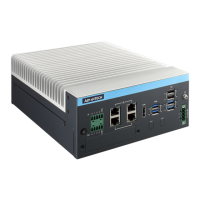
The Advantech AIMB-279 is a Mini-ITX motherboard designed for industrial applications, leveraging 12th/13th Gen Intel® Core™ processors (Alder Lake / Raptor Lake). It is built with either the Intel® Q670E or H610E PCH, providing a balance of performance computing and enhanced power management capabilities.
Function Description:
The AIMB-279 serves as a robust and versatile platform for various industrial computing needs. It supports a wide range of Intel® Core™ i9/i7/i5/i3, Pentium®, and Celeron® processors with an LGA1700 socket, offering up to 36 MB SmartCache. The motherboard is designed to provide abundant I/O connectivity and optimized integrated graphics, making it suitable for applications requiring multiple displays and diverse peripheral connections. Its Mini-ITX form factor ensures compatibility with compact industrial enclosures while maintaining a rich feature set.
Important Technical Specifications:
- Processor Support: 12th/13th Gen Intel® Core™ i9/i7/i5/i3, Pentium®, Celeron® (LGA1700 socket).
- Chipset: Intel® Q670E/H610E PCH.
- Memory: 2 x 260-pin SODIMM sockets supporting dual-channel DDR4 3200MHz SDRAM, with a maximum capacity of 64GB. Individual SODIMM capacities of 4GB, 8GB, 16GB, and 32GB are supported.
- Graphics:
- Controller: Intel® HD graphics.
- eDP: Supports a maximum resolution of 4096 x 2160 @ 60Hz (colay LVDS).
- DisplayPort 1.4: Supports a maximum resolution of 4096 x 2304 @ 60Hz.
- HDMI 2.0a: Supports a maximum resolution of 4096 x 2160 @ 60Hz.
- LVDS: Supports single/dual channel 18-/24-bit with a maximum resolution of 1920 x 1200 @ 60Hz (colay with eDP).
- Features a 32-/64-bit 3D graphics engine.
- Storage:
- 2 x onboard SATA III connectors with data transmission rates up to 600MB/s.
- 1 x M.2 M-Key connector supporting PCIe/NVMe x4 M.2 2242 SSDs.
- Expansion Slots:
- 1 x PCIe x16 Gen4 slot.
- 1 x M.2 E-Key connector (NGFF).
- LAN:
- Dual 10/100/2500 Mbps Ethernet ports via PCI Express x1 bus, providing 500 MB/s data transmission rates.
- Controllers: GbE LAN1 (Intel® i219LM) and GbE LAN2 (Intel® i226V).
- I/O Connectivity:
- Serial Ports: 2 (COM1 supports RS-232, COM2 supports RS-232/422/485).
- USB Ports: 4 x USB 3.2 (up to 10 Gbps transmission rates).
- GPIO: 8-bit general purpose Input/Output connector.
- BIOS: AMI EFI 256 Mbit SPI BIOS.
- Industrial Features:
- Watchdog Timer: Programmable with each unit equal to one second or one minute (255 levels), capable of generating a system reset.
- Mechanical & Environmental:
- Operating Temperature: 0 ~ 60°C (32 ~ 140°F), CPU dependent.
- Storage Temperature: -40 ~ 85°C (-40 ~ 185°F).
- Humidity: 5 ~ 95% non-condensing.
- Power Supply Voltage: +3.3V, +5V, +12V, -12V, +5VSB.
- Power Consumption: Example: Intel® Core™ i9-13900E 5.2GHz, 2x 32GB DDR4 3200MHz, 24V @4.45A with 24V DC Input adapter.
- Board Size: 170 x 170 mm (6.69" x 6.69").
- Board Weight: 0.365 kg.
Usage Features:
The AIMB-279 offers a comprehensive set of features for flexible system configuration and operation:
- Jumper Settings: The motherboard includes various jumpers to configure system settings, such as CMOS Clear (JCMOS1), ATX/AT Mode Selection (PSON1), eDP/LVDS Panel Voltage Selection (JEDP1_LVDS1), PCI Express x16 Bifurcation (SW1), and COM1_RI# Pin RI# / 5V / 12V Selection (JSETCOM1_V1). These allow users to tailor the motherboard's behavior to specific application requirements.
- Memory Installation: SODIMM modules are installed by ensuring the socket handles are open, sliding the module along the guides, and gently pressing until a click confirms proper seating and locking. Removal is achieved by pushing the handles outward.
- BIOS Setup Utility: The AMI BIOS Setup program allows users to modify BIOS settings and control special features. It provides a user-friendly interface with main and sub-menus, accessible via arrow keys and . Key functions include changing system time/date, configuring CPU and chipset settings, managing power and performance, setting security options, and defining boot parameters.
- Advanced BIOS Features: The Advanced tab in the BIOS setup provides detailed configuration options for CPU, PCH-FW, AMT, Trusted Computing, ACPI, Super IO, USB, Network Stack, CSM, NVMe, Tls Auth, and Driver Health. These settings enable fine-tuning of system performance, security, and peripheral interactions.
- Chipset Configuration Settings: This section of the BIOS allows configuration of System Agent (SA) and PCH-I/O parameters, including memory, graphics, DMI/OPI, VMD, PCI Express, SATA, and HD Audio subsystems.
- Boot Settings: Users can configure boot options such as Setup Prompt Timeout and Bootup NumLock State, and manage boot device priorities.
- Software API: Advantech provides a Value-Added Software Services suite, including APIs for General Purpose Input/Output (GPIO), System Management Bus (SMBus), Brightness Control, Watchdog Timer (WDT), and Hardware Monitor (HWM). These APIs simplify development by offering integrated interfaces for controlling embedded devices, monitoring system health, and managing power.
- Driver Installation: The motherboard requires specific drivers for optimal functionality. The Intel Chipset Software Installation (CSI) utility is crucial for configuring chipset components, including Core PCI PnP services, Serial ATA interface support, USB support, and identification of Intel chipset components in the Device Manager. Display and LAN drivers are also provided for Windows 10 (64-bit) systems.
Maintenance Features:
- CMOS Clear: A dedicated jumper (JCMOS1) allows users to erase CMOS data and reset BIOS settings to default values, useful for troubleshooting configuration issues.
- Battery-Powered RTC: The real-time clock circuit is battery-powered, ensuring timekeeping even when the system is off. Users are cautioned to replace the battery only with the same or equivalent type recommended by the manufacturer to prevent explosion.
- Static Discharge Precautions: The manual emphasizes the importance of grounding oneself with a wrist strap and handling electronic components on a static-dissipative surface or in static-shielded bags to prevent damage from electrostatic discharges during installation or maintenance.
- Power Disconnection Warning: Users are advised to completely disconnect the power cord from the chassis before working with the hardware to prevent damage from power surges and ensure safety.
- Return Merchandise Authorization (RMA): For defective products within the two-year warranty period, Advantech offers free repair or replacement. Customers are guided to collect problem information, contact their dealer for an RMA number, and properly pack the defective product with proof of purchase for efficient processing.
- Software Updates: Drivers and utilities are available on the Advantech support website, with updates provided via Microsoft* Service Packs, ensuring ongoing compatibility and performance improvements.

 Need help?
 General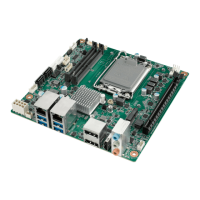

 To Next Page