AES 7788 Series RF Subscriber Unit ─ Installation and Operation Manual
AES Corporation 22 40-7788, Rev 6, August 30, 2016
3.6 Wiring - Zone Inputs
Following is an overview of the zone programming options. Use this to help
determine the wiring option that best suits your requirements,
Refer to illustrations on previous pages for location of Zone terminals.
Zone inputs may be programmed for use with several types of outputs in
alarm panels. Available options in the 7788F are, Supervised E.O.L. and Fire
Supervised E.O.L. and either with or without Restorals. Fire Supervised
refers to how the zone input behaves with an EOL device (similar to a typical
fire circuit loop) and not specifically to it being used to report a fire alarm
condition.
Unused zones should be programmed as bypassed.
Unused zones should NOT have EOL resistors installed.
The 7788F is intended for use in UL installations. The zone input wiring and
programming is limited to appropriate configurations for that purpose.
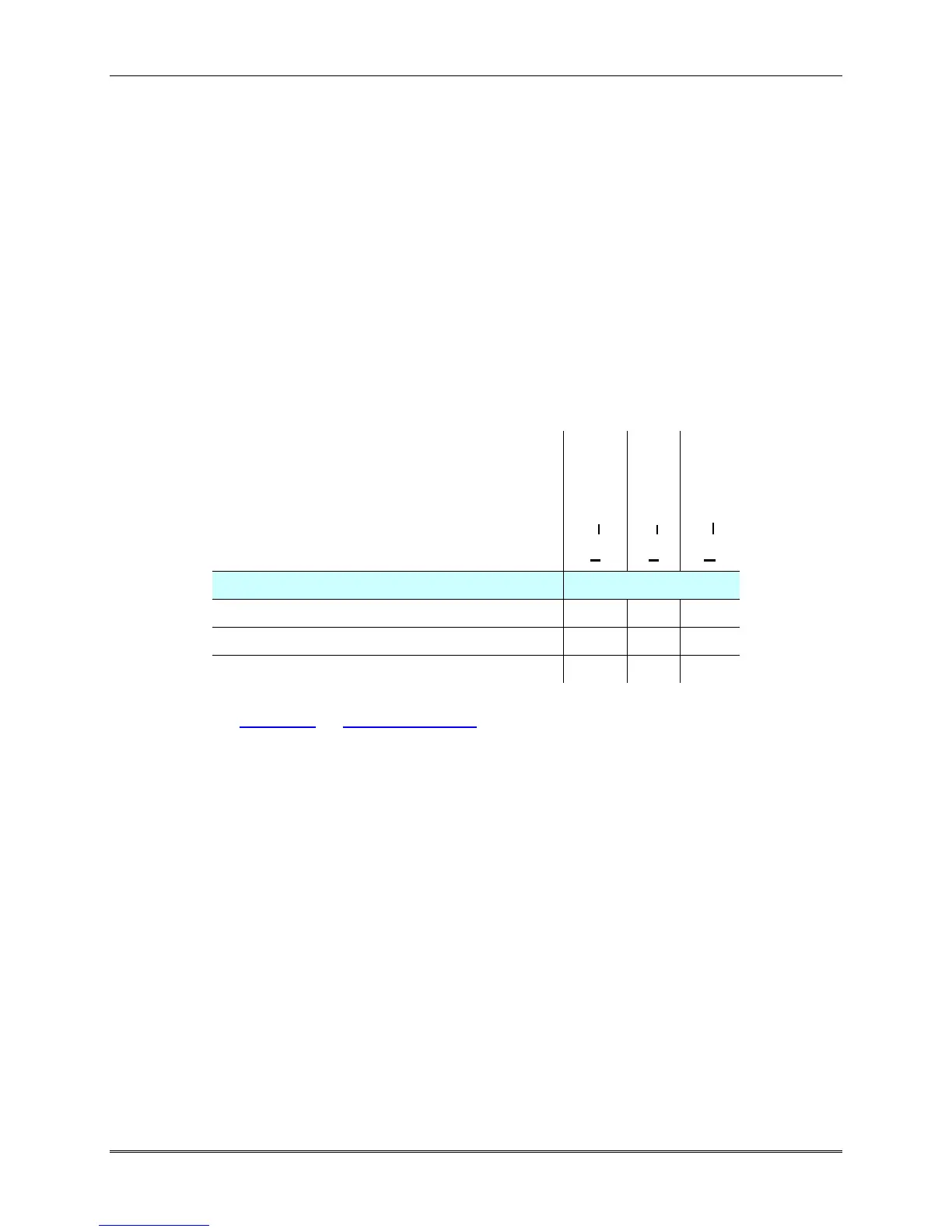
Input Electrical State / Condition
B=Bypassed/Changes Ignored; N=Normal; A=Alarm; T=Trouble**
See Section 4.4 for Zone Programming Instructions.
B = Bypassed - Zone Electrical State or condition is ignored
S = Supervised - EOL Resistor; 2.2K Ohm = Normal / Open = Alarm / Short = Alarm
F = Fire supervised - EOL Resistor; 2.2K Ohm = Normal / Open = Trouble** / Short = Alarm
** NOTES:
~ Reporting of “Trouble” messages to AES Receivers other than the 7705i, 7703 and
7701 requires firmware version 1.70 or later.
See Central Receiver Compatibility notes below.
Zone Reporting Chart
Notes on Central Receiver Compatibility
This Subscriber Unit is fully compatible with AES MultiNet Receivers, which are
fully compatible with Trouble Packets. Trouble packets are also compatible with
7000 Series Central Receiver Versions 1.70 and up. Contact AES if your receiver is
pre-1.70 for upgrade options. When “Fire” Zone programming is enabled, the unit
generates a specific packet type for reporting “Trouble”. Data within this packet type
can only be received on version 1.70 and newer receivers. Generally, any 7000
Series system shipped after 1997 would have a firmware version greater than 1.70.
The 7705i MultiNet Receiver is fully compatible with Trouble Packets.


 To Next Page