7
2241A EN 20040210
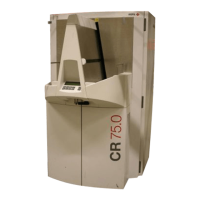
CR 75.0 features
The CR 75.0 scans the exposed ADC image plate, converts the information
into digital data and automatically transfers the image to the image
processing station for further processing and visualization.
The CR 75.0 requires but little manual interaction. All you have to do, after
exposure and identification of the cassette, is to place it in the input buffer of
the CR 75.0. You can deposit up to 10 cassettes of different sizes
simultaneously in the input buffer. The Digitizer takes in the cassettes one by
one. The Digitizer reads the demographic data and routing information from
the memory chip in the cassette, opens the cassette, removes the image
plate and scans the latent image by means of a sweeping laser beam.
Once the image is digitized, the cassette is returned to the output buffer to be
used for new exposures. After a full Digitizer cycle, the plate has turned 180°
in the cassette.
Depending on the X-ray intensity which has affected the phosphor during the
exposure, more or less light will be emitted during laser scanning. The light is
converted into an electrical signal. This signal is then converted into a digital
bit stream. Once converted into digital form, the digitized image is transferred
to the image processing station for further processing and visualization.
Further features of the CR 75.0 include:
" The CR 75.0 permits assigning the status ‘emergency’ to an image. An
emergency image will be given priority by the image processing station.
" The CR 75.0 permits re-erasing an image plate before re-using it. In specific
cases, this is necessary to prevent ghost images caused by previous
exposures or stray radiation from interfering with the image of interest. You
can erase a batch of up to 9 image plates.


 To Next Page