100 watts peak) until the desired amplifier peak output power occurs. The "ALC SET"
control should then be adjusted until the amplifier's RF output power just begins to drop.
CW Operation
The exciter output should be restricted to a level that limits the amplifier to 500 watts
output on a steady carrier or 50 watts reflected power, whichever is greater. Also, the
ALC should not be used to control the power level more than a few percent on CW. The
ALC LED should just barely flash on CW.
Begin by setting the ALC SET control fully clockwise. Begin with minimum RF output
power from your transceiver, and gradually increase your transceiver’s output power until
the amplifier outputs 500 watts. Now, send a series of “dits” and rotate the ALC SET
control counter-clockwise until the ALC LED just barely flashes.
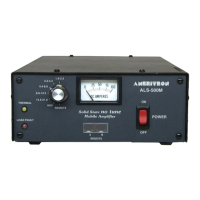
Note: The ALS-600 T/R relay enable time is typically 15 milliseconds. Many
transceivers permit setting a time delay between their relay-control output, and the
actual full-power RF output. If your transceiver has this capability, set this delay to 20
milliseconds to ensure you don’t transmit before the amplifier relay fully energizes
(which can result in the loss of part of the first Morse character).
Note: Transceivers should only be used in semi break-in mode when controlling the
ALS-600 T/R relay. QSK (full break-in) operation is available with the Ameritron QSK-5
external solid-state T/R switch.
RTTY, FM and Other High Duty Cycle
The transmitting duty cycle, ambient temperature, supply voltage, fan speed and the load
SWR all play important roles in determining the transmit time limit on high duty cycle
modes.
To minimize noise, Ameritron uses only enough fan speed to cool the ALS-600 for
typical amateur usage. If heavy duty cycle operation is planned, the following guidelines
should be followed.
The output power can be reduced to assist with cooling. This is not the most effective
method of improving performance since the power must be reduced 5 times to cut the
heat dissipation in half. The exciter output should be restricted to a power level where
less than 200 watts output or 25 watts reflected power is obtained on long duty cycle
modes.
The fan speed should be increased by replacing or supplementing the airflow from the
standard fan. A fan that delivers at least 80 CFM airflow at .l" of static pressure will
double the cooling and allow 500 watt RTTY transmissions with 2 minute on, one minute
off duty cycles.
22



 To Next Page