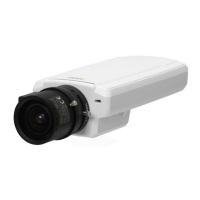
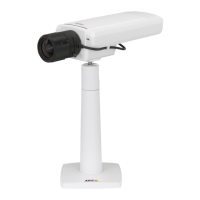
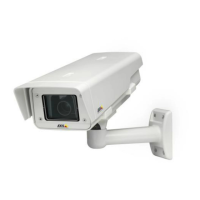
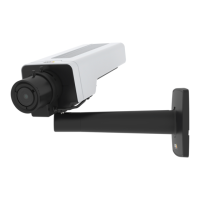
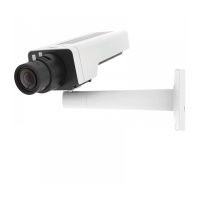
AXIS P1347 Network Camera
Video and Audio
White balance
White balance is us ed to make colors in the image appear the same regardless of the color temperature of the light source. The Axis
product can be set to automatically identify the light source and compensate for its color. Alternatively, select the type of light
source from the drop -down list. For a description of eac h available setting, see the online help
.
Wide Dynamic Range (Dynamic Contrast)
Wide dynamic range (Dynamic Contrast) can improve the exposure when there is a considerable contrast between light and dark
areas in the image. In intense backlight conditions, enable WDR. Disable WDR In low light conditions for optimal exposure.
Note
This setting is only possib le when using automatic exposure control.
Exposure Settings
Configure the exposure settings to suit the image quality req uire ments in relation to lighting, frame rate and bandwidth
considerations.
Exposure value - Click in the bar to fine-tune the exposure.
Exposure control - These settings is used to adapt to the amount of light used. Automatic is the default settings can be used in most
situations. The shutter speed is automa tically set to produce optimum image quality. Flicker-free 50 or 60 Hz is used to remove
flicker which can be caused by fluorescent and other l ight sources. The Hold current option locks the current exposure settings.
Enable Backlight compensation - Enable this option if a bright spot of light, for example a light bulb, causes other areas in
the image to appear too dark.
Exposure zones - This settings determines which part of the image is used to calculate the exposure. For most situations, the Auto
setting can be used. For particular requirement, select a predefined area.
Exposure priority - When Motion is prioritized and maximum Shutter time is set to a small value, motion blur in the image is
minimized. This can be useful f or recognition of moving objects such as people and vehic
les. Howe ver, prioritizing motion may cause
an increase in image noise, especially in low light situa t ions. When Low noise is prioritized and Gain is set to a small value, image
noise is minimized. The file size is reduced, which can be useful if storage space or bandwidth i s limited. However, prioritizing low
noise may result in a very dark image, especially in low light situations.
Day/Night
The IR cut filter prevents infrared (IR) light from reaching the image sensor. In poor lighting conditions, for example at nig ht, or
when using an IR lamp, set the IR cut filter to Off. This incr ea ses light sensitivity and allows the product to “see” infrared light. The
image is shown in black and white when the IR cut filter is off.
If using automatic Exposure control,settheIRcutfilter to Auto to automatically switch between On and Off accordingtothe
lighting conditions.
Iris configuration
Iris configuration shows the current configured iris type. Do not change the iris configuration unless the lens has been chang ed,
see Replacing the lens, on page 8 .
Iris adjustment
Select Enable automatic iris adjustment to automatically compensate for changing light conditions. This option is not available
if a fixed iris is used.
Use the Iris adjustment slider to set the preferred F-value. The scale represents the amount the i ris is open. If set to 0, the iris
is opened as much as possible. If set to 100, the iris is closed as much as possible. The actual F-value is shown below the
slider. If automatic iris adjustment is enabled, the iris will stay at this position as long as light conditions ar e favorable. If light
conditions change, the iris will adjust its elf to the best iris settings. If au tomatic iris adjustme nt is disabled, the iris will lock on
the s et position r egardless of light conditions
22



 To Next Page