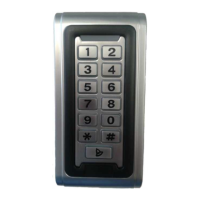
CS106/BL106 Combined Door Entry and Coded Access
7
time period only. This time period can be determined by a time-clock or
manually via a key switch.
For example, with factory settings, the operation of code 1 is unrestricted
(Executive Code) whilst code 2 is restricted to when the time-clock input is
closed (Zone 1 - Staff Code).
Codes can also be programmed to operate during alternate shifts. e.g. code 1
operates when the time-clock input is open (Zone 2) and code 2 operates when
the time-clock input is closed (Zone 1).
Refer to ‘Programming the Action Codes’ page 20 and Table 1 page 25 for
further details.
Exit Facility
The Exit facility enables the lock release to be operated directly from a
push-button for the predetermined lock duration. Typically this would be used
to allow personnel to freely exit through the controlled door. The facility may
also be used for a Fireman’s’ key-switch, or to interface with other security
products such as a Door Entry Telephone System.
Lock Delay
If required, the lock release can be programmed to operate after a preset time
delay, following entry of the access code. This function is useful if the keypad
is located a significant distance from the entrance.
Non-Volatile Memory
The access codes and user programs are stored in a protected non-volatile
EEPROM memory, which does not rely on batteries. The access codes and
other programmable parameters are retained indefinitely without power



 To Next Page