1C.
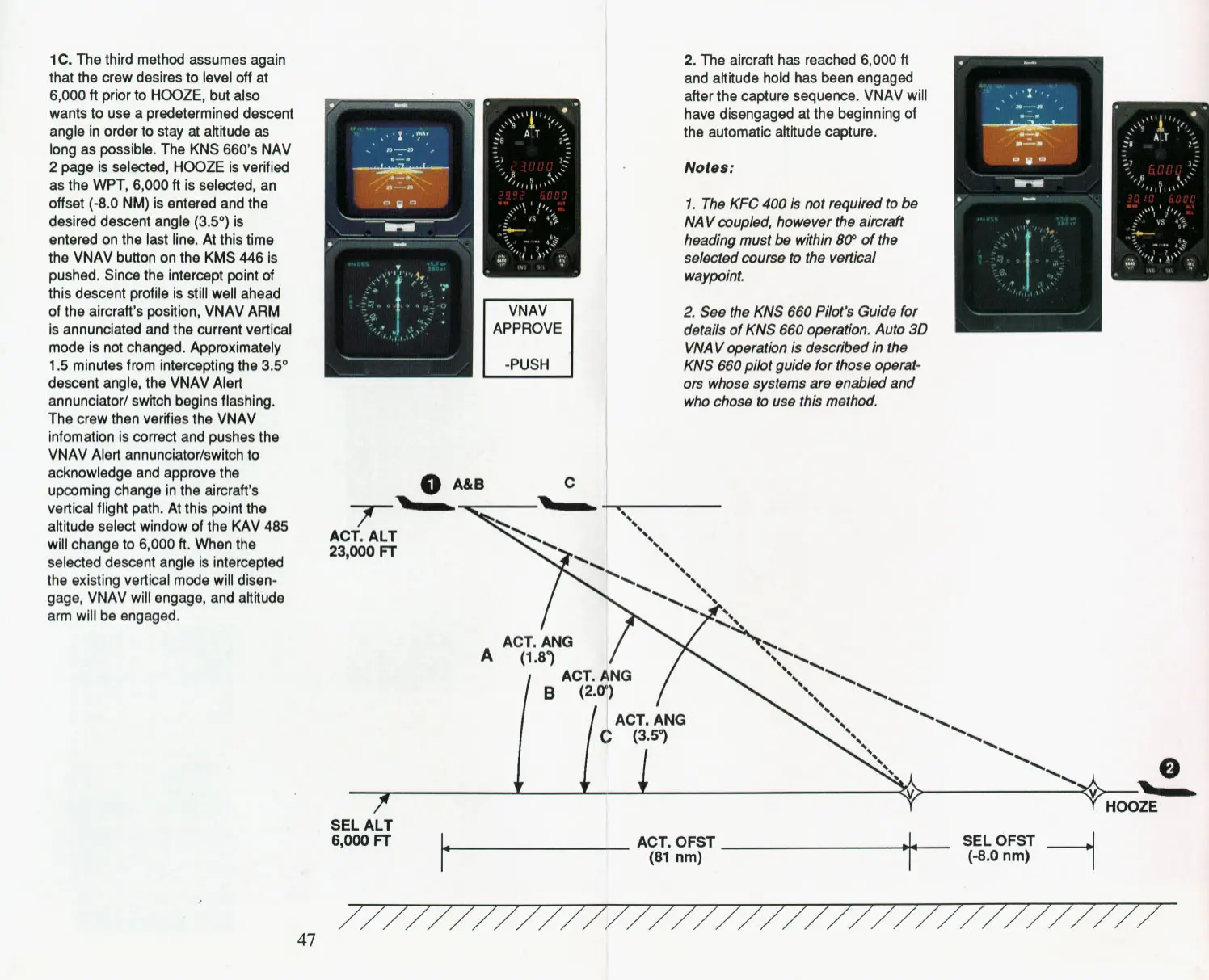
The third method assumes again
that the crew desires to level
off
at
6,000
ft
prior to HOOZE, but also
wants to use a predetermined descent
angle in order to stay
at
altitude
as
long as possible. The KNS
660's
NAV
2
page is selected, HOOZE is verified
as the WPT,
6,000
ft is selected, an
offset
(-8.0
NM) is entered and the
desired descent angle
(3.5O)
is
entered on the last line. At this time
the VNAV button on the KMS
446
is
pushed. Since the intercept point
of
this descent profile is
still
well ahead
of the aircraft's position, VNAV ARM
is annunciated and the current vertical
mode is not changed. Approximately
1.5
minutes from intercepting the
3.5"
descent angle, the VNAV Alert
annunciator/ switch begins flashing.
The crew then veriiies the VNAV
infomation is
correct
and pushes the
VNAV Alert annunciator/switch to
acknowledge and approve the
upcoming change in the aircraft's
vertical flight path. At this point the
altitude select window of the KAV
485
will change to
6,000
ft.
When the
selected descent angle is intercepted
the existing vertical mode will disen-
gage, VNAV will engage, and altitude
arm
will be engaged.
2.
The aircraft has reached
6,000
ft
and altitude hold has been engaged
after the capture sequence. VNAV will
have disengaged at the beginning of
the automatic altitude capture.
Notes:
1.
The KFC
400
is
not
required to
be
NA V coupled, however the aircraft
heading
must
be
within
80"
of the
selected course
to
the vertical
APPROVE
-PUSH
waypoint.
I
0
A&B
Ci
7-
ACT. ALT
23,000
FT
2.
See the KNS
660
Pilot's Guide for
details
of
KNS
660
operation. Auto
30
VNA
V
operation is described in the
KNS
660
pilot guide for those operat-
ors
whose systems are enabled
and
who chose
to
use this method.
47


 To Next Page