HDS-14LSX / HDS-14LSXE Lifts 6 P/N 5900162 — April 2018 — Rev. F3
Components
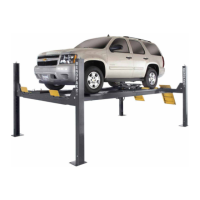
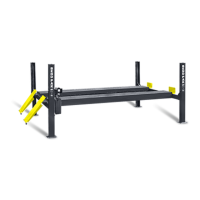
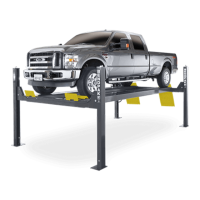
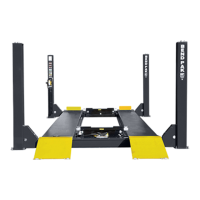
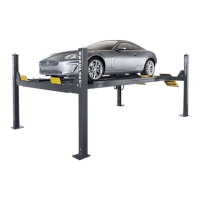
The main components of your Lift include:
• Power Post. The Post that holds the Power Unit.
You must put the Power Post in the
Rear left position
(refer to the drawing on the following page for more orientation information).
You can tell the Power Post from the other Posts because it has two Mounting Brackets on it.
Mount the Power Unit on one of the two Mounting Brackets.
• The other three Posts. These Posts are interchangeable, although their Labels are different.
• Power Unit. An electric/hydraulic unit that connects to an electric power source and then
provides hydraulic fluid to the Hydraulic Cylinder that raises and lowers the Runways.
• Powerside Runway. The Runway on the same side as the Power Post. The Powerside Runway
has the Hydraulic Cylinder and the Cables under it.
• Offside Runway. The other Runway. It does not have an Hydraulic Cylinder or Cables under it.
• Utility Rails. Hold the optional Rolling Bridge Jacks. Utility Rails must go on the inside of the Lift.
• Crosstubes. One at the front of the Lift, one at the rear. The Crosstubes are hollow; the Cables
that raise and lower the Runways are routed through the Crosstubes. The Crosstubes are not
interchangeable: the Front Crosstube has a small opening (called a ‘Window’) that faces the inside,
the Rear Crosstube has a larger Window that also faces the inside of the Lift.
Windows open to
the inside of the Lift only
. Cables go into the Crosstubes through the Windows.
• Ramps. One for each Runway. Use them to drive onto and off of the Runways.
• Tire Stops. Located at the Front of the Lift, Tire Stops prevent the vehicle’s front tires from going
any further forward. Additionally, we strongly recommend chocking the vehicle’s rear tires.
• Turn Plates. Movable plates that go near the Front of each Runway; required for alignments.
You must orient both Runways so that their Turn Plates are at the Front of the Lift, whether you are
doing alignments or not.
• Filler Plate. Sits next to the Turn Plate, holding it in position.
• Slip Plate. A large movable plate on both Runways towards the Rear of the Lift; used for
alignments.
• Safety Locks. Once engaged, they hold the Runways in position, even if the power goes out or
there is a leak in the Hydraulic Lines. Your Lift has 15 Safety Locks, spaced every four inches. This
lets you lock the Lift at just the right height for what you want to do. The Lift also has a backup
Slack Safety system; refer to About Safety Locks for more information.
Only leave your Lift
on the ground or engaged on a Safety Lock.
• Pushbutton Air Valve. Includes a pushbutton that moves the Safety Locks away from the
Ladder so that they do not engage as you lower the Lift. Used to lower the Runways.
• Ladder. A piece of steel that gets installed at the back of each Post. Each Ladder has 15 holes in
it; these are part of the Safety Lock system.
• Aligner. An optional, separate product that lets you perform vehicle alignments. Refer to the
aligner page on the BendPak website for more information.
• Rolling Bridge Jacks. An optional, separate product that raises wheels of the vehicle on the Lift
off the Runway, making it much easier to perform brake jobs and suspension work while the
vehicle is still on the Lift. Refer to the Rolling Bridge Jack page on the BendPak website
for more information.


 To Next Page