
 Need help?
Do you have a question about the Bertec FIT and is the answer not in the manual?
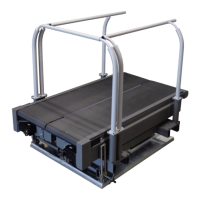
The Bertec Instrumented Treadmill is a specialized dual-belt treadmill designed for dynamic analysis of human locomotion, integrating strain gauge technology, innovative design, and quality manufacturing. It is equipped with multiple strain gauge load transducers and a built-in digital pre-amplifier for signal conditioning. The treadmill incorporates an independent force plate measuring six load components for each belt, providing the resultant force and the three components of the resultant moment in the same orthogonal coordinate system. This allows for calculation of the point of application of the force and the couple acting on each half of the treadmill.
The Bertec Instrumented Treadmill is primarily used for research and rehabilitation applications where precise measurement of ground reaction forces and moments during walking or running is critical. It allows for the study of gait, balance, and other biomechanical parameters in a controlled laboratory environment. The dual-belt design enables independent control of each belt, facilitating studies on split-belt locomotion and other experimental paradigms. The integrated force plates provide real-time kinetic data, which can be combined with kinematic data from motion capture systems for comprehensive biomechanical analysis.
The treadmill is designed to be state-of-the-art with 16-bit digital technology for signal acquisition and conditioning. It offers various calibration matrices, and the digital signal output can be directly plugged into the standard USB port of a personal computer without the requirement of an additional PC card for analog-to-digital (A/D) signal conversion, ensuring a simple plug-and-play installation procedure.
The Bertec Instrumented Treadmill comes in different configurations: Fully Instrumented Treadmill (FIT), Mini-FIT for Animal Application, and Quad-FIT for Quadrupedal Applications.
The treadmill requires a standard industrial 3-phase power supply.
The treadmill system includes an Electronic Control Unit (ECU) that houses the power electronics, motor drive units, and safety circuitry. The ECU connects to a computer via a USB cable for control and data acquisition. The treadmill motors are connected to the ECU via motor and feedback cables.
Control Panel: The treadmill is controlled via a software interface on a computer. The Control Panel displays real-time data for belt speed, incline, torque, drive temperature, and motor temperature. Users can adjust belt velocity and acceleration, and incline independently or jointly. The software provides visual feedback on the treadmill's status and allows for precise control of experimental parameters.
Incline Control: Optional incline feature allows for tilting the treadmill up to 15 degrees. The incline control is integrated into the software, allowing users to set the incline angle precisely.
Emergency Stop: The system includes multiple emergency stop buttons: one on the Control Panel, one on the Electronic Control Unit, and a remote E-Stop pendant. Activating any E-stop immediately halts the treadmill belts and, if applicable, the incline.
Safety Features: The manual emphasizes several safety precautions, including proper grounding, avoiding unattended operation, ensuring clear supervision, and preventing obstructions in air vents. Safety labels are prominently placed on the treadmill and control unit, indicating potential hazards such as moving belts, crush points, and electrical shock.
Data Acquisition: The treadmill uses AM6500 series external converters for digital signal acquisition and amplification. These converters connect to the treadmill force plates and transmit data to the computer via USB. The AM6500-TM unit is a digital signal converter, while the AM6501/AM6504/AM65XX series are analog amplifiers with fixed or adjustable gain settings. The system supports a standard bandwidth of 500 Hz, with actual analog gain ratios calibrated to 99.97% accuracy.
Load Calculations: The manual provides detailed equations for calculating load values (Fx, Fy, Fz, Mx, My, Mz) from the amplifier output voltages and scale factors. It also explains how to calculate the point of application of force and couple on the treadmill belt.
Installation Process: The treadmill requires professional installation by Bertec approved personnel. Site preparation involves ensuring a suitable pit for the treadmill, proper power requirements, and a clean, level floor surface. The installation includes connecting all cables (power, signal, and communication) between the treadmill, control cabinet, and computer.
Cleaning Instructions: Regular cleaning of the treadmill belts and surfaces is recommended. Dust and debris should be removed using a vacuum cleaner and a rag with denatured alcohol or industrial cleaners. The treadmill should not be cleaned using any household cleaners or water.
Lifting of Treadmill Components: If the treadmill needs to be moved or repositioned, specific instructions for lifting the treadmill components are provided, emphasizing the use of a fork lift or pallet jack. The treadmill control cabinet can be repositioned at the end user's discretion by means of rolling the cabinet on its castors.
Troubleshooting: The manual outlines steps for initial treadmill start-up and provides guidance on interpreting the Control Panel display. It also highlights the importance of proper grounding and warns against tampering with internal components to avoid electrical hazards.
Software Updates: Bertec Corporation provides software updates, and users are encouraged to ensure their software is up to date for optimal performance and functionality.
Customer Support: Bertec Corporation offers customer support for any issues related to the treadmill's operation, maintenance, or repair. Contact information for sales, information, and support is provided in the manual.
 General
| Brand | Bertec |
|---|---|
| Model | FIT |
| Category | Laboratory Equipment |
| Language | English |

 To Next Page