02 Bertec Corporation Instrumented Treadmill Manual
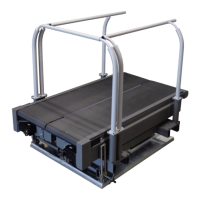
Bertec’s dual belt treadmill consists of two 20” treads running side by side. Each tread has a 6-component force plate integrated
into its structure to measure loads exerted on the tread belts. Each tread is driven and controlled separately. The tread belt and
force plate structure are constructed such that the forces generated by the tread belt and the tension from the driving timing belt
are internal forces and do not affect the load measurement. Both halves of the treadmill sit on a rigid steel structure or a split
mounting plate depending on the requested model. The handrails are attached to this structure or directly to the mounting plates.
Locomotion analysis can provide signicant information regarding the kinetics and kinematics of human motion. The necessity
for proper foot placement decreases the efciency of locomotion analysis using conventional, stationary force plates. Use of a
dual belt instrumented treadmill eliminates the need for targeting the force plate to record valid ground reaction data and avoids
the cumbersome process of multiple trials. In addition to increased efciency, the controllable belt speed allows testing a wide
range of subjects ranging from the elderly population to sprinting athletes.
Bertec treadmills are calibrated and pre-assembled in the factory. Do not attempt to change adjustments or disassemble the
treadmill - damage can occur to the transducer components or electronics. The limited warranty is void if the treadmill or any of
the accessories are disassembled without the authorization of Bertec.
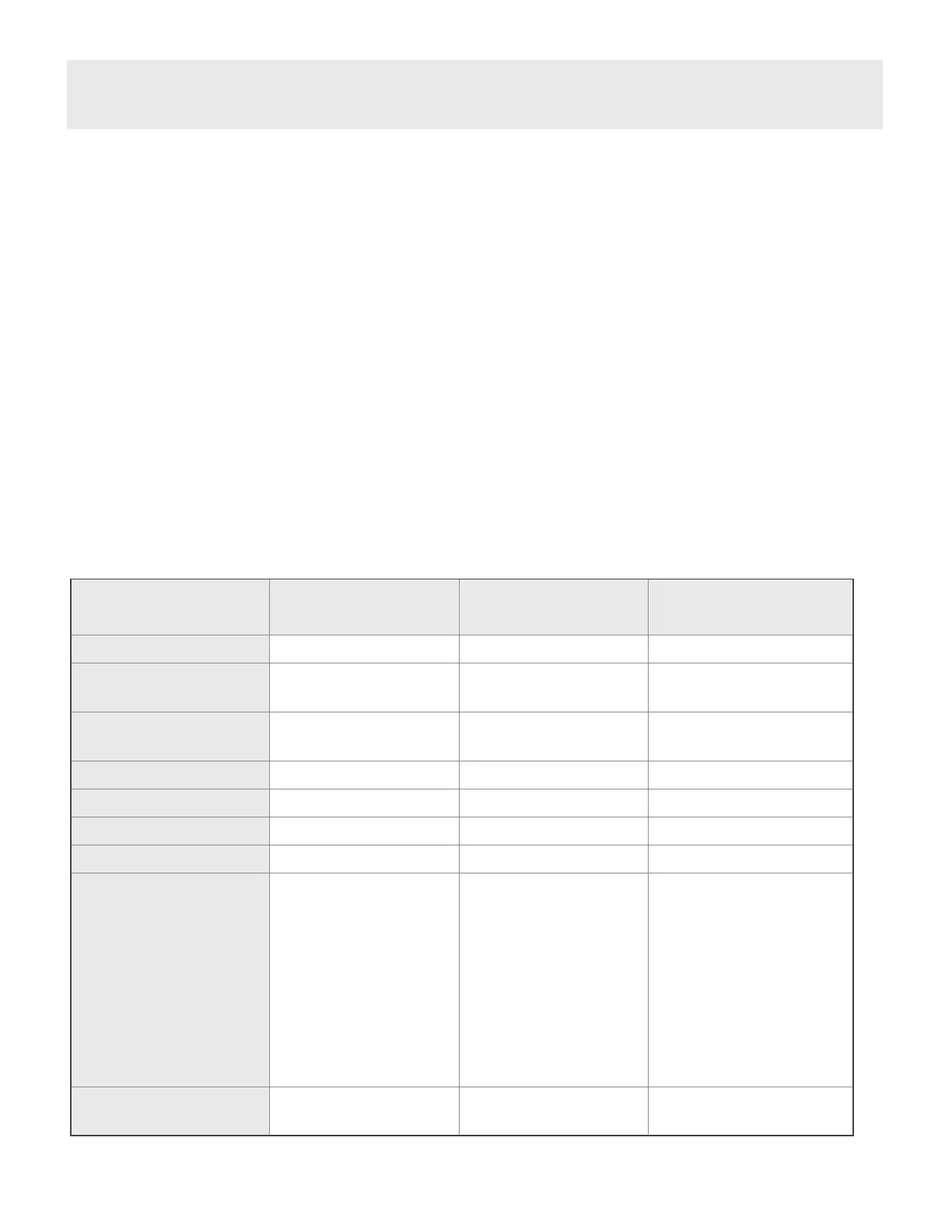
Technical Specications
Fully Instrumented
Treadmill (FIT)
Mini-FIT for Animal
Application
Quad-FIT for Quadrupedal
Applications
Dimensions (in) 81.1 x 54.6 x 15.3
Max Allowable Load, N (lb)
(per treadmill side)
6,675 (1500) 3,335 (750) 3,335 (750)
Max Load Range, N (lb) Fx, Fy: 2,225 (500)
Fz: 4,450 (1,000)
Fx, Fy: 1,100 (250)
Fz: 2,225 (500)
Fx, Fy: 1,110 (250)
Fz: 2,225 (500)
Speed Range, km/h (mi/h) 0-24 (0-15) 0-24 (0-15) 0-24 (0-15)
Acceleration, m/s² (ft/s²) 0-25 (0-82) 0-25 (0-82) 0-25 (0-82)
Max Sound Level 90 dB
Number of Belts 2 2 4
Size of Belts Two independent force
measuring running belts,
approximately 1.75 m (70
in) long and 0.5 m (20 in)
wide per belt.
Two independent force
measuring running belts,
approximately 1 m (40
in) long and 0.3 m (12 in)
wide per belt. *0.15 m (6
in) wide version available.
Four independent force
measuring running belts,
approximately 1 m (40 in)
long and 0.3 m (12 in) wide
per belt. Left side speed is
controlled separately from
the right side speed.
*0.15 m (6 in) wide version
available.
Walking Surface, m (in) 1.75 x 1 (approx. 70 x 40)
1 x 0.6 (approx. 40 x 24)
1 x 0.3 (approx. 40 x 12)
2 x 0.6 (approx. 80 x 24)
Treadmill Design


 To Next Page