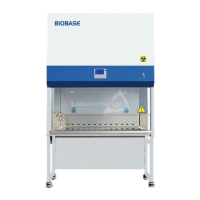
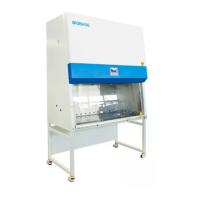
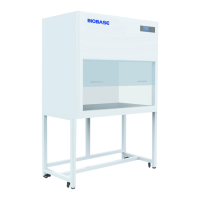
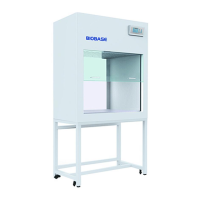
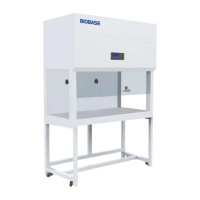
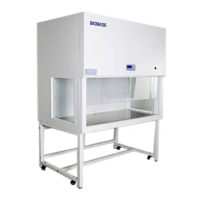
unpacked and checked. Only the tested and qualified safety cabinet can be sold.
2.7 Methods and procedures for disinfection
Disinfection is necessary when any contaminated part of the Microbiological Safety Cabinet needed
for routine maintenance, replacement filters, and performance testing, etc. Before doing certification
test and gas sterilization, all internal working surface and the exposed outer surface should be
disinfected with a suitable disinfectant. Besides, before doing certificate test, please use the
biological safety level 2 designated agents, in the form of gaseous state to entire safety cabinet to
ensure the disinfection is in line with the requirements. When the safety cabinet has been used, it is
recommended to use the biological safety level 3 designated agents. It should be disinfected first
while the cabinet with the potential hazard of contamination move the place. In addition, if the
reagents are overflowed and spilled after the experiment, the contaminated surface should be
properly disinfected. Please use the depolymerization of paraformaldehyde as a disinfectant on the
occasion stated below, while most time use the gas. Before disinfection by other methods,, the cycle
parameters and the validity of these parameters must be given for each model and size. The
compatibility of materials and the degradation and absorption of the alternatives are the key factors
to maintain the integrity of the safety cabinet and the time required for disinfection. There are some
cases need to use these alternative methods, e.g. slow virus disease. The disinfection methods should
be negotiated by the users and the authentication institution. When use paraformaldehyde for air
disinfection, it is necessary to point out the area of regulation, the gas masks, protective facilities, the
corresponding testing, medical monitoring, hazards training, record keeping and according to the
following steps:
Before disinfection, all hydrogen chloride must be removed from the safety cabinet.
Hydrogen chloride in the presence of formaldehyde in the air, ,will form a carcinogen two
chloromethyl ether (BCME) with the environment condition.
a、Multiply the height, width and depth to calculate the total volume of the safety cabinet
b
、
Safety cabinet total volume multiplied by 11g / m3, to determine the required quality of
paraformaldehyde. To confirm the quantity of ammonium hydrogen carbonate or its substitute
according to the stoichiometric method, and provide ammonia and formaldehyde with
neutralization reaction. Ammonium hydrogen carbonate need to be more than 10% to ensure the
complete reaction;
c
、
If there is exhaust pipe in safety cabinet, the pipeline must be airtight. The terminal air tightness
in the pipe can be realized, or if there is a valve regulating valve closed in the safe cabinet near. If
the exhaust pipe is longer than 3m, please increase the amount of paraformaldehyde in order to
compensate for the increased volume. If safety cabinet exhaust gas recirculation into the building
exhaust system, please disconnect safety cabinets and building system connection and make it


 To Next Page