E80/E70 Digital Electrocardiograph User’s Manual
19
Appendix E Measurement
One predominant beat is selected from each 12 leads waveform. The 12 predominant beats are
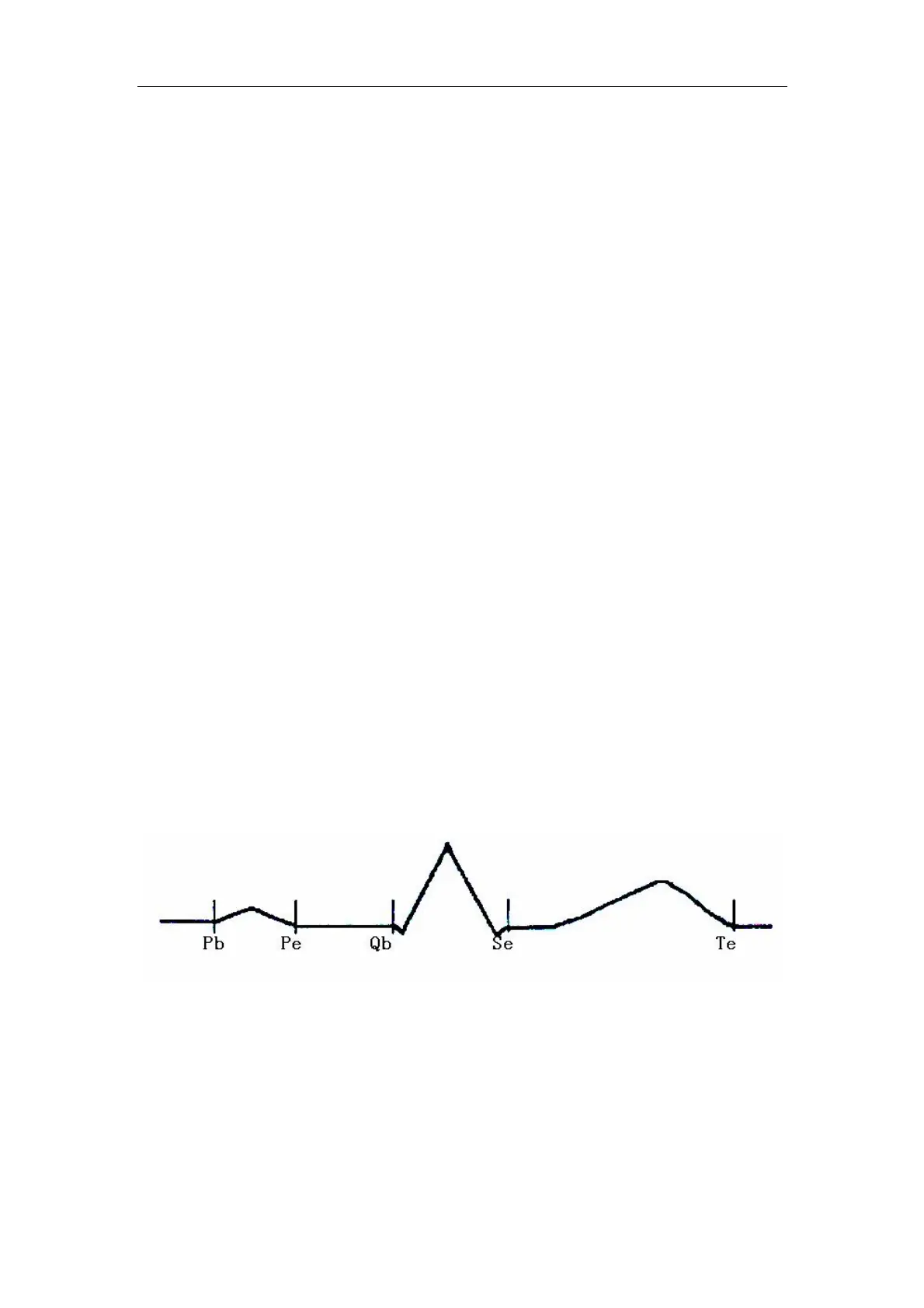
used by EMDI to locate the waveform boundaries (the onsets and ends of P, QRS, T wave) in
multilead ECG signal (the 12 standard leads) and measure features of clinical importance (such as
the amplitude and duration of the Q, R, S, R’ and S’ waves, the QT interval, the PR internal).
E.1 The Waveform Boundaries of 12 Leads
We adopt some scientific methods to determine multilead wave onset and end as follows:
Firstly, we detect and obtain, for each waveform boundary WB (including P end (Pe), P onset (Pb),
QRS onset (QRSb), QRS end (QRSe), T end (Te)) , a set of waveform boundary positions WBj(i)
belonging to beat I of lead j (j can take values from 1 to 12 (12 leads), except for values
corresponding to the leads where no detection was made). The next step is the selection, from
these WBj(i) positions, of the one WB(i) that will be considered as the real onset or end of
waveform at the ith beat. Electrophysiologically, if all WBj(i) were correctly detected, we should
select the earliest WBj(i) (j= 1,2,…,12) for the waveform onset and the latest for the waveform
end, in order to recover the boundary from that lead where the electrical activity of the heart has
the longest temporal project. However, due to noise or errors, misestimations could have occurred
in the determination of some WBj(i), that may lead to erroneous final WBj(i) position. To reduce
the risk of this occurrence, we apply the following mulitilead wave boundary detection rule for
each ith beat: we calculate the mean and the standard deviation of WBj(i) (j=1,2,…,12), and we
search the minimum time position (for onsets) or maximum time position (for ends) of WBj(i)
(j=1,2,…,12). If the difference between the minimum or maximum WBj(i) position and the mean
is bigger than three times the standard deviation, the minimum or maximum WBj(i) point is
rejected as a possible noisy detection. After that we take the wave onsets (ends) as the minimum
(maximum) of the remaining WBj(i) positions, obtaining the final WB(i).



 To Next Page