Preparing for the First Flight
Please note this checklist is not intended to be a replacement for the content of this instruction manual. Although it can be
used as a quick start guide, we strongly suggest reading through this manual completely before proceeding.
Remove and inspect contents•
Begin charging the flight battery (see charging procedures on following pages)•
Install the 4 included AA batteries in the transmitter•
Install the flight battery in the helicopter (once it has been fully charged)•
Check the Center of Gravity of the helicopter (see page 12)•
Test the controls (see page 14)•
Install the optional Training Gear Set (EFLH1527; strongly recommended if this is your first collective-pitch equipped •
helicopter model)
Familiarize yourself with the controls•
Find a suitable area for flying•
Flying Checklist
Please note this checklist is not intended to be a replacement for the content of this instruction manual. Although it can be
used as a quick start guide, we strongly suggest reading through this manual completely before proceeding.
Always turn the transmitter on first ❏
Plug the flight battery into the 2-in-1 control unit ❏
Allow the 2-in-1 control unit and gyro to arm and initialize properly ❏
Fly the model ❏
Land the model ❏
Unplug the flight battery from the 2-in-1 control unit ❏
Always turn the transmitter off last ❏
Battery Warnings and Guidelines
The 3S 11.1V 1000mAh Lithium Polymer Battery Pack (EFLB0997) included with your Blade SR features
Charge Protection Circuitry and Balance Charging via the included 3S 11.1V Lithium Polymer Balancing
Charger (EFLC3105). However, to help ensure a safe charge every time, you MUST read the following safety
instructions and warnings before handling, charging or using the Li-Po battery pack.
CAUTION: Lithium Polymer batteries are significantly more volatile than the alkaline, Ni-Cd or Ni-MH
batteries used in RC applications. All instructions and warnings must be followed exactly.
Mishandling of Li-Po batteries can result in fire property damage and injury.
By handling, charging or using the included Li-Po battery you assume all risks associated with lithium batteries.
If you do not agree with these conditions, return your complete Blade SR model in new, unused condition to the
place of purchase immediately.
You must charge the included 3S 11.1V 1000mAh Li-Po battery pack in a safe area away from flammable materials.•
Do not charge the battery when installed in the helicopter.•
Never charge the battery unattended. When charging the battery you should monitor the charging process and react to •
potential problems that may occur.
After flight, the battery must be cooled to ambient temperature before charging.•
•You MUST use the included 3S 11.1V Li-Po Balancing Charger ONLY. Failure to do so may result in a fire causing
personal injury and/or property damage. DO NOT use an Ni-Cd or Ni-MH charger.
If at any time during the charge or discharge process the battery begins to balloon or swell, discontinue charging or •
discharging immediately. Quickly and safely disconnect the battery, then place it in a safe, open area away from
flammable materials to observe it for at least 15 minutes. Continuing to charge or discharge a battery that has begun to
balloon or swell can result in a fire. A battery that has ballooned or swollen even a small amount must be removed from
service completely.
In the event of a crash, you must quickly and safely disconnect and remove the battery from the model, then place it in a •
safe, open area away from flammable materials to observe it for at least 15 minutes.
Store the battery at room temperature at approximately ½ charge (3.8V per cell; 11.4V for a 3S battery pack) for best •
results.
When transporting or temporarily storing the battery, the temperature range should be from 40–120 degrees Fahrenheit. •
Do not store the battery or model in a car or direct sunlight whenever possible. If stored in a hot car, the battery can be
damaged or even catch fire.
Do not over-discharge the battery. Discharging the battery too low can cause damage to the pack resulting in reduced •
performance and duration.
Li-Po cells should not be discharged to below 3V each under load. In the case of the 3S Li-Po packs used for the Blade •
SR, you will not want to allow the battery to fall to below 9V during flight.
Over-discharge of the Li-Po battery pack can result in shortened flight times, loss of power output or failure of the pack •
entirely.
Battery Charging
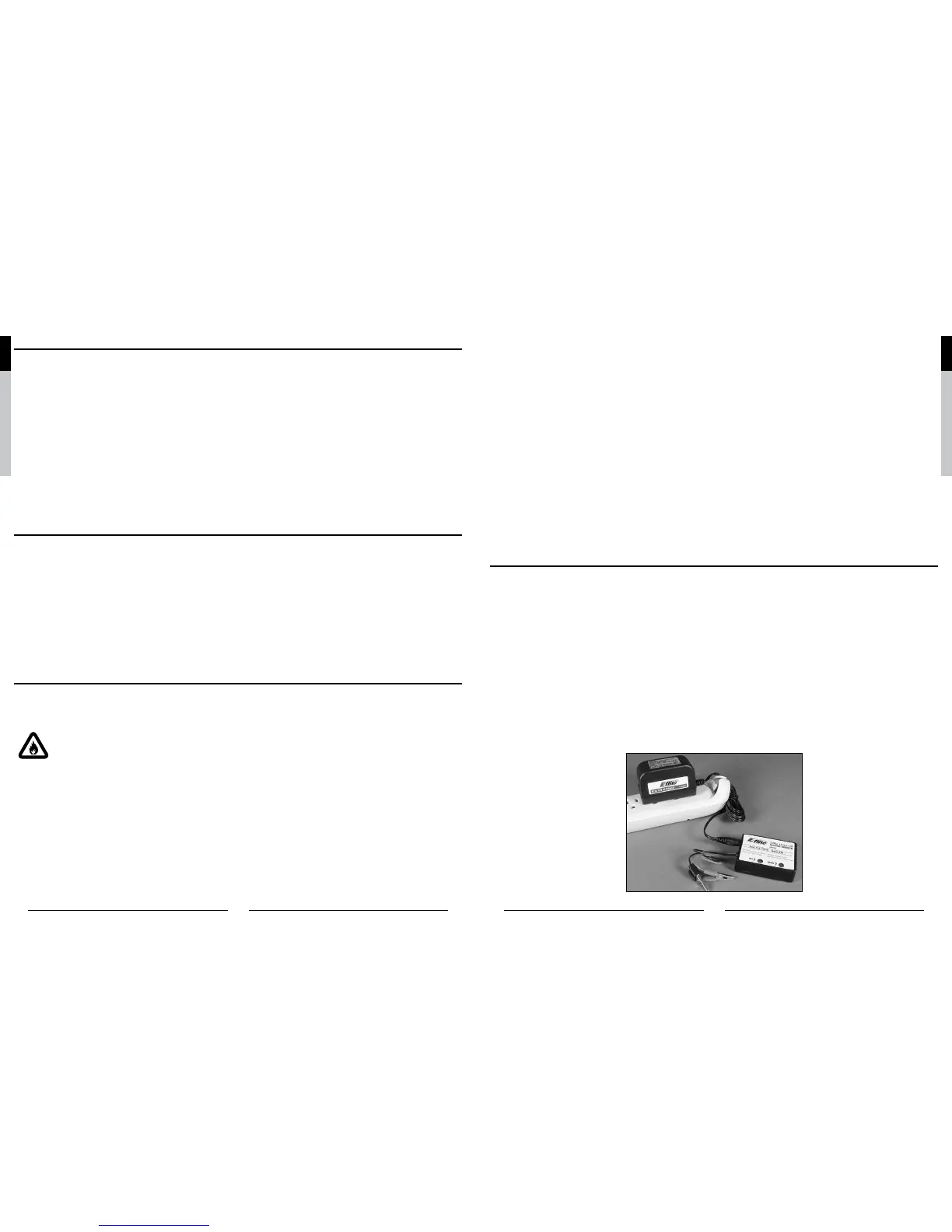
It is important that you only charge the included 3S 11.1V 1000mAh Li-Po Battery Pack (EFLB0997) with the included 3S
11.1V Li-Po Balancing Charger (EFLC3105). Your battery pack is equipped with special Charge Protection Circuitry and a
Balance Charge Lead with connector that is only compatible with this charger. Attempting to charge the pack using another
Li-Po charger or non Li-Po compatible charger could result in serious damage. Please familiarize yourself thoroughly with the
Battery Warnings and Guidelines section before continuing.
The included 3S 11.1V Li-Po Balancing Charger will charge a near fully discharged (not over-discharged) 3S 11.1V 1000mAh
Li-Po Battery Pack in approximately 1.2–1.5 hours. In some cases the charge time may be shorter depending on the actual
amount of capacity left in the pack after a flight. NEVER charge the battery unattended.
Note: The Li-Po battery pack included with your Blade SR will arrive partially charged. For this reason the initial charge
may only take approximately 30–50 minutes.
The charger requires up to 1.5 amps of 11.5–15-volt DC input power that can be supplied by the included AC to 12V DC,
1.5-amp Power Supply (EFLC4000) for convenient charging anywhere an AC outlet is available. NEVER attempt to power
the charger from an AC outlet without the use of a proper AC to DC adapter/power supply.
Note: When using the AC to DC adapter/power supply, the charger is protected to prevent damage if the alligator clips
touch. However, please take care to ensure that the alligator clips do not cause shorting of the battery, adapter/
power supply, etc. by keeping them clear.


 To Next Page