33
block is well in front of the saw blade, because
the cutoff piece could bind between the fence
and the blade causing kickback.
MAKING THE FACING BLOCK
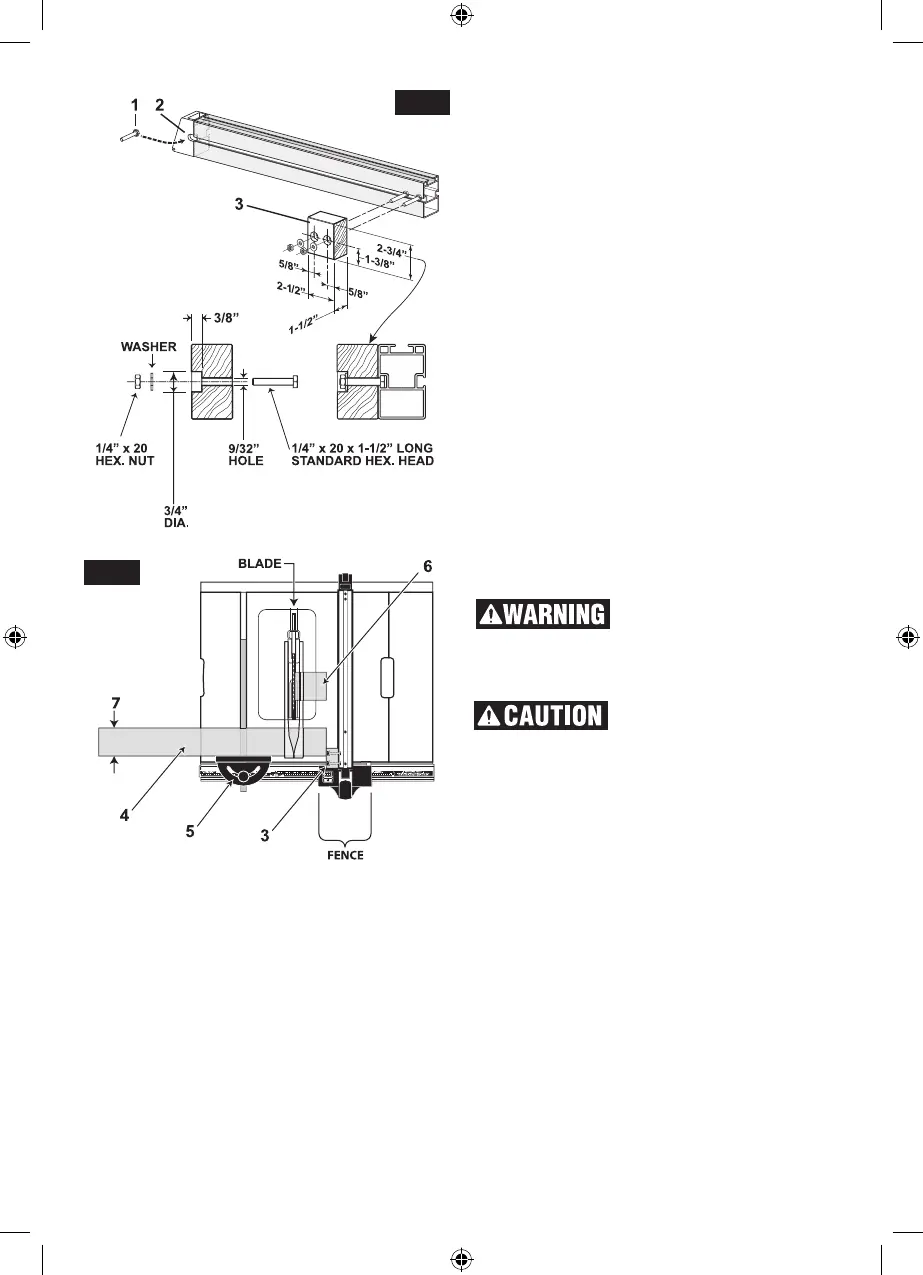
The facing block should be made of 1-1/2 inch
thick wood – Figure 54 shows dimensions to
make a facing block.
Parts Required:
• 1-1/2”thickwoodboardcuttosize(1)
• 1/4 x 20 x 1-1/2” long hex. head machine
screws (2)
• 1/4”Washers(2)
• 1/4x20machinenuts(2)
The facing block is made to the same height (2-
3/4”) as the fence and can work with the blade
guard system in place when cutoff pieces are
1-1/2 inches or greater. Cut the board to the size
shown, drill through 9/32” holes, then counter-
sink each hole (down 3/8 inch) using a 3/4 inch
drill bit.
ASSEMBLY:
- PRIMARY
1. Loosen and remove the four flat head screws
clamping the wear plate to the fence. Remove
the wear plate from the fence.
2. Place the hex. head 1 of each machine screw
into the recess 2 in the rear fence housing –
then slide each screw forward to the locations
shown.
3. Place facing block 3 over screws.
4. Place washers over screw threads.
5. Thread and tighten the nuts onto the screws.
- SECONDARY
1. Thread and tighten the ¼” x 20 Screws into the
wear plate nuts as shown.
Ensure the Facing Block is
clamped securely to the
fence. A loose Facing Block could cause the cut-
off piece to bind between the fence and the blade
causing kickback.
Be sure to replace wear
plate after guide block is no
longer needed.
MAKING THE REPETITIVE CROSSCUT
1. When making repetitive cuts, securely attach a
wood facing block to the fence as shown. The
T-slot in the rip fence allows for attachment -
see Figure 55.
2. Slide the fence (with the facing block) to a
position which gives you the length of board
that you want to repeat. Lock fence in position.
Note: If you are using the scale on the saws
front rail during the set-up, be sure move the
fence an additional 1-1/2 inches to compensate
for the thickness of the facing block.
3. Slide the work piece 4 along the miter gauge
5 until it touches the facing block 3. Hold work
piece securely.
4. Make a “Dry Run” (practice) – with the saw un-
plugged, move the miter gauge and work piece
along the facing block until it touches the idle
blade (blade is set 1/8 inch higher than work
Fig. 54
Fig. 55
1600A009XC 09-15.indb 33 9/14/15 1:51 PM









 To Next Page