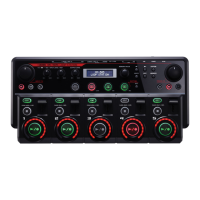
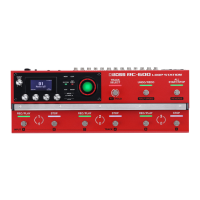
The BOSS RC-600 Loop Station is a versatile and powerful looping device designed for musicians to create, record, and manipulate audio phrases in real-time. It features six stereo tracks, allowing for complex multi-layered performances, and offers extensive control over recording, playback, and effects.
Function Description
The core function of the RC-600 is to record and play back audio loops, referred to as "phrases." Users can record on a single track or layer recordings across multiple tracks, building intricate arrangements. The device supports both "recording" (to an empty track) and "overdubbing" (adding new audio on top of an existing recording). Each track can be independently controlled for recording, playback, and overdubbing, offering flexibility in performance.
Beyond basic looping, the RC-600 integrates a comprehensive effects engine. "Input FX" can be applied to incoming audio before it's recorded, while "Track FX" can be applied to individual tracks during playback. There are 16 input/track FX slots organized into four banks with four types each, providing a wide array of sonic possibilities. These effects can be registered to buttons for quick access and real-time manipulation.
A built-in "Rhythm" function allows users to play various rhythm patterns, which can serve as a guide for recording or as an accompaniment during live performances. The tempo of the rhythm can be set manually or by tapping, and its volume, type, and start/stop behavior are customizable.
All settings for tracks, input/track FX, and rhythm are collectively stored as a "memory." The RC-600 can store up to 99 such memories, enabling users to recall different song arrangements or performance setups instantly. System-wide settings, such as display contrast, USB, and MIDI configurations, are also managed separately.
The device offers extensive control options. Nine footswitches on the unit's top panel are assignable to various functions, allowing for hands-free operation during performance. This "Pedal Mode" features three distinct modes, each with its own set of assignable functions, and these settings can be saved per memory. External footswitches and expression pedals can also be connected for additional control, and the RC-600 can send and receive MIDI messages, enabling synchronization with other MIDI devices and external control over its parameters.
Usage Features
Getting started with the RC-600 involves connecting instruments or microphones to its input jacks, adjusting input/output levels, and selecting a memory. The intuitive display shows essential information, including track status, loop position, and effect settings. Dedicated knobs allow for quick adjustments of parameters shown on the screen, and a "Lock" function prevents accidental changes during live use.
Recording a loop phrase is straightforward: select a track, press the REC/PLAY switch to start recording, play your instrument or sing, then press REC/PLAY again to stop recording and begin playback. Subsequent presses of REC/PLAY will initiate overdubbing, allowing for layering. The UNDO/REDO switch provides an essential safety net, allowing users to cancel or restore the last recording or overdub.
The RC-600's multi-track capabilities allow for complex arrangements. Users can record on track 1, then seamlessly move to track 2, 3, and so on, building up a full song structure. The "ALL START/STOP" switch provides a convenient way to control all tracks simultaneously.
Adjusting the tempo of the rhythm is done via the TAP TEMPO button, which can also be long-pressed to return to the default tempo. Input FX and Track FX are accessed through the LOOP menu, where users can select effects, switch banks, and adjust individual parameters. The ability to save these effect configurations within a memory is crucial for consistent performance.
Saving a memory is a critical step to preserve recorded phrases and settings. This is done by simultaneously pressing the EXIT and ENTER buttons, then selecting a memory slot. Similarly, memories can be cleared to free up space. The device also allows for editing various aspects of a memory, including track settings (playback level, pan, reverse playback, one-shot playback, start/stop modes, overdubbing method, and effect on/off), rhythm settings (genre, pattern, variation, kit, beat, and start/stop triggers), and input/track FX settings (effect type and parameters).
System settings offer further customization, including phantom power for microphones, EQ and dynamics for inputs and outputs, routing of audio, and MIDI configurations. The "ASSIGN" function is particularly powerful, allowing users to map various internal parameters to physical controls on the unit or external MIDI devices, creating highly personalized control schemes.
Maintenance Features
The RC-600 includes several features to ensure data integrity and device longevity. Users are advised to regularly back up their data to a computer via USB. This process involves connecting the RC-600 to a computer, accessing its internal drive, and copying the "ROLAND" folder. In case of data loss or corruption, this backup can be used to recover the device's memories. The manual explicitly warns that unsaved data will be lost if the power is turned off, emphasizing the importance of saving memories.
The "Factory Reset" function allows users to restore all settings to their default values, which can be useful for troubleshooting or starting fresh. This function offers options to reset only memories, only system settings, or both.
The device also provides a "Troubleshooting" section to address common issues such as no sound, insufficient volume, rhythm problems, or difficulties with memory switching or MIDI communication. This section guides users through checks like verifying connections, adjusting levels, confirming settings, and, if necessary, contacting a dealer for support. Error messages are listed with their meanings and suggested actions, helping users diagnose and resolve problems efficiently.
For physical maintenance, the manual advises using only the supplied AC adaptor and power cord, handling the ground terminal carefully, and turning off phantom power when connecting devices other than condenser microphones. It also recommends using only specified expression pedals to prevent malfunction or damage. These guidelines are crucial for safe and reliable operation of the RC-600.


 To Next Page

 General
 Weight and Dimensions