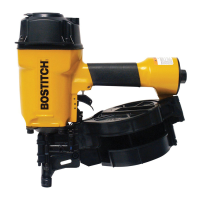
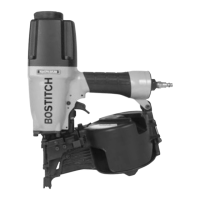
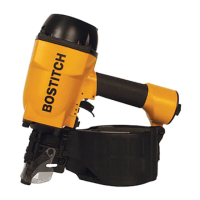
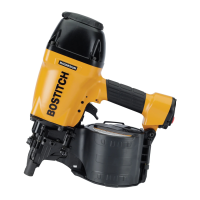
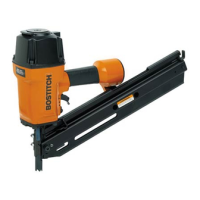
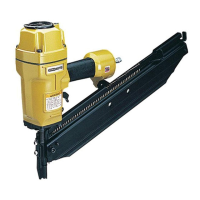
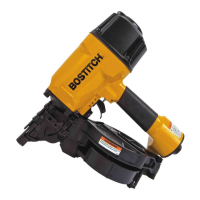
The provided manual describes the Stanley Bostitch N12B Series Coil-Fed Pneumatic Nailers, which are precision-built tools designed for high-speed, high-volume nailing, particularly for roofing applications. These nailers are engineered to deliver efficient and dependable service when used correctly and with care.
Function Description
The N12B Series nailers are pneumatic tools that operate using compressed air to drive fasteners. They are specifically designed for coil-fed nails, accommodating lengths from 7/8" to 1-3/4". The primary function is to rapidly and accurately drive nails for various applications, with a particular emphasis on roofing due to features like the adjustable shingle gauge. The tool's operation is based on a single-piston design, cycling through four stages: at rest, driving stroke, end of stroke, and returning.
Important Technical Specifications
- Model: N12B Series (N12B-1 for Contact Trip, N12B-1ST for Sequential Trip)
- Dimensions:
- Length: 10-5/8" (270mm)
- Height: 10" (250mm)
- Width: 4-3/8" (112mm)
- Weight: 6 lbs. (2.7 kg)
- Nail Compatibility:
- Accommodates 7/8" to 1-3/4" nails.
- Specific nail numbers: CR2DCGAL (7/8"), CR2DGAL (1"), CR3DGAL (1-1/4"), CR4DGAL (1-1/2"), CR5DGAL (1-3/4").
- Magazine capacity: 120 nails per coil.
- Air Supply:
- Fitting: 1/4 N.P.T. male plug with an inside diameter of .200" (5mm) or larger, capable of discharging tool air pressure when disconnected.
- Hoses: Minimum 150 p.s.i. (10.5 kg/cm²) working pressure rating or 150% of maximum system pressure. Must have quick-disconnect fittings.
- Regulator: Required, with an operating pressure range of 0-125 p.s.i.
- Operating Pressure: 70 to 100 p.s.i.g. (4.9 to 7.0 kg/cm²). Exceeding this range is not recommended.
- Air Consumption: 3.8 cubic feet per minute (c.f.m.) of free air at 100 nails per minute at 80 p.s.i.g.
- Filter: Required to provide clean, compressed air and prevent dirt/water from causing wear. Must have adequate flow capacity and be kept clean.
- Materials: Light alloy frame for ease of handling and good balance.
- Safety Features: Wide contact trip with carbide inserts to resist granule abrasion.
Usage Features
The N12B Series offers a choice between two primary operating systems:
-
Contact Trip Operation (N12B-1):
- Description: The tool contains a work contacting arm that operates in conjunction with the trigger.
- Single Fastener Placement: Position the nose on the work surface (finger off trigger), depress the contact trip, pull the trigger, then release the trigger.
- Rapid Fastener Operation: Pull the trigger with the tool off the work surface, then "tap" the nose against the work surface in a "bouncing" motion. Each depression of the contact trip drives a fastener.
- Identification: Black Trigger.
- Safety Note: Operators must not hold the trigger pulled on contact trip tools except during fastening operations to prevent accidental cycling if the trip contacts something or someone. Recoil can cause unwanted second fasteners if the trigger remains pulled and the tool recontacts the surface.
-
Sequential Trip Operation (N12B-1ST):
- Description: The tool contains a work contacting arm that operates in conjunction with the trigger.
- Single Fastener Placement (only method): Release the trigger, press the nose of the tool on the work surface, then pull the trigger. This sequence must be performed for each fastener.
- Identification: Silver Trigger.
- Safety Advantage: Provides a positive safety advantage as it will not accidentally drive a fastener if the nose unintentionally recontacts the work surface or anything else while the operator is holding the trigger pulled. This makes accurate fastener placement easier and prevents second fasteners on recoil.
General Usage Features:
- Loading: Fast, easy reloading with 120 nails per coil. The magazine and driving channel open completely.
- Nail Support Adjustment: An adjustable nail platform allows for three settings based on nail length:
- Bottom step: 1-3/4" (45 mm) nails
- Middle step: 1-1/4", 1-1/2" (32, 38 mm) nails
- Top step: 7/8", 1" (22, 25 mm) nails
- Nails are placed over the post, uncoiled to reach the feed pawl, with the first nail in front of the front tooth in the driver channel and nail heads in the nose slot.
- Shingle Gauge: An adjustable gauge is included for quick, accurate shingle placement, controlled by loosening two screws to set the desired exposure.
- Ergonomics: Light alloy frame contributes to ease of handling and good balance.
Maintenance Features
- Lubrication:
- Frequent, but not excessive, lubrication is required.
- Use STANLEY-BOSTITCH Air Tool Lubricant, Mobil Velocite #10, or equivalent.
- Add a few drops of oil through the air fitting once or twice a day if no airline lubricator is used.
- Avoid detergent oil or additives as they accelerate wear to seals and bumpers.
- Cold Weather Operation:
- For temperatures near or below freezing, use STANLEY-BOSTITCH WINTER FORMULA air tool lubricant or permanent antifreeze (ethylene glycol) to prevent moisture from freezing in the air line.
- Caution: Do not store tools in a cold weather environment to prevent frost or ice formation on operating valves and mechanisms.
- Note: Some commercial air line drying liquids are harmful to O-rings and seals; check compatibility before use.
- Cleaning (Roofing Nailer Specific):
- Tar and dirt buildup on the nose and trip lever can prevent correct operation.
- Remove buildup with kerosene, #2 fuel oil, or diesel fuel.
- Warning: Do not use gasoline or other highly flammable liquids due to explosion risk from sparks.
- Do not dunk the nailer beyond the height of the nail heads to avoid solvent entering the drive cylinder.
- Dry the nailer thoroughly after cleaning. An oil film left after cleanup will accelerate tar buildup.
- Note: Solvents sprayed on the nose may soften tar on shingles and accelerate tar buildup; dry operation is preferred.
- Replacement Parts: STAN-TECH replacement parts are recommended to ensure equivalent performance to original equipment.
- Assembly Procedure for Seals: When repairing, ensure internal parts are clean and lubricated. Use Parker "O"-LUBE or equivalent on all O-rings and moving surfaces.
- Air Supply Maintenance: Ensure the air supply system is free of restrictions (undersize fittings, hoses, dirt, water) to maintain adequate air volume and pressure, which is crucial for preventing slow operation, misfeeds, or reduced driving power.
- Troubleshooting Guide: A comprehensive table is provided to diagnose common problems (e.g., air leaks, failure to cycle, lack of power, skipping fasteners, jams) and offers corresponding corrections.
- Tool Maintenance/Service Record: A dedicated section is included for users to log maintenance and service activities.
General Safety and Handling:
- Eye Protection: ALWAYS wear ANSI Z87.1-1979 compliant eye protection (frontal and side shields) when loading, operating, or servicing the tool.
- Ear Protection: May be required in high-noise environments.
- Air Supply Warnings: Never use oxygen, combustible gases, or bottled gases as a power source; never exceed 200 P.S.I.G. supply pressure.
- Loading Warnings: Never place hands in the fastener discharge area, point the tool at anyone, or pull the trigger/depress the trip during loading.
- Operation Warnings: Handle with care, avoid horseplay, keep others at a safe distance, do not drive fasteners on top of others.
- Tool Integrity: Do not alter or modify the tool without approval. Do not clamp or tape the trigger or contact trip. Do not operate if the warning label is illegible.
- Malfunction: Discontinue use if the tool leaks air or does not function properly, and contact a Stanley-Bostitch representative.
The manual emphasizes that Stanley-Bostitch cannot assume responsibility for product performance if tools are used with fasteners or accessories not meeting the specific requirements for genuine Stanley-Bostitch products.

 Need help?

 To Next Page
 General