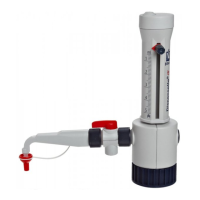
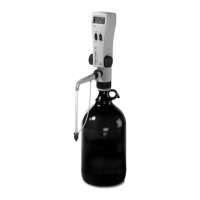
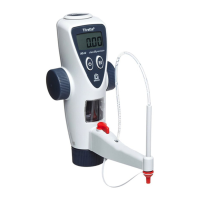
The document provided is an operating manual for the Titrette® bottle-top burette, specifically focusing on its software (version 4.01) and its functionality for transmitting titration data to a PC.
Function Description
The Titrette® bottle-top burette is designed for precise liquid dispensing, and this manual details how its titration data can be transmitted to a personal computer. The primary function of the associated software is to facilitate this data transfer, allowing users to record and manage titration results digitally. The data can be transmitted either immediately after a titration or at a later time, and it can be integrated into spreadsheet programs like Microsoft Excel.
The system supports connecting multiple Titrette® instruments to a single PC, provided there are enough available RS 232-ports. For PCs with USB interfaces, a standard USB/RS 232-adapter is required. The communication protocol (RS 232) is open, meaning that for customized applications and databases, the serial data string can be directly converted and read out from protocol files (.ptk-files), which are uncoded clear text (ASCII) files. This flexibility allows for integration into various data management systems beyond simple spreadsheets.
The software also includes features for managing instrument identification data such as serial number, nominal capacity, adjustment value (CAL), and next calibration date. This information is stored and can be transferred alongside the titration volumes, providing a comprehensive record for each measurement.
Usage Features
The Titrette® software is designed for user-friendly operation, starting with a straightforward installation process on Windows 7 (Service Pack 1) or higher. Users need appropriate authorization for installation and writing rights for necessary files. If a previous version of the software is installed, it must be uninstalled first, though log files are retained.
Connecting the Titrette® to the PC involves plugging the supplied RS 232 cable into the instrument's locking socket and then to the PC's COM-port or a USB/RS 232 adapter. The instrument's LCD will display a computer connection symbol once successfully connected.
Upon starting the program, the "BRAND – Instrument Window" opens, along with a minimized "BRAND – Instrument Manager." The "Instrument Window" allows users to control communication, view instrument data and settings, and select the appropriate COM-port. The "Instrument Manager" is crucial for environments with multiple instruments, enabling users to add, remove, and open individual instrument windows. Tool tips are available to explain button functions, which can be toggled off in "expert mode."
Titration data transmission is initiated by a double-click on the instrument's CLEAR key after a titration, or by clicking the "Transmit Data" button in the "Instrument Window." The transmitted data, including volume, date, time, serial number, size, CAL, and GLP information, is then listed in the "Data Logging" tab and saved to a chosen log file (e.g., .ptk file). Users can select existing log files or create new ones. The software allows for displaying all data or only new data, providing flexibility in data review.
For integration into target applications like Excel, the "Target Application" tab allows users to select the application and file. Data can be transmitted "online" directly from the instrument or later from the "Data Logging" tab. Users can customize the line format (e.g., Windows® Standard) and select additional parameters to be transmitted, such as date, time, serial number, size, CAL, and GLP. Column headers can also be sent to the target application to organize the data effectively. The software ensures that if instrument data (like "Transferred Data" and "Stored Data") do not match upon reconnection, the differing field is highlighted with a red background, alerting the user to potential discrepancies.
Maintenance Features
While the manual primarily focuses on software operation and data transmission, it implicitly touches upon maintenance through its data logging and calibration features. The ability to record the "Adjustment Value (CAL)" and "Next Calibration" date for each instrument is a key maintenance-related feature. This ensures that users can track when their Titrette® instruments were last calibrated and when the next calibration is due, which is critical for maintaining measurement accuracy and compliance with quality standards.
The software's capacity to store and display this calibration data alongside titration results provides a comprehensive audit trail for instrument performance. By transmitting this information to a PC, users can easily manage calibration schedules and ensure that instruments are always operating within specified precision limits. The "Alarm at data deviation" feature also serves as a maintenance alert, signaling if there are inconsistencies in the instrument's stored data versus transferred data, which could indicate a need for inspection or recalibration.
The retention of log files even after uninstalling previous software versions also highlights a focus on data integrity and long-term record-keeping, which is essential for laboratory and quality assurance processes. This ensures that valuable historical data is not lost during software updates or reinstallation.


 To Next Page

 General