Operation & Installation Manual RFS1 V2
MA365 Rev 3
8 of 46
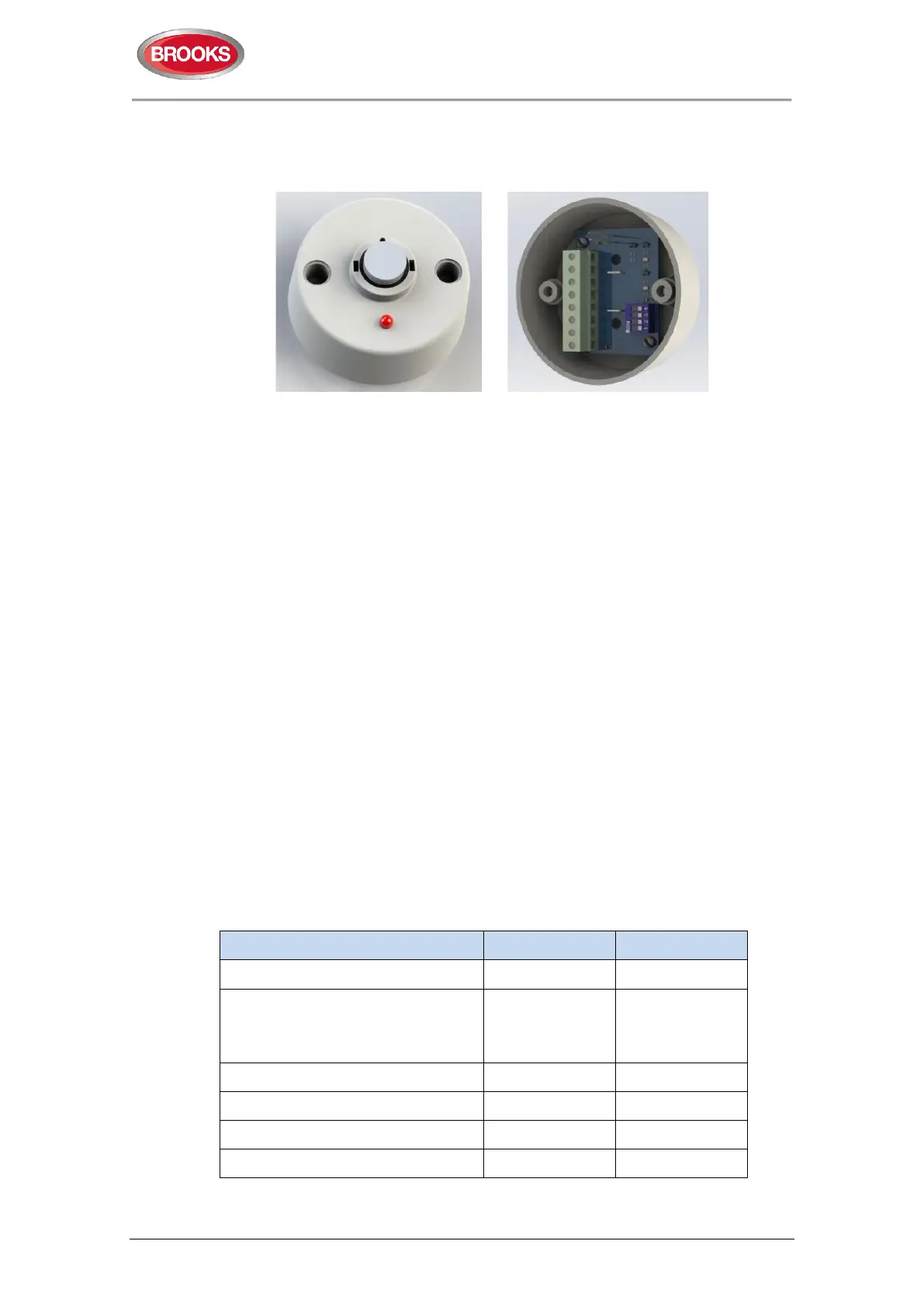
2.2 Roof Space Heat Detectors
2.2.1 Overview
Figure 1 Roof Space Heat Detectors
Standard Smoke or Heat Alarms are not suitable for residential roof space
applications where fire may occur.
Brooks has developed a solution to protect residential roof space when a residential
fire panel is used. The heat detector utilises a bi-metallic heat switches to detect
temperature rise in the roof space.
When the temperature in the roof space reaches the set point of the bi-metallic
switch, the contact of the switch will close and connects approximately 12V (with a
diode forward voltage drop) to the interconnect which activates all Smoke or Heat
Alarms within RFS1. Roof space detectors available for 60⁰ C or 80⁰ C applications.
2.2.2 Features
• Minimum current draw, refer to Table 1 below.
• Up to 10 of HS60V2 or HS80V2 can be connected to RFS1 V2.
• Minimise false alarms.
• Suitable for harsh environment e.g. roof spaces, garages, etc.
• Built-in alarm LED indication
• Support Remote Indicator Light (RIL), with selectable “Latching” and “Non-
Latching” mode
2.2.3 Specifications
Table 1 Roof space heat detectors
Function HS60V2 HS80V2
Temperature 60°C ±5°C 80°C ±5°C
Current Consumption(@12.8V)
Quiescent
Alarm (without RIL)
0.1 uA
6.7 mA
0.1 uA
6.7 mA
Nominal Voltage 12 V 12 V
No. of units per zone 10 10
Dot Colour Blue Red
Size 73mm diameter 73mm diameter



 To Next Page