Factors that can influence the measurement:
• Not enough sample material available
• Sample not homogenious or representative
• Humidity of sample material
• Temperature of sample material
• Sample cup inadeqate (e.g. cup material and thickness, blind spots, dirt etc.)
NOTE
• The samples should either be measured at a constant temperature or the temperature influences
must be considered during calibration.
• Coarse grained samples should be milled before carrying out the measurement. Recommended
number of scans: Qualitative calibration: 4−16; quantitative calibration: 16−32;
granules: 64.
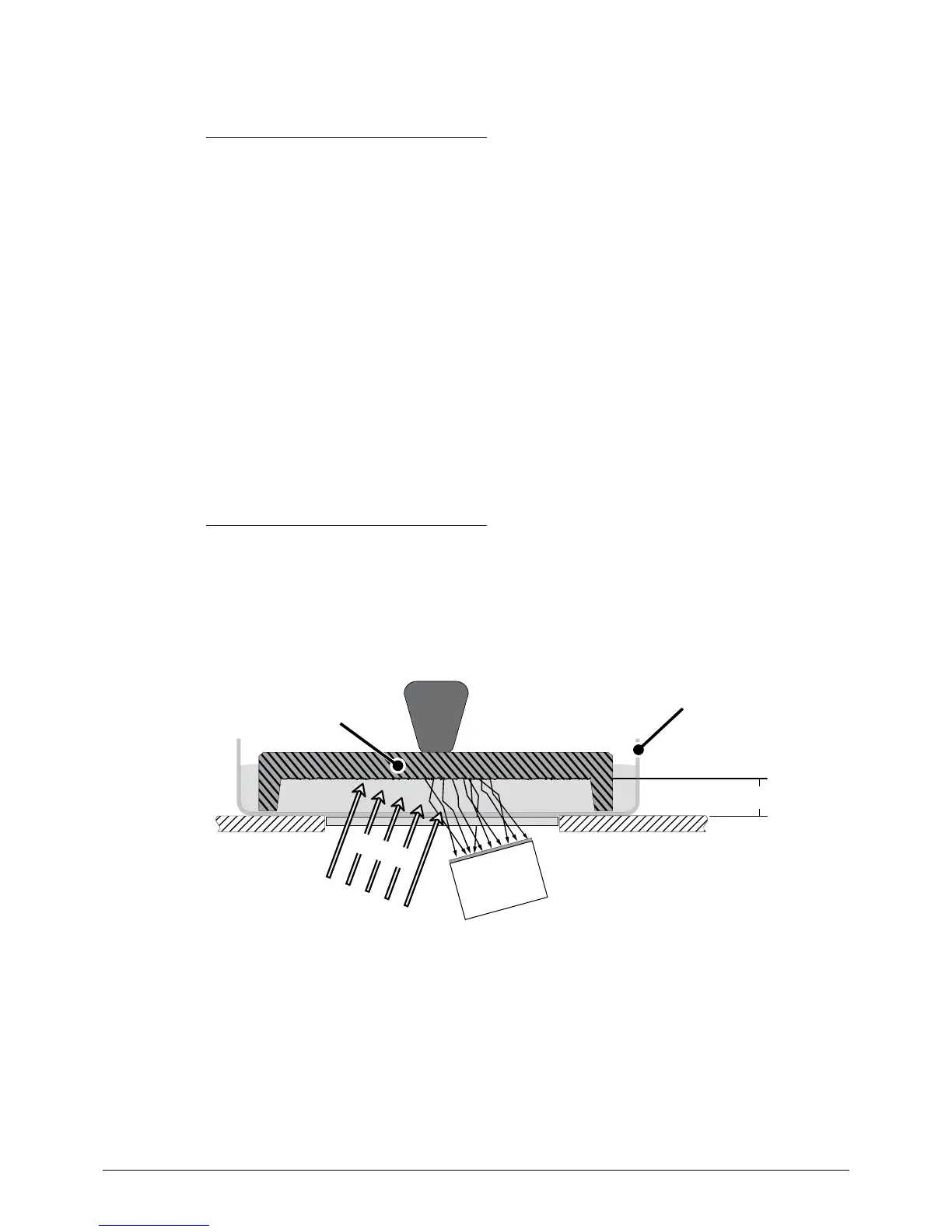
4.2.2 Transflectance mode
Translucent and opaque liquids can be analyzed via transflectance mode. The light penetrates the
liquid, is diffusely reflected by the reference plate and passes the sample a second time. The trans-
flected rays contain the spectral information of the sample.
Factors that can influence the measurement:
• Not enough sample material available
• Air bubbles in the measurement path and under the transflectance cover
• Sample not homogenious or representative
• Temperature of sample material
• Sample cup or transflectance cover inadequate (e.g. cup material and thickness, blind spots, dirt
etc.)
Diffuse reflecting / reference plate
Small, defined gap for liquid samples
Sensor
NIR light
Sample cup / petri dish
NOTE
• The samples should either be measured at a constant temperature or the temperature influences
must be considered during calibration.
• Recommended number of scans: Qualitative calibration: 4−16; quantitative calibration: 16−32
• Most liquid sample materials can be constantly analyzed with the help of a flow-cell adapter.



 To Next Page