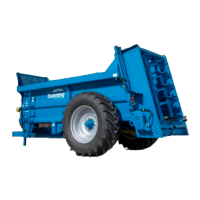
LOWLANDER HD MK2 & WIDEBODY MANURE SPREADER – INSTRUCTION & SPARES MANUAL
Page 77
6.3.4 TWO-LINE SYSTEM – OPERATION
The air enters the trailer via the red susie (2) and passes through a filter (6). The filter is designed to trap particles of
dirt, to stop them entering other valves further down the line. It is not designed to stop water entering the trailer’s
system, as this function is part of the tractor’s braking system when fitted with an air dryer. From time to time it is
worthwhile dismantling each filter and cleaning out any debris that has been caught.
The air then passes through a shunt valve (7), which is mounted
on the side of the trailer, and the air pressure pushes out its
button. This button can be pushed in to release the trailer’s
brakes, when a tractor with air braking is not available. The button
can be pulled out again, to re-apply the brakes, or it will
automatically be reset after the red susie is reconnected to a
tractor with air braking.
The air travels into the combined RELSV (9) at port 1, before exiting
at port 1-2 to feed the air tank (8). The tank is linked back to the
shunt valve, and this link is used to “fool” the RELSV into thinking
the red susie has been reconnected, after the shunt button is
pushed in.
The tank then charges up with air until it reaches the system
pressure set by the tractor. This is normally between 6.5 bar and 8.5
bar, and this pressure is also present at port 1 of the ABS modulator
valve (10).
NOTE: Any pipe shown as red in Figure 1 (and the black pipe
between the tank and ABS) will be pressurized all of the time the
tractor is connected and charged up. None of these pipes should be
removed, for diagnostic or repair purposes, until the tractor has
been disconnected from the trailer and all the air drained from the
trailer’s air tanks.
Draining is achieved using a drain valve which is found at the bottom of each air tank. Draining should be done
periodically to remove any water that has condensed in the air tanks. Failure to drain the tanks will lead to a reduction
in the available air capacity of the tanks, affecting the brake performance, and this water may also freeze in the
winter, causing other problems.
During service braking, a control pressure is sent to the trailer down the yellow susie (1). This pressure is determined
by how hard the driver presses the brake pedal, and the pressure may be anything up to the maximum pressure in the
tractor’s system. However, under normal braking (known as check braking) this control pressure is often around 2 bar.
The control pressure enters the trailer and passes through the yellow line filter, before reaching the RELSV at port 4.



 To Next Page