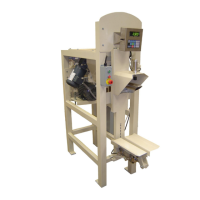
230 Series Auger Packer
9 OF 115
ELECTRICAL NOISE CONSIDERATIONS
A major consideration in the installation of a successful system is the problem created by electrical noise.
The following paragraphs provide information to help the user avoid electrical noise problems. Though
many potential problems are presented, few, if any, will be encountered in an actual application using a
suitably installed PLC system, even in a relatively harsh industrial noise environment.
BACKGROUND NOISE
Electrical noise is defined as any unwanted electrical signal which enters the control equipment. Noise
signals cover the entire spectrum of frequencies and may have any wave shape. The largest single
difficulty with noise is that it is not always present. Continuous, or frequent, periodic noises are generally
easy to detect and accommodate. Intermittent noise sources that produce short, high energy bursts at
irregular and widely spaced intervals cause the majority of problems. Noise has a number of different
pathways into the control equipment. It can be conducted through signal or power wiring or it can be
radiated by electromagnetic waves. Conducted noise is typically coupled into the signal or power wiring
either electro-statically or magnetically. Electrostatic coupling occurs through parasitic capacitance
between the noisy line and the signal/power line. This typically would be the case for long wire runs in
the same conduit. Magnetic coupling occurs through parasitic mutual inductances between lines. This
requires high currents or high currents or high rate of change of current as well as significant mutual
inductance, which may result from proximity or wiring. Electromagnetically radiated noise is typically
high frequency (radio waves). The control system and its wiring may act as antennas in picking up noise
signals. This pathway is least likely to present problem levels of noise to a PLC, and its sources are rare
industrial applications. The dominate sources of noise in industry are those devises (and their wiring)
that produce and switch high voltages and currents. Typical examples include large motors, welders, and
contactors that switch heavily inductive loads such as brakes or clutches. Other examples of noise
sources are Triac/SCR motor control and power invertors.
EFFECTS OF ELECTRICAL NOISE
The predominant effect of noise on the system is to cause “soft” failures; that is, failures which do not
damage the system but do cause it to function improperly.
Three main types of soft failures are encountered:
Logic memory alteration.
Register alteration.
Momentary I/O failure.
Logic memory alteration presents the most significant potential problem in that it may, in some cases,
result in improper machine operation. Both register and momentary I/O failures normally result only in
nuisance failures such as operation in the wrong mode, machine glitches or incorrect/non-existent error
messages.


 To Next Page