HI-PE multi-zone --- Rev. FI 050 GB 60K10 v2_1
5
I - DESCRIPTION
Operating Principle
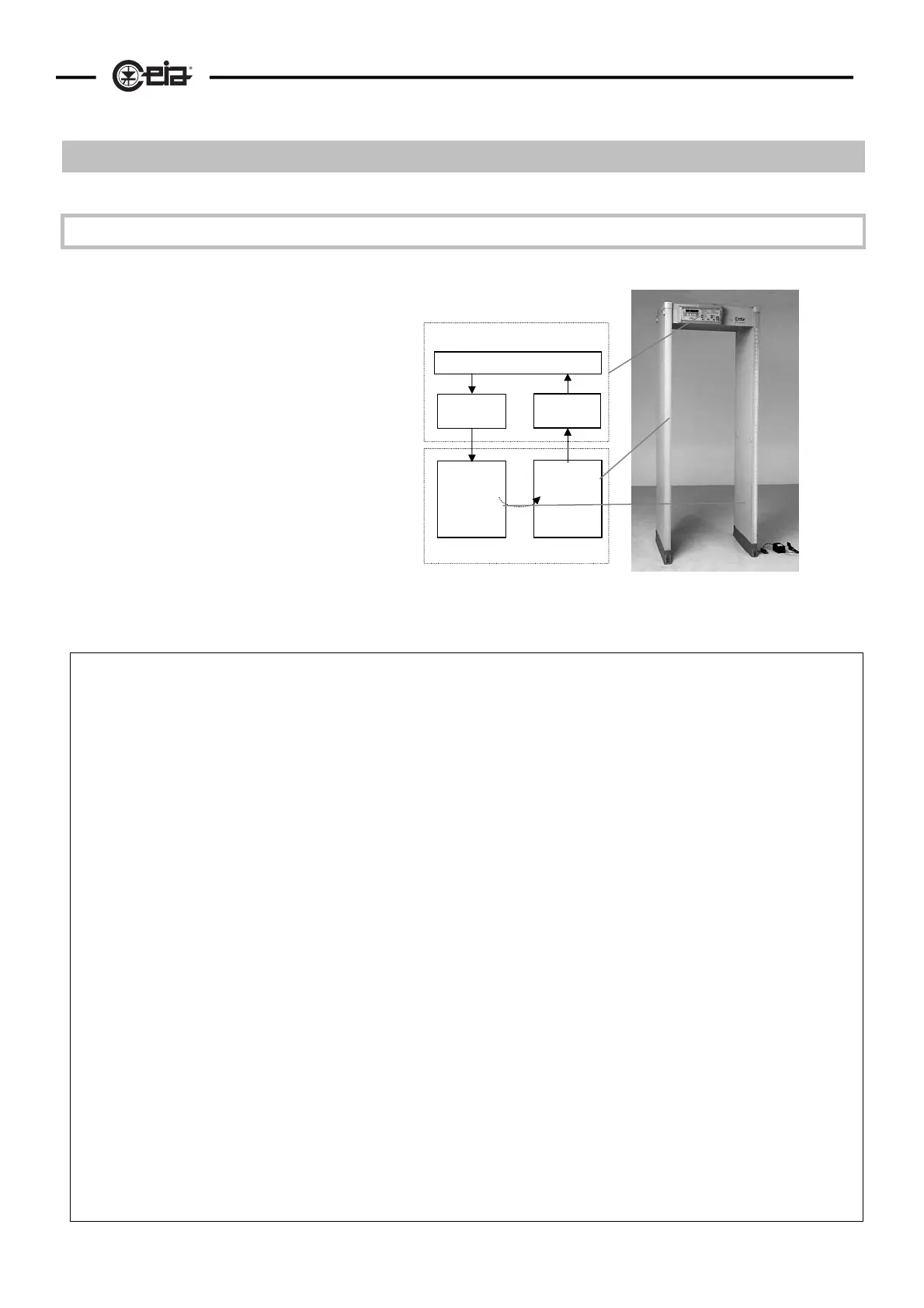
In general, a modern Metal Detector for checking people in transit comprises:
• An electronics unit, made up of:
• a variable magnetic field
generator
• a receiver
• a processing and control unit,
which determines if the variation
of the received signal is due to
metal masses in transit of a
certain shape, volume or
composition
• a transceiver antenna in the
form of an archway
Field
Generator
Receiver
Processing and Control Unit
Transmitter
Antenna
Receiver
Antenna
Antenna
Electronics unit
Fig. I-1: general block diagram of a metal detector
SOME HELPFUL GUIDELINES FOR METAL DETECTORS
The parameters which best characterise a Metal Detector are as
follows
• Discrimination: This parameter reflects the variation in
sensitivity between potentially dangerous metal objects (due to
their particular shape compared with their volume) and personal
effects (such as coins, keys, watches, buckles, etc...). When a
detector with low discrimination is used, personal effects can
cause a large number of false alarms, rendering the system
ineffective in practical terms.
• Uniformity in detection efficiency: This parameter is closely
connected with the linearity of the magnetic field generated
inside the Metal Detector. Generally speaking, the greater the
uniformity, the better the discrimination.
• Sensitivity: alarm activation threshold: the greater the
sensitivity, the smaller the metal mass which will cause an
alarm.
• Interception speed: the transit speed of a person through the
metal detector archway usually depends on situational factors,
and can vary considerably. The sensitivity of a good Metal
Detector should be independent of the speed of transit.
• Programming: C.E.I.A. have designed their Metal Detectors to
include the possibility of selecting the settings of the operational
parameters: this predisposition facilitates both the installation of
the device (rejection of external sources of interference) and
adaptation to the user’s requirements (orientation towards
ferromagnetic and/or non-magnetic metals). This feature is
particularly important in the detection of weapons made of light
metal.
• Immunity to interference: environmental electromagnetic
interference of mechanical or electrical origin is the principal
cause of false alarms, because it augments the effective signal
of the mass to be detected. Particular attention must therefore
be paid to the Metal Detector’s immunity to this type of
interference.
• Harmlessness to life support systems and storage media: the
field emitted by the Metal Detector should be below the values
set by international standards which guarantee harmlessness
to life support systems such as pace-makers, adrenaline
pumps etc. Observance of these limits also means that there
is no effect whatsoever on computer-type storage media.
• Synchronisation: multiple installations of Metal Detectors are
very common (just think of an airport departure terminal). To
allow several Metal Detectors to operate in a restricted area
without influencing each other, it must be possible to
synchronise them without the help of cable connections.
• Power supply flexibility: wide tolerance range for the input
voltage and emergency batteries which cut in automatically
ensure that the Metal Detector continues operating in the case
of variations or cuts in the mains supply.
• Set-up and calibration with respect to the reference sample: a
modern Metal Detector must allow its installation in whatever
environment, without any interference caused by other
external devices. The security level may usually be adjusted
acting on sensitivity: CEIA’s Metal Detectors are also provided
with a special command (IS) allowing the direct selection of
the functioning parameters which determine a security level
conforming to the International Standards.
• Maintenance: a modern Metal Detector generally incorporates
a self-diagnosis system which identifies any sabotage and
which also signals accidental faults. Modular construction
furthermore allows the faulty parts to be replaced quickly and
easily, thereby minimising the time the device is out of
operation.



 To Next Page