IMPORTANT
The same Pass list or Block list must be applied to all
transceiver units that are part of a defined network.
Failure to use the same Pass list or Block list may cause units
to incorrectly receive, or be incorrectly excluded from, network
traffic.
If a Pass list or Block list is applied to a network, the list must be created
as a *.CSV file before being uploaded to each unit in the network. This
procedure is described below.
To create a Pass list or Block list, do the following steps:
1. Create a *.CSV file. Open the file for editing.
2. Enter the Pass list or Block list into the *.CSV file. Use the
following syntax rules to create the list:
• A Pass list and Block list are mutually exclusive. Pass lists
and Block lists are always separate lists, and are never
combined.
• A Pass list is always expressed in the form of
<source>,<destination>,<routing priority>,
where <source> is the unique unit ID number of the
sending unit, <destination> is the unique unit ID number of
the receiving unit, and <routing priority> is a natural
number with a minimum value of 0 and a maximum value
of 3.
IMPORTANT
Source
and destination values are always unit
ID numbers. Do not enter a unit's IP address
as a source or destination value.
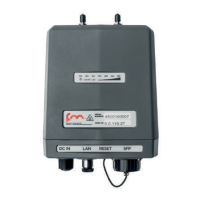
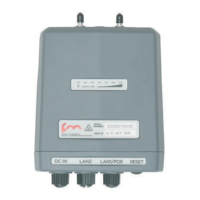
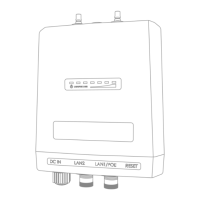
The unit ID number is printed on the
identification label of each unit. This number
always takes the following form: 5.a.b.c
• The smaller the routing priority value, the greater the
routing priority.
• Block list syntax is the same as shown above, except for
one additional rule: Block lists do not include routing
priority numbers.
• Unit ID numbers and routing priority values are always
separated with commas (,) and never with spaces.
• To make sure that the packet flow is allowed or blocked in
both directions, the unit ID numbers for each link in a Pass
list or Block list must be listed in forward order and in
reverse order.
Device configuration using the configurator interface
© 2021 Cisco and/or its affiliates. All rights reserved. Page 98 of 175



 To Next Page