EasyManua.ls Logo

Clark NPR17 - Page 100

Clark NPR17
110 pages
Print Icon
To Next Page IconTo Next Page
To Previous Page IconTo Previous Page
Loading...
Battery
Handling
1
Change (remove)
or
service storage batteries only
in an
area
designated
for
this purpose.
2.
Be
sure this area
has
provisions
to
flush
and
neutralize spillage,
to
ventilate fumes
from
gassing batteries,
and for
fire protection.
3.
This area
should
be
equipped with
material-handling
tools
de-
signed
for
removing
and
replacing batteries,
including
a
conveyor
or
overhead hoist.
Use
lift hooks that have
safety
latches.
4.
Always
use a
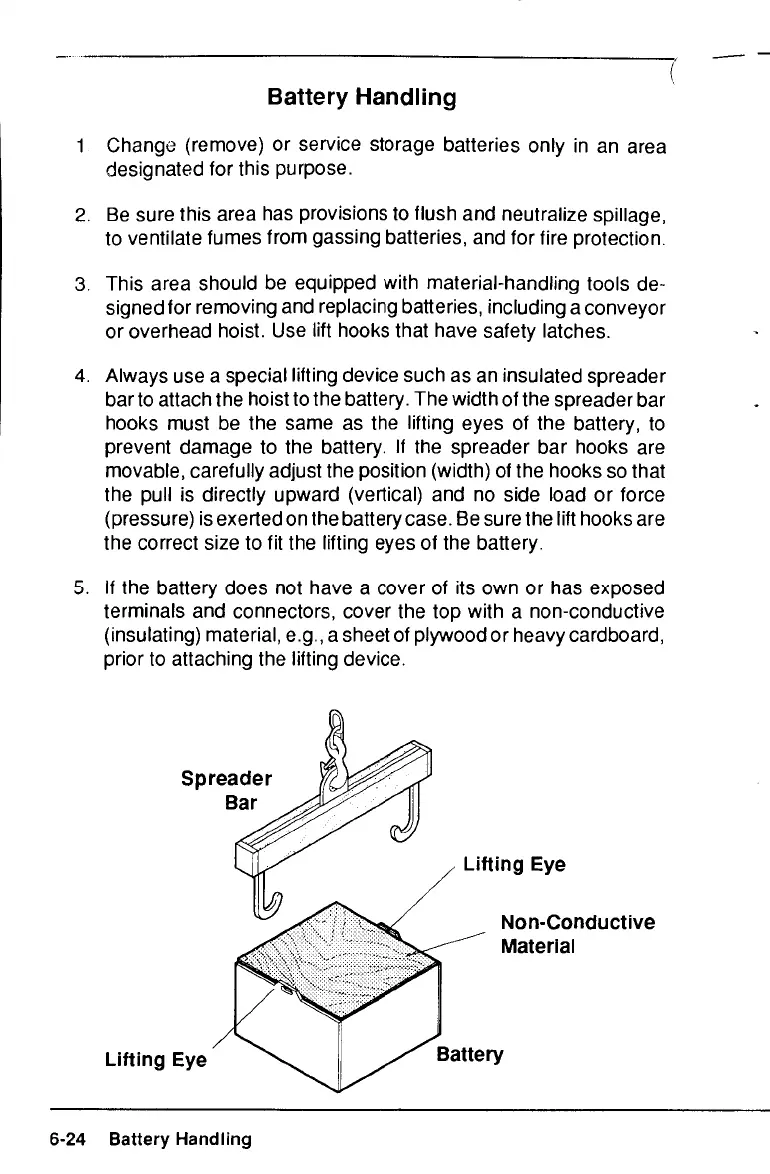
special lifting device such
as an
insulated spreader
bar to
attach
the
hoist
to the
battery.
The
width
of the
spreader
bar
hooks must
be the
same
as the
lifting eyes
of the
battery,
to
prevent damage
to the
battery.
If the
spreader
bar
hooks
are
movable, carefully adjust
the
position (width)
of the
hooks
so
that
the
pull
is
directly upward (vertical)
and no
side load
or
force
(pressure)
is
exerted
on the
battery case.
Be
sure
the
lift hooks
are
the
correct
size
to fit the
lifting
eyes
of the
battery.
5. If the
battery does
not
have
a
cover
of its own or has
exposed
terminals
and
connectors,
cover
the top
with
a
non-conductive
(insulating) material,
e.g.,
a
sheet
of
plywood
or
heavy cardboard,
prior
to
attaching
the
lifting device.
Spreader
Bar
Lifting
Eye
Lifting
Eye
Non-Conductive
Material
Battery
6-24 Battery
Handling

Related product manuals