750-166 1-9
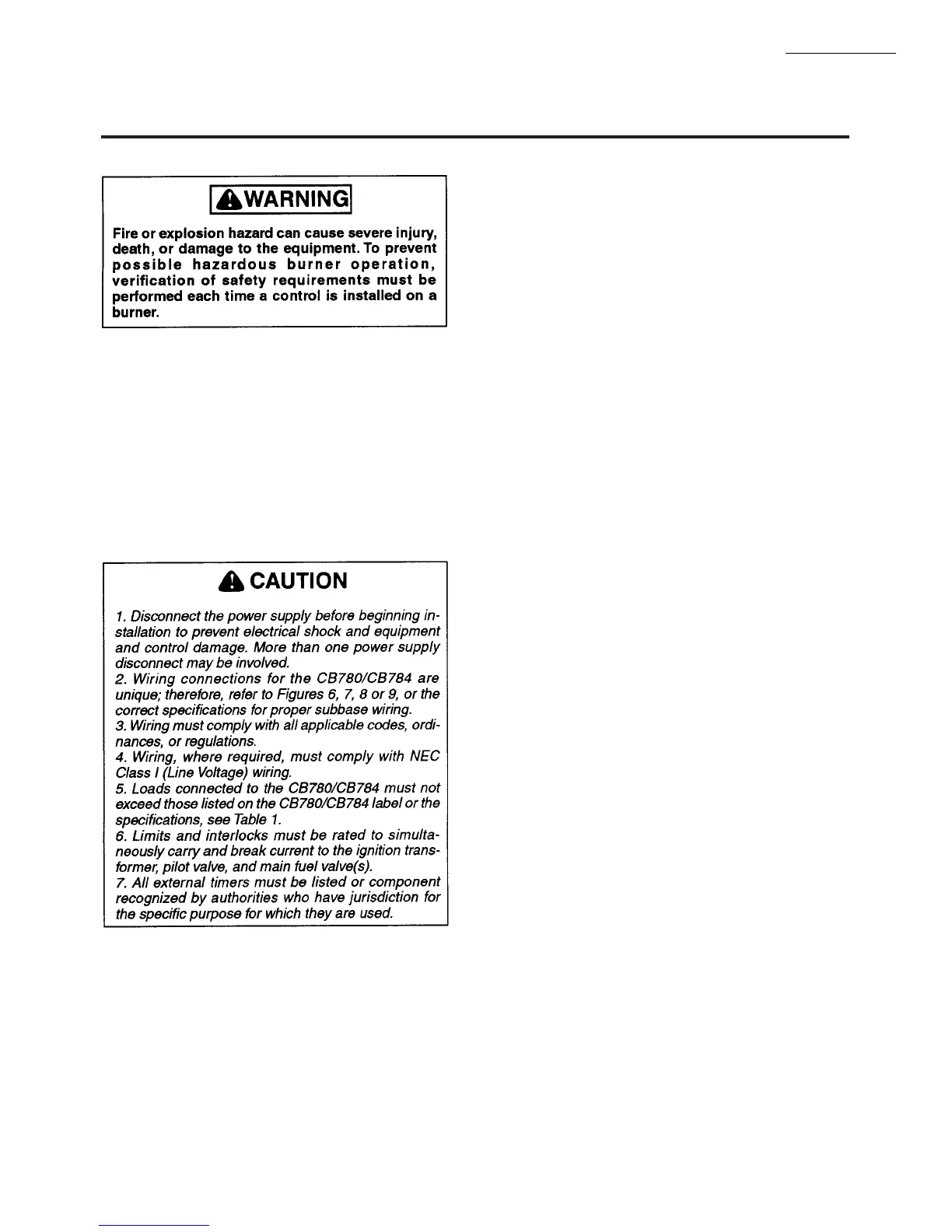
WARNING
FIRE OR EXPLOSION HAZARD
CAN CAUSE PROPERTY DAMAGE,
SEVERE INJURY, OR DEATH.
To prevent possible hazardous burner operation,
verification of safety requirememts must be per-
formed each time a control is installed on a burner.
WHEN INSTALLING THIS PRODUCT…
1. Read these instructions carefully. Failure to follow
them could damage the product or cause a hazardous
condition.
2. Check the ratings given in the instructions and
marked on the product to make sure the product is suitable
for the application.
3. Installer must be a trained, experienced, flame safe-
guard service technician.
4. After installation is complete, check out the product
operation as provided in these instructions.
CAUTION
1. Disconnect the power supply before beginning
installation to prevent electrical shock, equip-
ment and control damage. More than one power
supply disconnect may be involved.
2. Wiring connections for the CB780/CB784 are
unique; therefore, refer to Figs. 6, 7, 8 or 9 or
the correct Specifications for proper subbase
wiring.
3. Wiring must comply with all applicable codes,
ordinances and regulations.
4. Wiring, where required, must comply with NEC
Class 1 (Line Voltage) wiring.
5. Loads connected to the CB780/CB784 must not
exceed those listed on the CB780/CB784 label
or the Specifications, see Table 1.
6. Limits and interlocks must be rated to simulta-
neously carry and break current to the ignition
transformer, pilot valve, and main fuel valve(s).
7. All external timers must be listed or component
recognized by authorities who have jurisdiction
for the specific purpose for which they are used.
IMPORTANT:
1. For on-off gas-fired systems, some authorities who
have jurisdiction prohibit the wiring of any limit or
operating contacts in series between the flame safe-
guard control and the main fuel valve(s).
2. Two Flame Detectors can be connected in parallel with
the exception of Infrared Flame Detector (817-1742).
CB780/CB784
INSTALLATION
Installation
3. This equipment generates, uses and can radiate radio
frequency energy and, if not installed and used in
accordance with the instructions, may cause interfer-
ence to radio communications. It has been tested and
found to comply with the limits for a Class B comput-
ing device of Part 15 of FCC rules which are designed
to provide reasonable protection against such inter-
ference when operated in a commercial environment.
Operation of this equipment in a residential area may
cause interference; in which case, the users at their
own expense may be required to take whatever mea-
sures are required to correct this interference.
4. This digital apparatus does not exceed the Class B
limits for radio noise for digital apparatus set out in
the Radio Interference Regulations of the Canadian
Department of Communications.
HUMIDITY
Install the CB780/CB784 where the relative humidity
never reaches the saturation point. The CB780/CB784 is
designed to operate in a maximum 85% RH continuous,
noncondensing, moisture environment. Condensing mois-
ture may cause a safety shutdown.
VIBRATION
Do not install the CB780/CB784 where it could be sub-
jected to vibration in excess of 0.5G continuous maximum
vibration.
WEATHER
The CB780/CB784 is not designed to be weather tight. If
installed outdoors, the CB780/CB784 must be protected by
an approved weather-tight enclosure.
MOUNTING WIRING SUBBASE
NOTE: For installation dimensions, see Fig. 1.
1. Mount the subbase in any position except horizontally
with the bifurcated contacts pointing down. The standard
vertical position is recommended. Any other position de-
creases the maximum ambient temperature rating.
2. The 833-2725 Wiring Subbase can be mounted di-
rectly in the control cabinet. Be sure to allow adequate clear-
ance for servicing, installation, access or removal of the
CB780/CB784, Expanded Annunciator, Keyboard Dis-
play Module, flame amplifier, flame amplifier signal voltage
probes, Run/Test Switch, electrical signal voltage probes
and electrical field connections.
3. For surface mounting, use the back of the subbase as a
template to mark the four screw locations. Drill the pilot
holes.
4. Securely mount the subbase using four no. 6 screws.


 To Next Page