750-166 2-7
LOCKOUT MESSAGES (TABLE 4)
When the CB780/CB784 is locked out, it displays a
repeating cycle of messages (in English text); see Table 4.
In addition to the lockout messages, Table 4 provides the
system failure and recommended troubleshooting. There
are four states in the cycle:
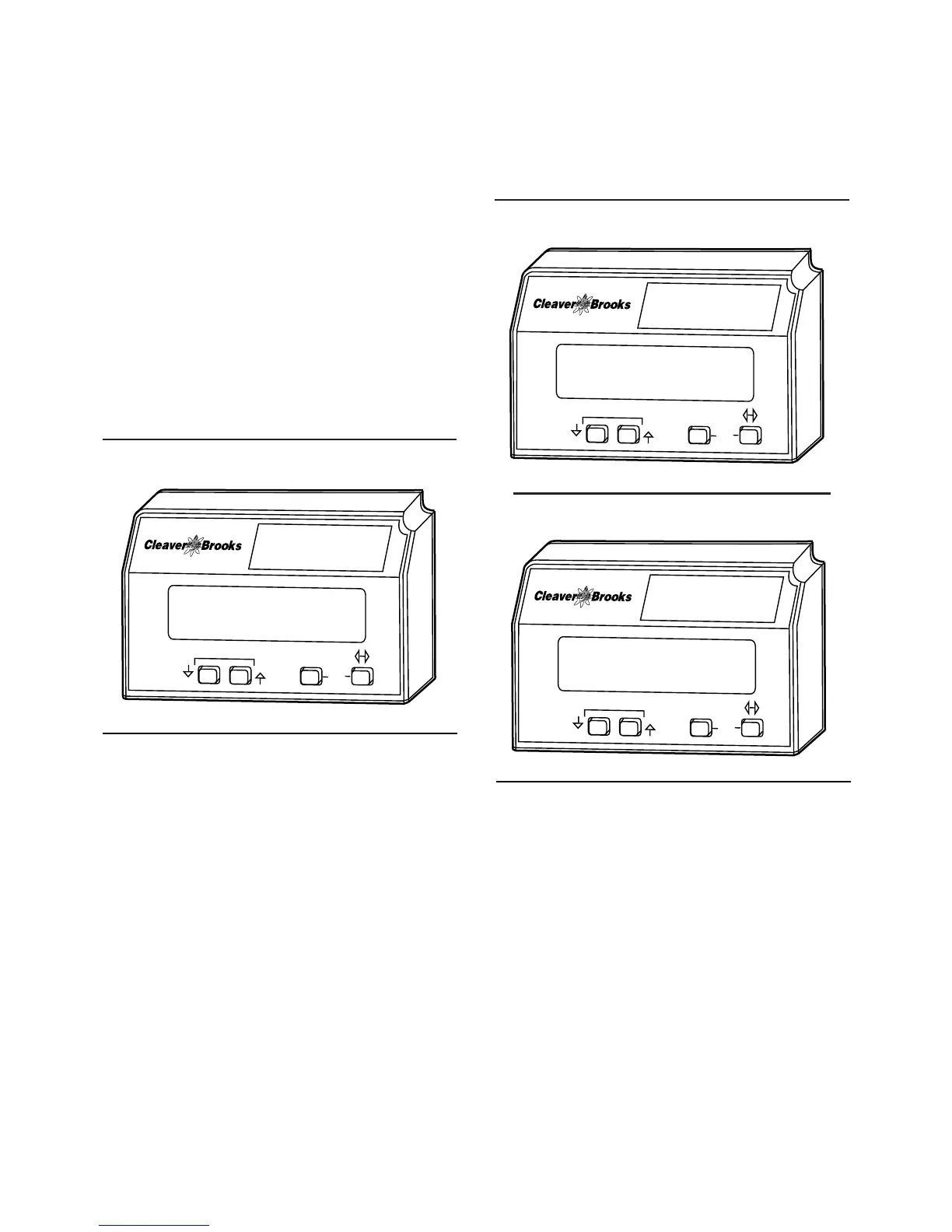
1. STATE 1, see Fig. 1: First state message display lasts
six seconds. First line displays the word LOCKOUT fol-
lowed by the fault code number, and possibly a lower case
letter if an Expanded Annunciator is connected. The status
of the Relay Module at the time of lockout is shown on the
right side of the first line as either INITIATE, STANDBY,
PURGE, PFEP, MFEP, RUN or POSTPRG. The lockout
reason corresponding to the fault code number is displayed
on the second line, highlighted by asterisks on each side. If
the lockout reason is being enhanced due to the presence of
an Expanded Annunciator, a lower case letter follows the
fault code number. This letter corresponds to the first-out
code supplied by the Expanded Annunciator.
2. STATE 2, see Fig. 2: Display of the second state
message lasts two seconds.
3. STATE 3, see Fig. 3: Display of the third state mes-
sage lasts three seconds. It is a replica of the burner status as
it existed at the time of lockout. The second line will be blank
if the burner status at the time of lockout did not include a
pre-emptive message (in parentheses) for the second line.
4. STATE 4: In the fourth state, both lines are blanked for
one-half second, then sequence to the first state.
M7416
LOCKOUT #23p PURGE
*Airflow Sw.*
SCROLL
MODE
SAVE
BURNER CONTROL
M7415
Condition at the
time of lockout ...
SCROLL
MODE
SAVE
BURNER CONTROL
M7414
PURGE HOLD: T7
(Airflow Sw.)
SCROLL
MODE
SAVE
BURNER CONTROL
Fig. 1—Lockout message state 1.
Fig. 2—Lockout message state 2.
Fig. 3—Lockout message state 3.


 To Next Page