15
Example:
on a monitor with user code 5, P1 programming = generic actuator,
= coded actuator (code 125)
1. Set S2 DIP switches 6 to the combination 1.
» the privacy LED
flashes.
S2 DIP
1 2 3 4 5 6
0 0 0 0 0 1
S2
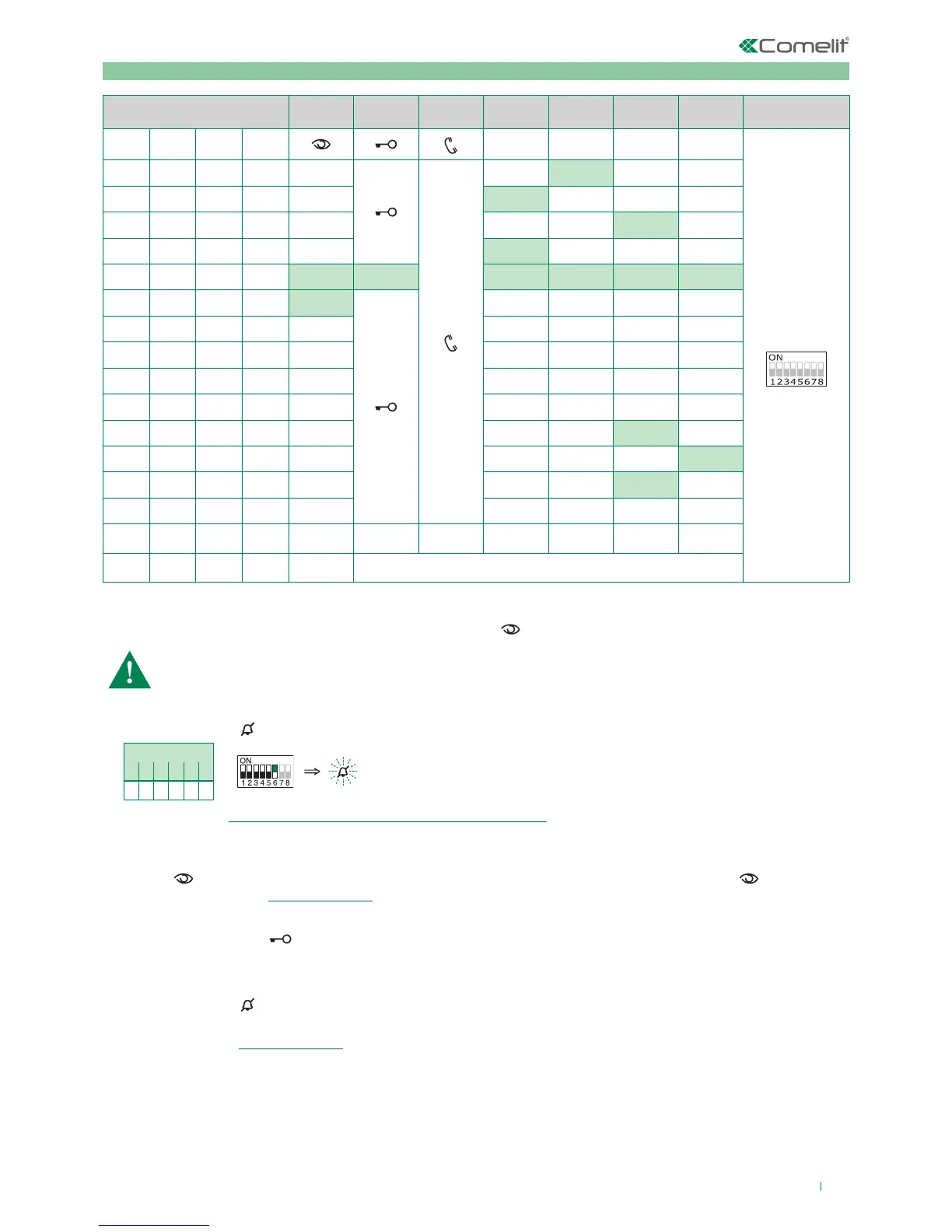
2. Refer to the table “Programming keys for generic or coded actuator” select a combination in which the actuator
function (ACT) is listed for the buttons you wish to program.
E.g.: for P1= generic actuator, set S2 DIP switches 1-2-3-4 to the combination 1000 or 1100 or 0010 (P1=ACT), set S1 DIP
switches to the combination 11111111, then go to point 3.
E.g.: for = coded actuator (code 125), set S2 DIP switches 1-2-3-4 to the combination 0010 or 1010 ( =ACT), set S1
with address 125 as per addressing table, then go to point 3.
3. Press and release the key to be associated with the function.
» the lock-release LED
flashes 4 times.
» a confirmation tone will sound.
4. To exit programming mode, set S2 DIP switches 5-6 to the combination 00.
» the privacy LED
switches o.
5. When programming is complete, set S2 DIP switches 1-2-3-4 to the combination 1111. Restore the user code
setting on S1, see addressing table.
Take note of the DIP-switch settings
DIP S2 DIP S1
DIP 1 DIP 2 DIP 3 DIP 4
P1 P2 P3 P4
ADDRESS
0 0 0 0
ACT
1 0 0 0 ACT
0 1 0 0 ACT
1 1 0 0 ACT
0 0 1 0 ACT ACT ACT ACT ACT ACT
1 0 1 0 ACT
0 1 1 0
1 1 1 0
0 0 0 1
1 0 0 1
0 1 0 1 ACT
1 1 0 1 ACT
0 0 1 1 ACT
1 0 1 1
0 1 1 1
1 1 1 1 PROG
Programming keys for generic or coded actuator


 To Next Page