EN
11
BACKLIGHTING LED
• Mode: this option is used to manage nameplate backlighting using the twilight sensor supplied
◊ Auto: backlighting comes on at night and switches o during the day (default)
◊ On: backlighting is always on
◊ O: backlighting is always o
• Adjustment: this option is used to adjust the backlighting intensity (from 0, o, to 100, default: 100)
• Activation threshold*: this option is used to set the backlighting activation threshold (Low, Medium, High,
Maximum, default: Medium)
• Enable Light-me function*: this function can be used to enable button backlighting only on the user’s
request, by pressing the LIGHT-ME button on the audio module; this saves energy and reduces light
pollution. Backlighting management for this button depends on the twilight sensor setting.
* Menu only shown if “Mode” is set to “Auto”.
COMMUNICATIONS
CALL SETTINGS
• Lock-release enabled only with forwarded call: if this option is enabled, the door-entry phone can only
trigger the electric door lock after receiving a call (disabled by default)
• Reset after lock-release: if this option is enabled (default), after the electric door lock is triggered,
communication is stopped for the period of time set in the field “Wait time before reset (sec.)”
• Answer wait time (sec): after a call, once this time period has elapsed without communication being
established between the audio module and the door-entry phone, the system reverts to standby mode
(from 10 to 120 seconds, default: 60 seconds)
• Talk time (sec): duration of communication between the audio module and the door-entry phone. Once
this time period has elapsed, the system reverts to standby mode (from 30 to 300 seconds, default: 90
seconds)
• Wait time before reset (sec): after the electric door lock has been triggered, communication is stopped
for this time period (from 0, immediately, to 10 seconds)
• System busy signalling time (sec): if a call attempt is made and the system is engaged in previous
communication, a busy signal is displayed for the time period specified in this option (from 1 to 300
seconds, default: 10 seconds)
• Call: number of calls sent to the door-entry phone when the key on the audio module is pressed
◊ Single: a single call is sent (default)
◊ Triple: 3 consecutive calls are sent
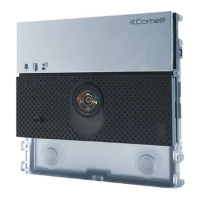
• Amplified microphone audio: this option is used to increase audio or audio/video module microphone
gain. Only for use in special installations.
SETTINGS
GENERAL
• Button tone: if the option is enabled, every time the call button is pressed a tone will be emitted (enabled
by default)
• Confirmation tone on call sent: if the option is enabled, every time a call is made a confirmation tone will
be emitted (enabled by default)
• Voice message language and visual indications: this option is used to activate visual indications and
voice messages assisting disabled individuals
◊ None: both visual indications and voice messages are disabled
◊ Visual indications only: when a call is sent and communication is established, and when a lock-release
command is sent, visual indications are enabled on the module
◊ [English] + visual indications: when a call is sent and communication is established, and when a lock-
release command is sent, both visual indications and the corresponding audio messages are enabled
on the module
• Enable RTE control voice message: if the option enabled (and voice messages are enabled), upon
closure of the contact the corresponding voice message is played (disabled by default)


 To Next Page