51
ANNEX 1
METHOD OF CALCULATING HEART RATE
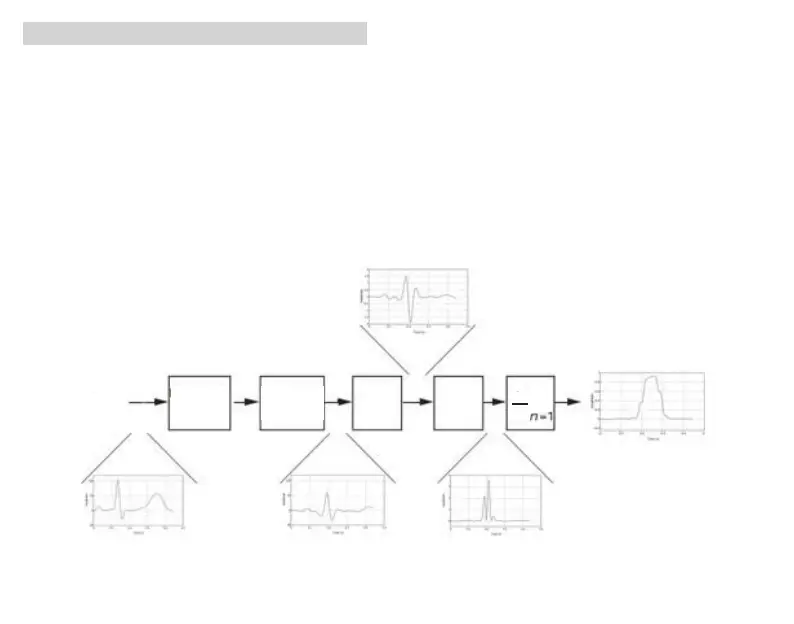
The Pan and Tompkins algorithm is one of the most widely used methods for real-time recognition of the QRS complex
from the ECG signal. The algorithm, based on slope, width and width of the QRS complex, includes a series of lters (low
pass, high pass, shunt, quadrator and integrator) and methods (adaptive threshold and search procedure). The block
diagram of the algorithm is shown in gure A.1.
In particular, the band-pass lter, obtained from the cascade of a low-pass lter and a high-pass lter, selects the
frequency range in order to reduce the foreign components to the QRS, that is the P-wave, and the T-wave in particular;
the shunt lter shows the rapid variation that characterizes the QRS complex; The quadrator lter makes the positive
signal and emphasizes the components of the QRS complex and nally the moving average lter performs the ltering
of the output signal from the previous lter, which could present multiple peaks at the QRS.
Figure a.1
Block diagram of the Pan and Tompkins algorithm.
References:
Pan J, Tompkins W. A real-time QRS detection algorithm. IEEE Trans Eng Biomed Eng. 1985;32(3):230–236.
ECG
Low-pass
lter
High-pass
lter
d[ ]
___
dt
1
32
2
[ ]
32
Σ



 To Next Page