EasyManua.ls Logo

Commodore 1541 - Page 29

Commodore 1541
80 pages
Print Icon
To Next Page IconTo Next Page
To Previous Page IconTo Previous Page
Loading...
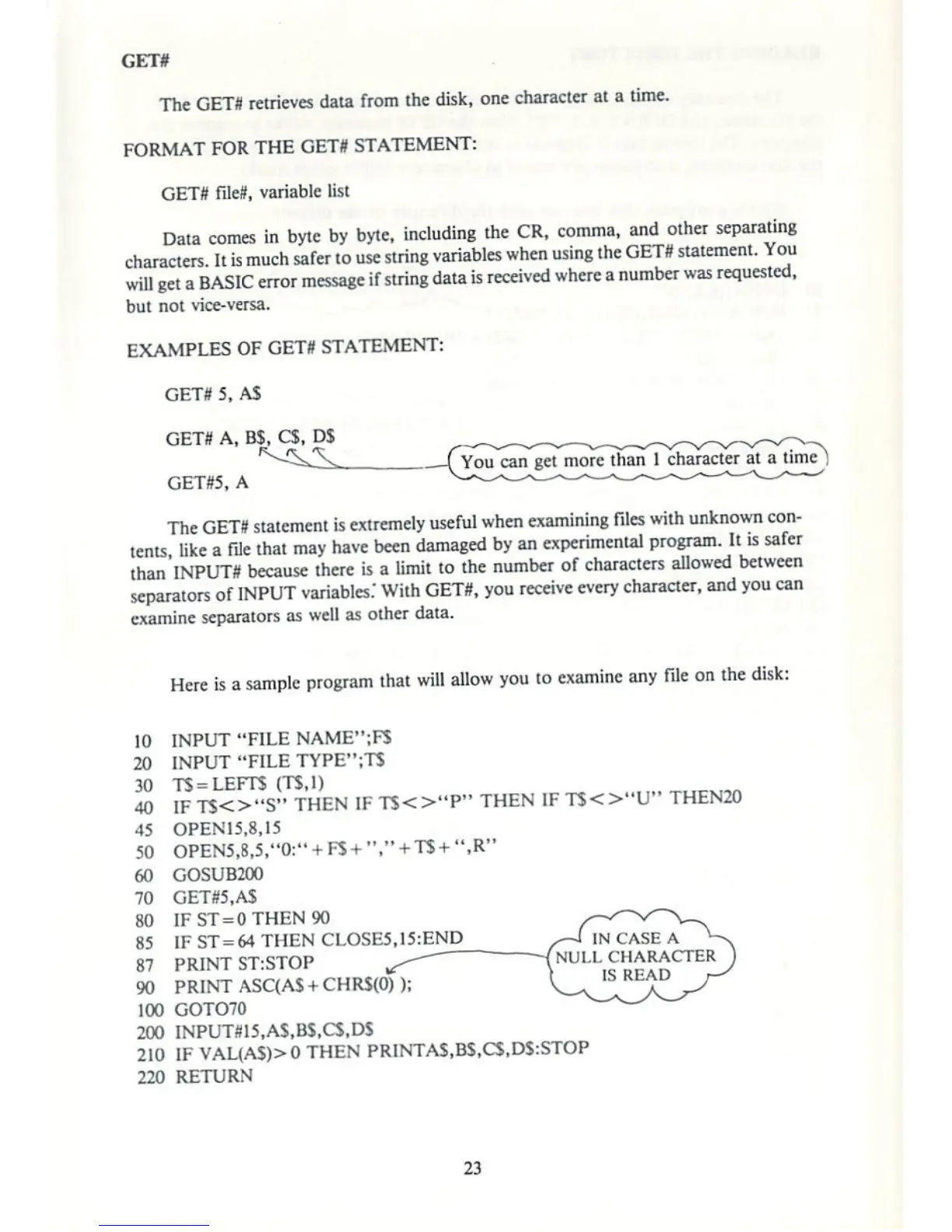
GET*
The
GET#
retrieves
data
from
the
disk,
one
character
at
a
time.
FORMAT
FOR
THE
GET*
STATEMENT:
GETS
fileS,
variable
list
Data
comes
in
byte
by
byte,
including
the
CR, comma,
and
other
separating
characters.
It
is
much
safer
to
use
string
variables
when
using
the
GET*
statement.
You
will
get
a
BASIC
error
message
if
string
data
is
received
where
a
number
was
requested,
but
not
vice-versa.
EXAMPLES
OF
GETS
STATEMENT:
GETS
5,
AS
GETS
A,
BS,
C$,
D$
—-^-^^--^-^-^-^-^-^-^
^
_(
You
can
get
more
than
1
character
at
a
time
)
GET#5,
A
The
GET#
statement
is
extremely
useful
when
examining
files
with
unknown
con
tents
like
a
file
that
may
have been
damaged
by an
experimental
program.
It is
safer
than'lNPUTS
because
there
is
a
limit
to
the
number
of
characters
allowed
between
separators
of
INPUT
variables."
With
GET#,
you
receive
every
character,
and you
can
examine
separators
as well as
other
data.
Here
is
a
sample
program
that
will
allow
you
to
examine
any
file
on
the
disk;
10
INPUT
"FILE
NAME";FS
20
INPUT
"FILE
TYPE";TS
30
TS
=
LEFTS
{T$,l>
_
,„
40
IFTS<>"S"
THEN
IFTS<>"P"
THEN
IF
TS<>"U"THEN20
45
OPEN15,8,i5
50
OPENS^,'^:11
60
GOSUB200
70
GETS5.AS
80
IFST
=
0THEN90
85
IF
ST
=
64
THEN
CLOSE5,15:END_
87
PRINT
ST:STOP
90
PRINT
ASC(AS
+
CHR$(0)
100
GOTO70
200
INPUTS15,A$,BS,C$,DS
210
IFVAL(A$)>OTHEN
PRINTA$,B$,C$,D$:STOP
220
RETURN
23
IN
CASE
A
NULL
CHARACTER
IS
RtAD

Other manuals for Commodore 1541

Related product manuals