Coolerado Installation
Page 10 of 63
Duct openings should only be cut into the front of
the supply plenum. DO NOT CUT OPENING IN THE
BOTTOM OF SUPPLY PLENUM or within 2” (20mm)
of the bottom. Coat and seal any exposed metal, see
Appendices 8, 10 and 12.
NOTE: Seasonal shut off dampers or easily accessible duct
blocks should be installed for easy winterization
changeover.
NOTE: A flexible duct connector should be installed between
the unit and any rigid ductwork to allow for seasonal
leveling and to mitigate vibration.
Recommendations for reducing temperature loss and
creating displacement ventilation conditions:
The air pressure at the units conditioned air plenum
should be 0.01 to 0.15 inches of water column (2.5
Pa to 37 Pa) greater than the working air exhaust
plenum under full air-flow. This will prevent water
migration from the exhaust side to the conditioned
air-side and provide adequate working air.
Seal duct work.
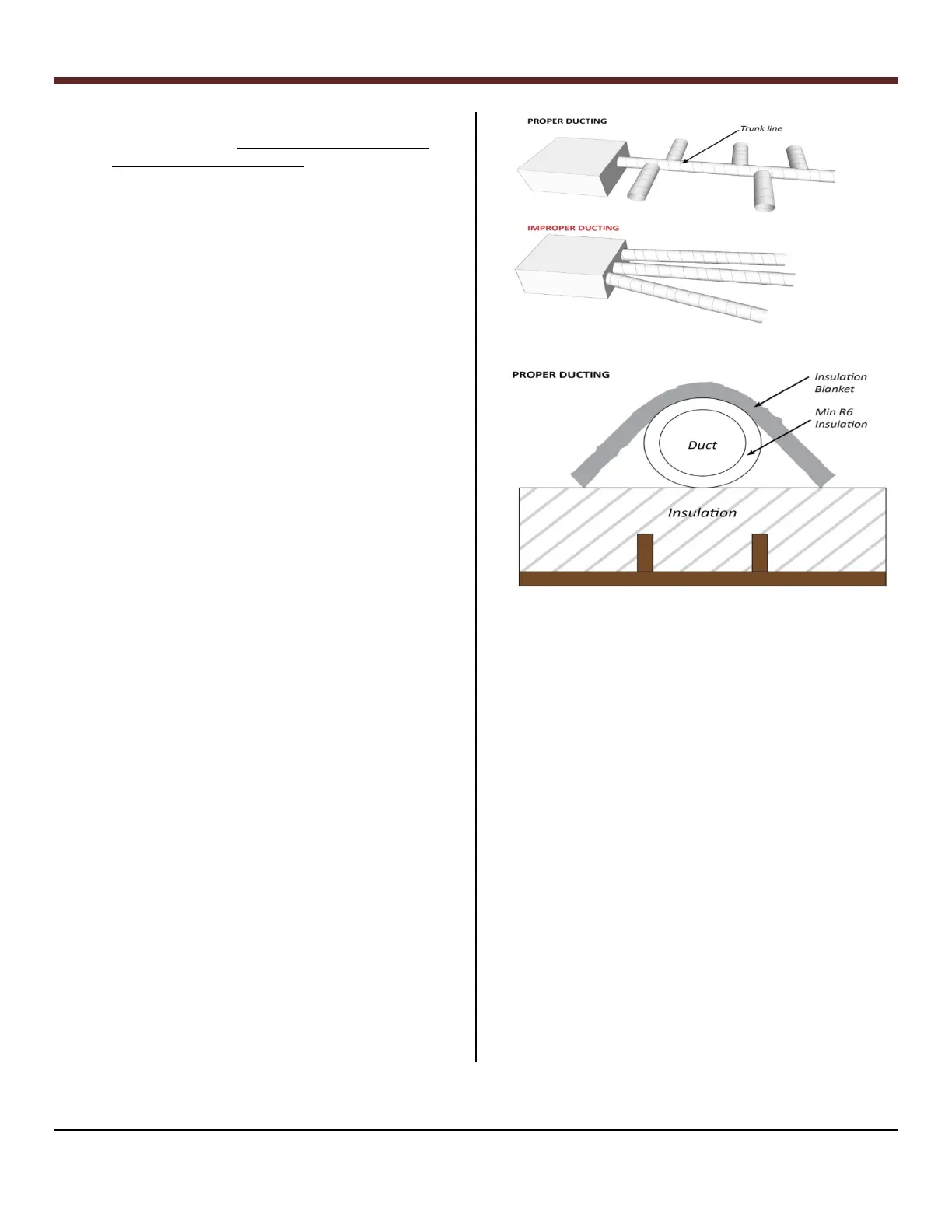
If the conditioned air ducts are located external to
the building or in an attic space, a minimum of R6
insulation is required. Follow local building and
insulation code requirements.
Size ducts to about 0.08 inches of water column per
100 feet (66 Pa per 100 m) of duct. Typically, a
round duct connection to the C60 or M50 supply or
conditioned air plenum would be a 16 inches
(400mm) in diameter.
Maximize the trunk duct and minimize the length of
duct branches, see Figure 13.
Too many air-drops can cause excessive temperature
losses.
Large, non-mixing type diffusers (positioned low) are
recommended.
High ceiling installations should direct the air down
at low velocities, less than 200 ft/min (60 m/min),
preferably 50 ft/min (15 m/min). Do not mix air, see
Figure 18.
Ductwork Example, Figure 13
Duct Insulation, Figure 14
NOTE: Additional duct insulation may be required in high
heat gain areas such as attics, see Figure 14.
CAUTION: To get proper air movement it is sometimes
necessary to install several barometric dampers and/or
building exhaust fans.
NOTE: Adjust barometric dampers to optimize air
distribution.
Diffuser location examples:
Installation of a room diffuser might have the
conditioned air delivered at the opposite side of the
room from the door and sweep toward the door to a
barometric duct in the ceiling, see Figure 17.
A room with a window may have the diffuser
installed on the opposite side from the window, with
cooled air sweeping the room toward the window
and removing the hot air above the window, see
Figure 18.
NOTE: Avoid sharp bends and sudden reductions in ducting
causing pressure drops which impede air-flow.



 To Next Page