Monopolar Cut and Coag Modes
Introduction
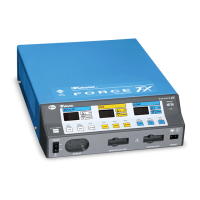
Force FX Electrosurgical Generator C User’s Guide 1-3
Three bipolar modes are available: precise, standard, and macrobipolar.
• Precise (low) may be used when a high degree of precision and fine control over the
amount of desiccation are essential. Voltage is kept low to prevent sparking. The
power remains constant over a specific range of tissue resistance, allowing a
consistent tissue effect.
• Standard (medium) may be used for most bipolar applications. Voltage is kept low to
prevent sparking. The power remains constant over a specific range of tissue
resistance, allowing a consistent tissue effect.
• Macro (macrobipolar) may be used for bipolar cutting or rapid coagulation. Voltage is
higher and there is more power than with the other two bipolar modes.
For details about the output characteristics, refer to Output Characteristics on page 9-11.
Monopolar Cut and Coag Modes
Three cut modes—low, pure, and blend—allow a wide range of power settings necessary
to perform diverse surgical procedures.
• Low may be used for a cut with little or no sparking; useful for delicate tissue or
laparoscopic surgery.
• Pure may be used when you desire a clean, precise cut in any tissue with little or no
hemostasis.
• Blend may be used where slower cutting and additional hemostasis is desired.
The three coagulation modes—desiccate, fulgurate, and spray—help control the size of
the area and the depth of penetration during tissue coagulation.
• Desiccate dehydrates and destroys tissue without sparking or cutting. Because the
active electrode directly touches the tissue, more current reaches the patient.
Desiccation places the greatest demand on the patient return electrode.
• Fulgurate coagulates tissue by sparking from the active electrode, through air, to the
patient tissue. Since sparks may spray unpredictably from the electrode during
fulguration, using fulguration for delicate tissue or in confined areas can complicate
surgery. Accidental sparking to adjacent areas can occur as tissue at the surgical site
dries and becomes more resistant to current flow.
• Spray affords optimum fulguration; penetration is less deep and the tissue area is
larger than with the fulgurate mode.
For details about the output characteristics, refer to Output Characteristics on page 9-11.




 To Next Page