2
Cell Type: Industrial grade rechargeable lithium-ion
Capacity: 97.68 Wh
Output Voltage Range: 9V-12.6V DC
USB Output Voltage: 5V DC, 2A
Output Current: 8A maximum
Power Gauge: Digital display charge level indicator
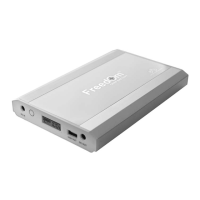
Size: 7.5” x 4.8” x 0.8” (L x W x H)
Weight: 1.7 lbs
SAFETY FEATURES
Protective Circuit Board (PCB) provides internal protection against
thermal runaway (overheating), over charging, over discharging,
over voltage, over current, and short circuiting.
Aluminum alloy shell provides maximum cell protection and durability.
The Freedom
TM
CPAP Battery has been UN 38.3 tested and meets
all current safety regulations and shipping requirements.
CHARGE TIME
The Freedom
TM
CPAP Battery can be charged in approximately 4 hours
(per battery) when fully discharged. The battery does not need to be fully
discharged before charging. Do not charge on any flammable surface.
LIFE SPAN
Under normal conditions the average life span of the Freedom
TM
CPAP
Battery is generally around 400-500 charge/discharge cycles. The amount
of charge the battery will hold will gradually decrease due to usage and
aging. This decrease in charge capacity is true for all rechargeable lithium-
ion batteries. See page 33 for more information.
WARRANTY
The Freedom
TM
CPAP Battery, all components and accessories are under
warranty for manufacturing and quality defects for one (1) year.
Product Specifications
33
Understanding common phenomenon with rechargeable lithium-ion
batteries can help you better care for your Freedom
TM
CPAP Battery and
answer many common questions regarding usage.
Lithium-ion batteries do not suffer from the memory effects that are
associated with other types of battery chemistries. This means that
the battery does not need to be completely discharged before charging.
Upon initial use or after a prolonged storage period lithium-ion
batteries may require 3-4 charge/discharge cycles before achieving
their maximum capacity.
Lithium-ion batteries will self-discharge when unused; therefore,
the battery will need to be charged after a storage period. On average
the battery will self-discharge by 20% every 30 days.
The amount of charge lithium-ion batteries will hold will gradually
decrease due to usage and aging. Over time, the actual battery capacity
decreases as less and less active material within each lithium-ion cell
is available to electrochemically store a charge. This loss in capacity
(aging) is true for all rechargeable lithium-ion batteries.
It is normal for a lithium-ion battery and its AC power supply to
become slightly warm to the touch during charging and discharging.
Do not charge the battery on any flammable surface.
Battery Care Instructions
Fully charge the battery before storage.
Store the battery in a dry, cool place away from extreme heat, direct
sunlight and metal objects.
If the battery is being stored for long periods of time we recommend
charging the battery to 50% of capacity at least once every 90 days.
Battery Storage


 To Next Page