14
medium such as engine exhaust, furnace exhaust etc.
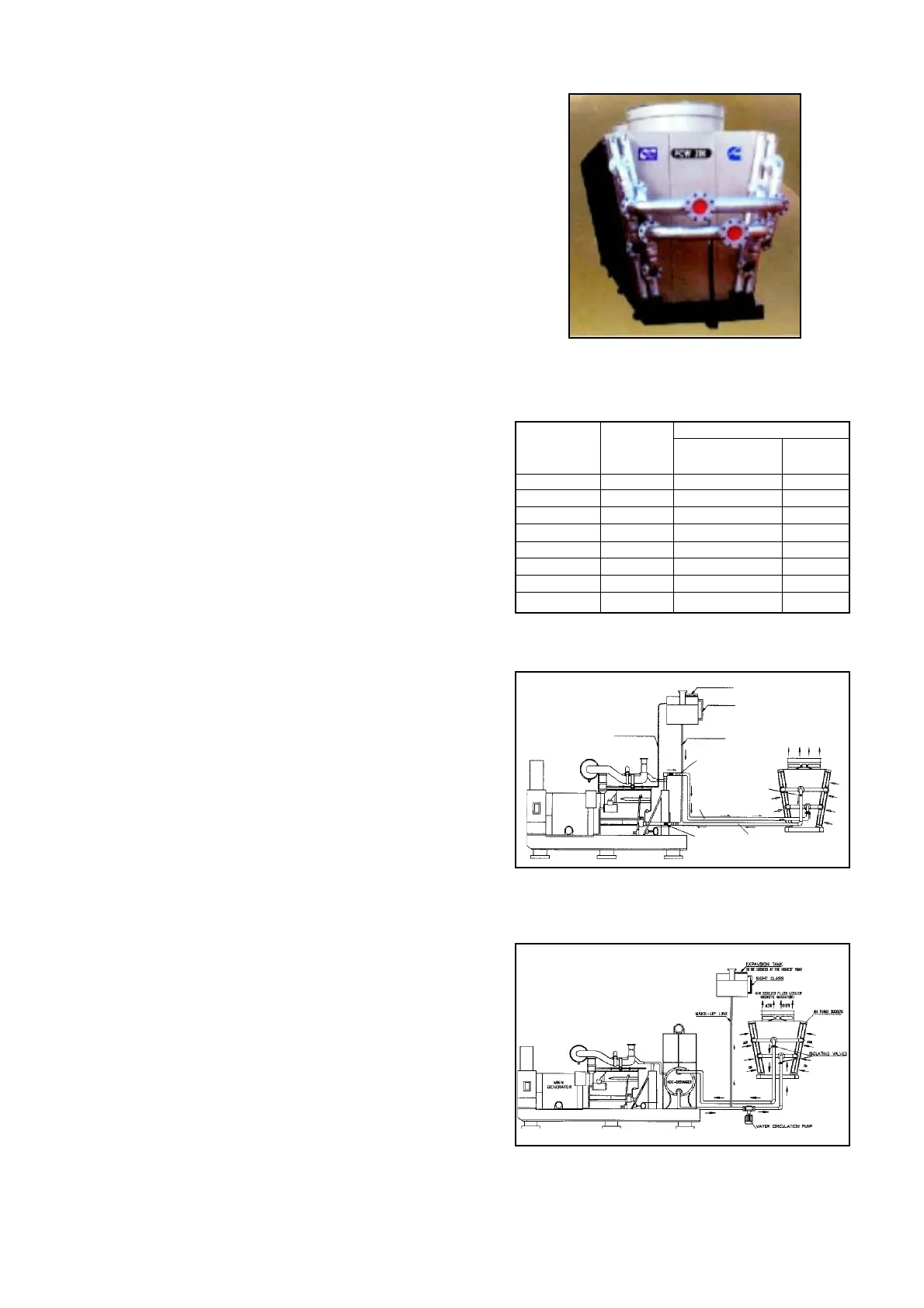
Coil cooler is type of remote radiator.
• There should be no restriction at the fan outlet (from
where the hot air is going out) such as ceiling.
• If the remote radiator is connected in primary circuit
care should be taken that maximum vertical
distance from engine water pump to highest point
in cooling system should not exceed 5 m.
The max. horizontal distance of remote radiator
from engine should not exceed 10 m.
Mounting
• No special masonry is necessary except to keep
the remote radiator in leveled surface. Normally 150
to 200 mm (6" to 8" ) foundation should be made to
place the remote radiator. It is preferable to elevate
the remote radiator as additional protection from
drainage, for easy installation and to minimise the
chances of dust / dirt getting attracted from ground.
Pillar or mounting structure of approx. 1 m is usual
practice in such case.
• In case of roof top installations, check your building
specifications for permissible floor loading as
mentioned above.
Expansion / Deaerating Tank
A suitable expansion / deration tank must be used along with
remote radiator (Normally 20% of the system capacity). The
tank should be located at the highest point (min. 0.5 m from
radiator top) of entire cooling system. Due to the requirement
of positive pressure at water pump inlet the expansion tank is
usually installed in cold water line. i.e. the outlet of radiator
and near to the engine pump suction line. Ensure proper venting
of total cooling system.
Water Piping and Connections
The most important factor in the piping layout of remote radiator
is the size of the pipe. The exact size of the pipe is essential
so as to get proper flow rate of water and for achieving the
pressure drop within prescribed limits. It is advisable to use
MS pipe of Schedule 20. It is recommended to use flexible
joints in the pipeline close to the DG set.
Piping size should be such that external restriction of piping
and remote radiator is within limit. The maximum pressure
drop allowed in HT and LTA circuit is 0.35 kg/cm
2
(5 psi) and
0.28 kg/cm
2
(4 psi) respectively.
Valves and Fittings
Butterfly valves should be used in the pipe line for isolating
the engine so that the entire system does not have to be drained
during maintenance in the DG set or Remote radiator.
Coolant Treatment
Cooling system capacities with remote radiator are high. It is
mandatory to use additional coolant additive to treat high
volume of water.
Note : Remote radiator can also be used in secondary circuit
in place of cooling towers.
Quick Selection of Remote Radiator for Cummins Engine
Engine Model Prime rating Remote Radiator
KVA Primary Secondary
Circuit Circuit
QSK60G4 2000 FCW-160 (LT + HT) FCW-200
KTA50G8-I 1500 FCW-140 (LT + HT) FCW-180
KTA50G3 1250 FCW-120 FCW-140
KTA50G3 1P2L 1250 FCW-120 (LT + HT) FCW-140
KTA38G5 1000 FCW-100 (LT + HT) FCW-120
KTA2300 750 FCW-080 FCW-100
VTA28G5 600/625 FCW-060 FCW-080
KTA19G4 500 FCW-060 (LT + HT) FCW-080
REMOTE RADIATOR IN SECONDARY CIRCUIT
REMOTE RADIATOR IN PRIMARY CIRCUIT
EXPANSION TANK
TO BE LOCATED AT THE HIGHEST POINT
SIGHT GLASS
MAKE UP LINE
AIR COOLED FLUID COOLER
(REMOTE RADIATOR)
AIR
OUT
GAUGES (TYP)
ISOLATING VALVE
AIR
AIR IN
SUPPLY LINE
FLEXIBLE JOINT
(TYP)
RETURN LINE
1/4” VENT LINE
MAIN
GENERATOR



 To Next Page