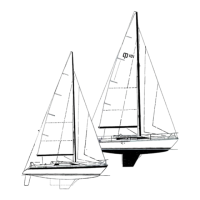
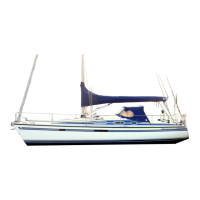
D E H L E R 3 4
3. Environmental Protection
All our efforts were taken that the materials used to build this yacht will not harm the environment.
There are a number of regulations regarding environmental protection, and we advise you to
observe them when using your boat. The following section contains some notes with regard to
the environment protection.
Sailing is a quiet sport. Please handle your boat in a responsible manner and render your
contribution so that nature is not damaged more than inevitable.
Please pay attention these notes carefully.
3.1. Fuels and oil
Fuels and oil are an environmental hazard because a faulting over a longer time can result in
restriction or damage of the environment.
Handle these substances carefully on board so that nothing goes overboard when refilling or
pumping out.
Take special care before draining the boat that there is no oil in the bilge water. Use special oil
sump agents to clean the bilge water or pump this mixture into a separate canister and deposit
ashore.
3.2. Waste
Waste of all sorts must be disposed according to environmental regulations. For this purpose you
should separate the waste on board and dispose of it ashore in the appropriate waste containers
provided by the ports.
Reduce the amount of waste, in particular by reducing packaging! Use packaging that can be
reduced in volume after use.
Glass packaging do not belong in the water either!
3.3. Sound
Sound is also ecological damaged. We have realized some soundproofing measures to reduce
the sound, especially of the engines, below the legal permitted values. Maintain and preserve the
engine room sound insulation. Do not paint over the insulation.
You should additionally choose engine speeds that keep noise within bearable limits.
3.4. Swell
Reduce speed when driving in narrow waters and in the vicinity of protected coastal zones.
Pay attention to relevant signs and speed restrictions.
3.5. Exhaust gases
Exhaust gases are unavoidable. We chose our engines according to the most favourable exhaust
emission values. Pay attention to the colour of the exhaust gas as this can be an indication of a
faulty adjustment of the engine. A blue or sooty appearance is a sign of serious adjustment
errors. Have them repaired!
Do not run the engine as an “auxiliary aggregate” in the port for charging the batteries. Use the
shore connection instead.


 To Next Page