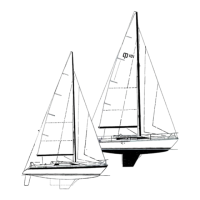
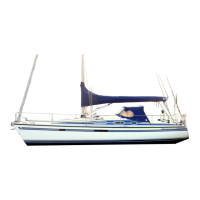
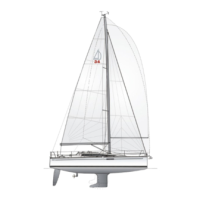
D E H L E R 3 4
The owner is solely responsible for the maintenance and upkeep
of the yacht and for ensuring that this work is carried out by
suitably experienced and qualified persons.
Maintenance must be carried out according to the manufacturers
recommendations, those of the individual equipment suppliers
and good working practice.
Failure to follow the guidelines will result in poor reliability,
premature failure and may void warranty coverage.
4.1. External inspection
Winter storage is the right opportunity to thoroughly inspect the hull and all supporting parts. A
damaged coating or visible parts of the laminate or the wood must be repaired, in compliance
with the coating's manufacturer's recommendations. The yard or your dealer is able to supply the
coating, resin and reinforcement material.
Further information to the technical equipment of the yacht can be found in this manual or in the
operating manuals of the respective appliances and systems.
4.2. Maintenance and cleaning
The boat should only be cleaned with fresh water if possible. Environmentally compatible
cleaning agents suitable for FRP and varnished surfaces may be used for persistent dirt. Do not
use any agents containing silicone.
Special agents are offered for further treatment like refurbishing and sealing FRP surfaces. Only
use suitable agents for this!
Teak
Through the effects of weather, teak wood receives a natural gray colour. This colour does not
affect the physical properties of the wood. The robust weather resistant properties of teak make
the application of weather protective coatings unnecessary.
We recommend the use of fresh water, or fresh water with a minimal amount of a neutral
detergent, and a soft brush for cleaning teak. For hard stains or extremely dirty decks use a hard
sponge.
An important note is to make sure and brush across the grain of the wood. If you brush in the
direction of the wood grain, you run the risk of leaving small ruts in the wood. You will if fact
brush the softer wood out and leave the harder wood in place. The use of a pressure washer on
the teak is not recommended. This could damage the wood as well as the seams between the
wood.
Metallic parts
Please note: Stainless steels are a group of low-maintenance, corrosion resistant steels that
contain a minimum of 10.5% Chromium. At this point the Chromium forms a tenacious, stable
oxide film called the passive film. This passive film forms instantaneously in ordinary
atmospheres and has the remarkable capability of being self-healing should the surface of the
material become damaged.
All grades of stainless steels may, over time, show signs of corrosion in the form of rust or
staining, due to dirt deposits collecting in the surface pores of the material.
The dirt deposits actively prevent the Chromium from oxidizing, resulting in the protective passive
film being unable to form in that area and allowing under deposit corrosion to take place.
To achieve the maximum corrosion resistance, therefore, the surface of the stainless must be
kept clean as part of a routine maintenance plan.
The frequency of cleaning is dependent on the application - a simple rule is: Clean the metal
when it is dirty. This may vary from one to four times a year.


 To Next Page