Preliminary
941322_VMS Instruction Book 2006.pdf2009-09-07
No. Name Range Default Description/optionsNo. Name Range Default Description/options
0 = no acidic cleaning0 = no acidic cleaning
1 = one alkaline, one acidic cleaning1 = one alkaline, one acidic cleaning
2 = two alkaline, one acidic cleaning2 = two alkaline, one acidic cleaning
3 = etc.3 = etc.
Maintenance an calibration
The following points are important to sustain
correct dosing of etergents. Note that
these two tasks should be performed by an
authorised DeLaval service engineer.
• The tubes in the peristaltic pumps should
be replaced at least two times a year.
• The dosing volume (P6-P8) of the
detergent pumps should be checked
every third month. The dosing capacity
(P32-P34) may need to be adjusted.
Starting cleaning or rinsing
from the touch screen
Note: Any ongoing backflush process must
first be finished before cleaning or rinsing
can be started.
1. Ensure that the milking station is in
manual mode.
2. Remove any cow that might be in the
milking station.
After treatment window
Note: Both gates should be closed to
prevent a cow from entering before the
system cleaning has been started. Closing
and opening gates is done in the Stall
control window.
3. Press the tab After Treatment on the
touch screen to display the After treatment
window.
4. In the After treatment window, press the
Cleaning and Rinsing button. This will open
the Cleaning and rinsing window.
5 Milking a sick or treated cow into
a bucket
When an animal in the parlour is not supposed to
be milked into the regular milk line because it has
colostrum milk, is sick, or is treated with penicillin
and so on, it can be milked into a milk bucket
using a separate cluster.
When the cluster is retracted, proceed as follows:
1. Disconnect the cluster milk tube from the
dropper pipe below the platform and con-
nect it to the lid of the milk bucket.
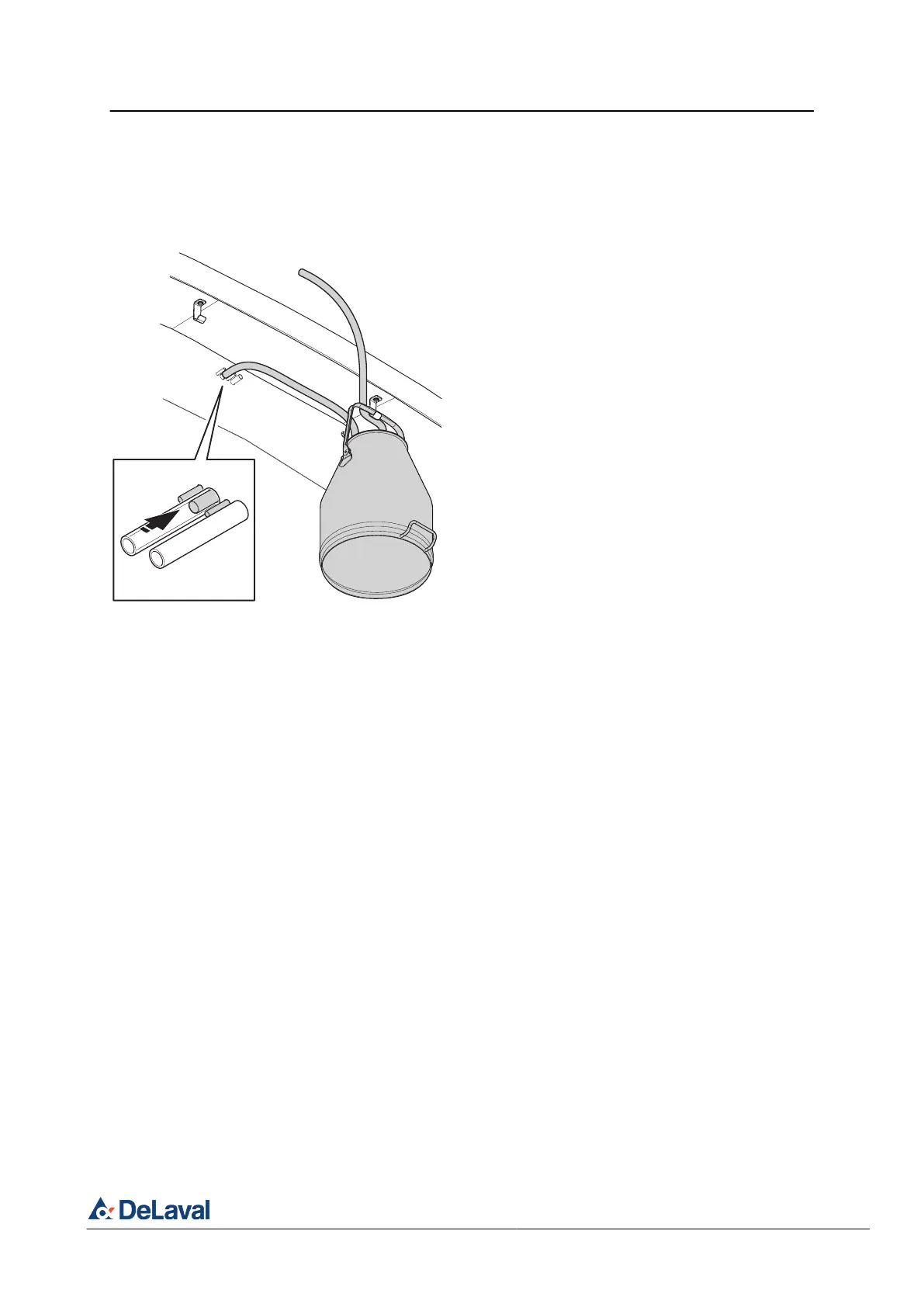
2. Connect a tube from the lid of the milk
bucket to the dropper pipe, see Fig. 13.
3. Milk the cow manually according to
Ä
Chapter 4.1 "Milking in manual
mode" on page 41.
Note! Take off the cluster in due time to
avoid over-milking the animal.
Note! Avoid over-flowing the bucket, to
prevent milk entering the vacuum line.
4. Report to the system the appropriated flag
"Do not milk" or "Dump milk" from IDD or
directly into the DelPro herd management
system.
Note! The herd management alarm is acti-
vated for the period set into the system for
future milkings.
269865
Fig. 13: Milking into a bucket.
DeLaval milking automation MA200 (Test installation)
Operation
© DeLaval 2019.
2019-05-31, Version 1 49 (62)



 To Next Page