7
95-8704
2.7
WARNING
All entries must contain appropriately rated
plugs or fittings. It is required that each
plug or fitting be wrench-tightened to an
appropriate installation torque and meet the
minimum thread engagement requirements
per the applicable local standards, codes,
and practices in order to retain the dened
ratings. PTFE sealant or equivalent should
be used on NPT threads.
IMPORTANT
Devices certified for hazardous locations
shall be installed in accordance with EN/
IEC 60079-14 and NEC 505.
CAUTION
Installation of the detector and wiring should
be performed only by qualied personnel.
Detector Installation
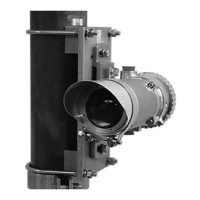
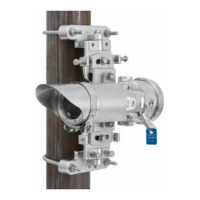
Install the mounting arm assembly on a rigid
surface. The ideal installation surface should
be free of vibration and suitable to receive 3/8
inch or M10 bolts with a length of at least 1 inch
(25 mm). The surface must also have sufficient
capacity to hold the detector and mounting arm
weights (see "Specifications" section). Refer to
the Q9033 Mounting Arm and Collar Attachment
manual, number 95-8686, for additional installation
information. See Figure3 for dimensions.
Relay and 0-20 mA Output Models
Follow the instructions below to install the
X3301.
1. Make field connections following local
ordinances and guidelines in this manual.
– Figure 4 shows the wiring terminal strip
located inside the detector’s integral
junction box.
– Figure 5 shows the wiring terminal
identification for the X3301 Flame
Detector.
– Figure 6 shows an EOL resistor installed
within the integral wiring compartment of
the detector (refer to “EOL Resistors” for
details).
– Figures 7 and 8 provide examples of
typical installations with a X3301 wired to
a fire alarm panel.
– If the detector is equipped with a 0–20 mA
output, refer to Figures 9 through 12.
2. Check all field wiring to be sure that the
proper connections have been made.
IMPORTANT
Do not test any wiring connected to the
detector with a meg-ohmmeter. Disconnect
wiring at the detector before checking
system wiring for continuity.
3. Make the final sighting adjustments and
use a 14 mm hex wrench to ensure that the
mounting arm assembly is tight.
EOL Resistors (Not Used with EQP Model)
To ensure that the insulating material of the
wiring terminal block will not be affected by
the heat generated by EOL resistors, observe
the following guidelines when installing the
resistors.
1. Required EOL resistor power rating must be
5 watts minimum.
NOTE
EOL resistors must be ceramic, wirewound
type, rated 5 watts minimum, with actual
power dissipation not to exceed 2.5 watts.
This applies to ATEX/IECEx installations
only.
2. Resistor leads should be cut to a length of
approximately 1 1/2 inches (40 mm).
3. Bend the leads and install the EOL resistor
as shown in Figure6.
4. Maintain a 3/8 inch (10 mm) minimum gap
between the resistor body and the terminal
block or any other neighboring parts.
NOTE
The EOL resistor can only be used within the
flameproof terminal compartment. Unused
conduit entries shall be closed with suitable
blanking elements.




 To Next Page