12
Remember that generally speaking, all frequencies can detect all
kinds of targets, so for example a frequency of 4 kHz will detect a very
small target and a frequency of 18 kHz will detect a large, deep mass.
However, the 18 kHz frequency will lead you to discover a relatively higher
number of small targets that cannot compare with that achieved with a
frequency of 4 kHz. Similarly, sometimes the 18 kHz frequency can be
slightly less eective with a large mass.
If you are just starting out, the 8 kHz frequency is a good compromise for
general use. On a wet beach the 18 kHz frequency will be better at nding
small gold jewellery such as chain necklaces and bracelets that are usually
so dicult to detect.
MENU
FREQ.
REACTIVITY
AUDIO RESP.
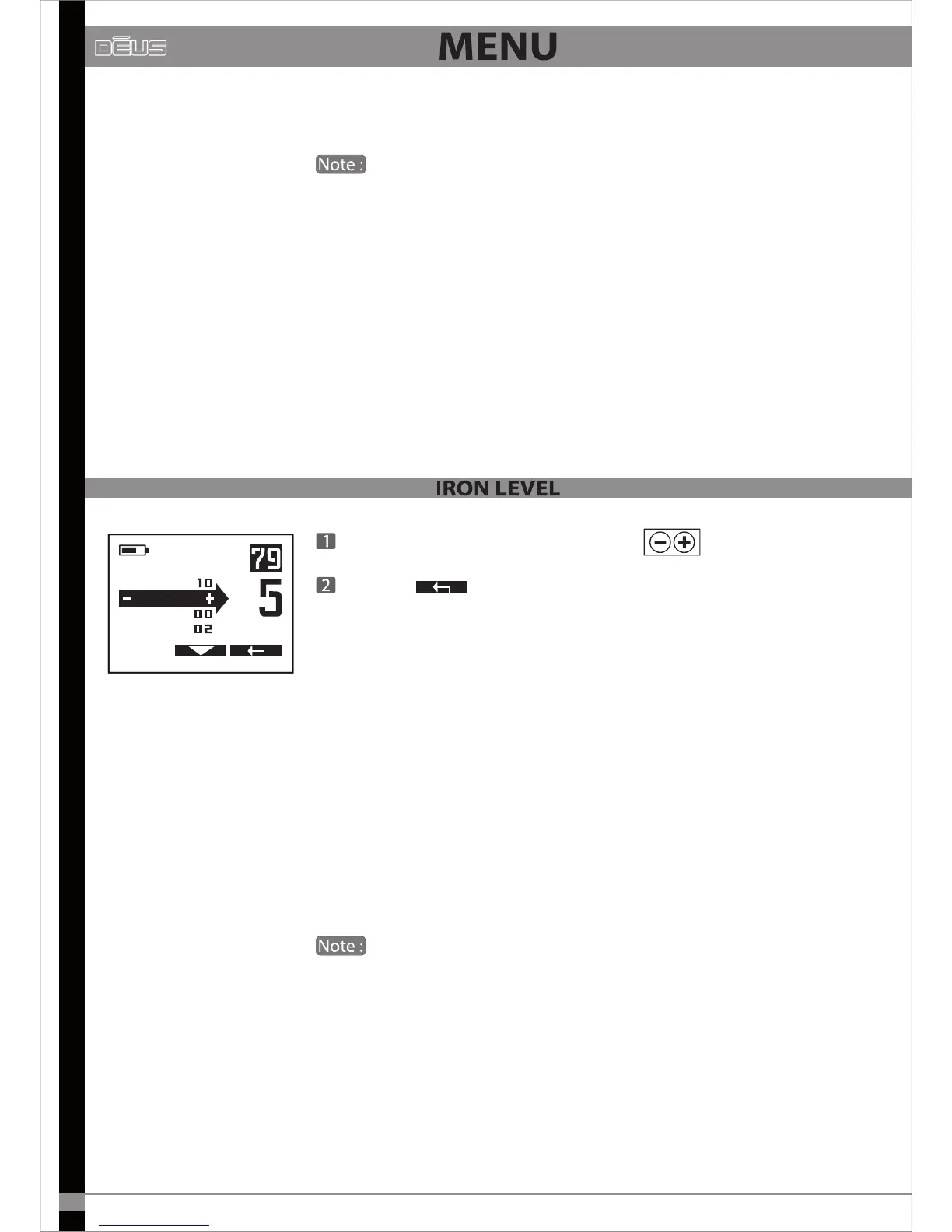
IRON VO.
Adjust the Iron Level (from 0 to 5) with
Exit with
You have the option of controlling the sound volume of the low-pitched
tone which generally corresponds to iron. Depending on the circumstances,
this enables more attention to be paid to other sounds, by reducing those
generated by iron.
On the other hand, some users prefer that the low-pitched signals from
iron are more audible, as they know that good targets at the detector’s
range limit in mineralised ground sometimes generate low amplitude,
low-pitched sounds.
- At 0 the low-pitched tone is cut o.
- At 5 the low-pitched tone will have a sound level equivalent to other medium
- or high-pitched tones.
If the discrimination threshold is too low, 0 or 2 for example,
most iron will generate not low- but medium-pitched tones, as you will
practically be in the All Metals mode. In this case, the iron level setting
will not be of much use.


 To Next Page