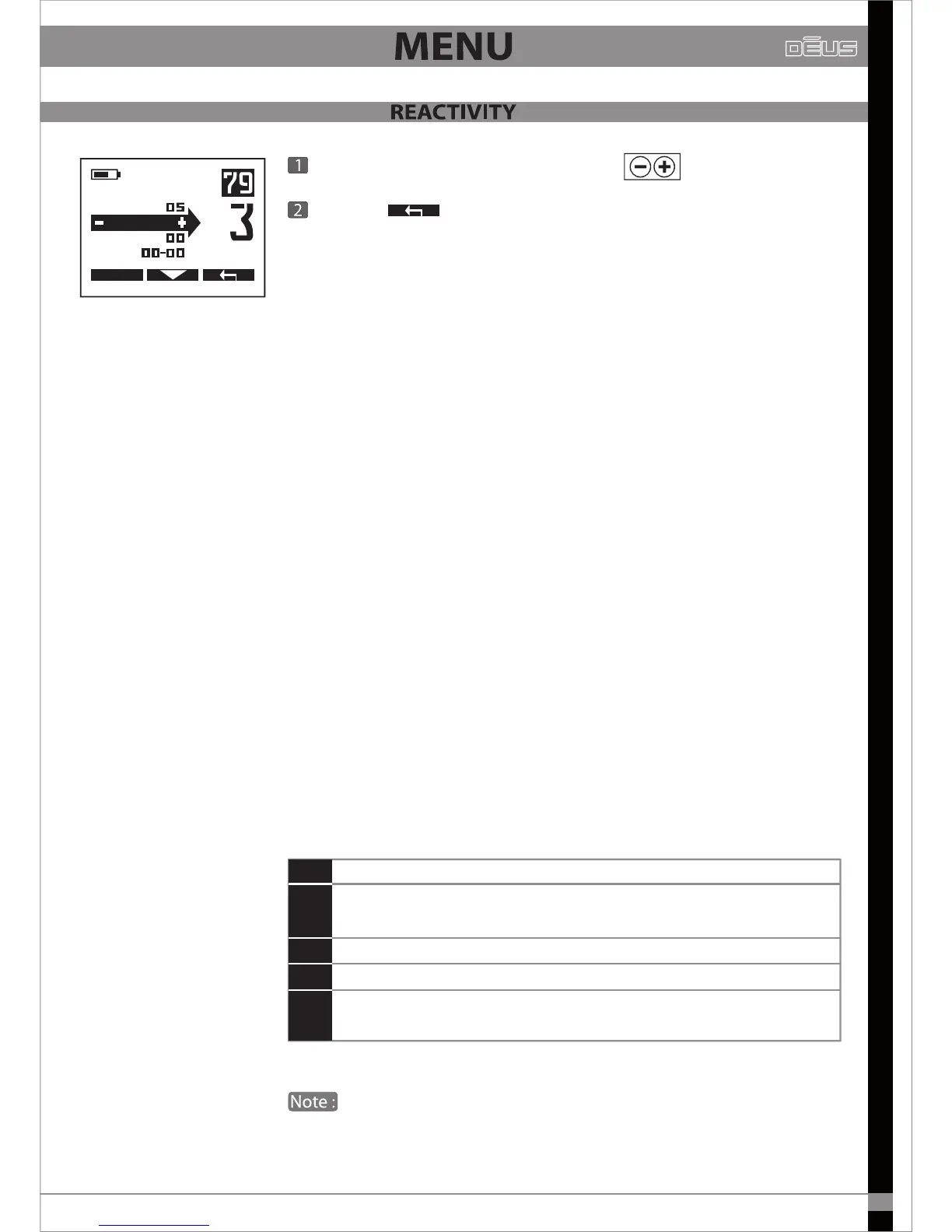
Adjust the Reactivity from -2 to +3 with
Exit with
EXPERT
MENU
IRON VOL.
AUDIO RESP.
NOTCH
REACTIV.
Large masses and coins, in ground uncontaminated by iron.
Large masses and coins, in ground with little iron contamination,
and general use.
General use, and mineralised soils contaminated with iron.
Dicult soils contaminated with iron, hot rocks, etc.
Very dicult soils, highly contaminated with iron and hot rocks,
sensitivity to small targets.
0
1
2
3
4/5
Most likely nds with the recommended settings are as follows:
13
Reactivity is a vital setting that determines the detector’s performance
in terms of speed of analysis and selectivity.
If a soil contains a great deal of iron, hot rocks or other mineralised
debris, soil penetration is generally reduced, as is a detector’s ability to
identify targets similar to iron.
In these conditions, Dēus enables you to select a high degree of
reactivity which will help you speed up the analysis of signals.
On the other hand, if the ground is ‘clean’, it is better to reduce the
reactivity and sweep more slowly, in order to be more sensitive to deep
masses and obtain more thorough penetration.
Users familiar with the Gold Maxx Power have already had a foretaste
of the reactivity of XP’s detectors. And even though Dēus is a particularly
fast and selective detector, you now have the option of adjusting the
reactivity setting to make it even more selective!
By way of example, and to help you better understand the reactivity
levels available, you should note that the reactivity of most detectors
on the market is generally only equivalent to level -1 of the Dēus.
This is true, for instance, of the Gold Maxx and earlier XP models.
The Gold Maxx Power has a reactivity equivalent to level 0 of the Dēus.
Higher reactivity levels (1, 2, 3) enable the detector to tolerate
fast sweeps better.


 To Next Page